
Understanding Business Expenses: A Comprehensive Guide
Businesses incur various types of expenses. An expense is a type of expenditure that flows through the income statementIncome StatementThe Income Statement is one of a company's core financial statements that shows their profit and loss over a period of time. The profit or and is deducted from revenue to arrive at net incomeNet IncomeNet Income is a key line item, not only in the income statement, but in all three core financial statements. While it is arrived at through. Due to the accrual principleAccrual PrincipleThe accrual principle is an accounting concept that requires transactions to be recorded in the time period in which they occur, regardless of in accounting, expenses are recognized when they are incurred, not necessarily when they are paid for.
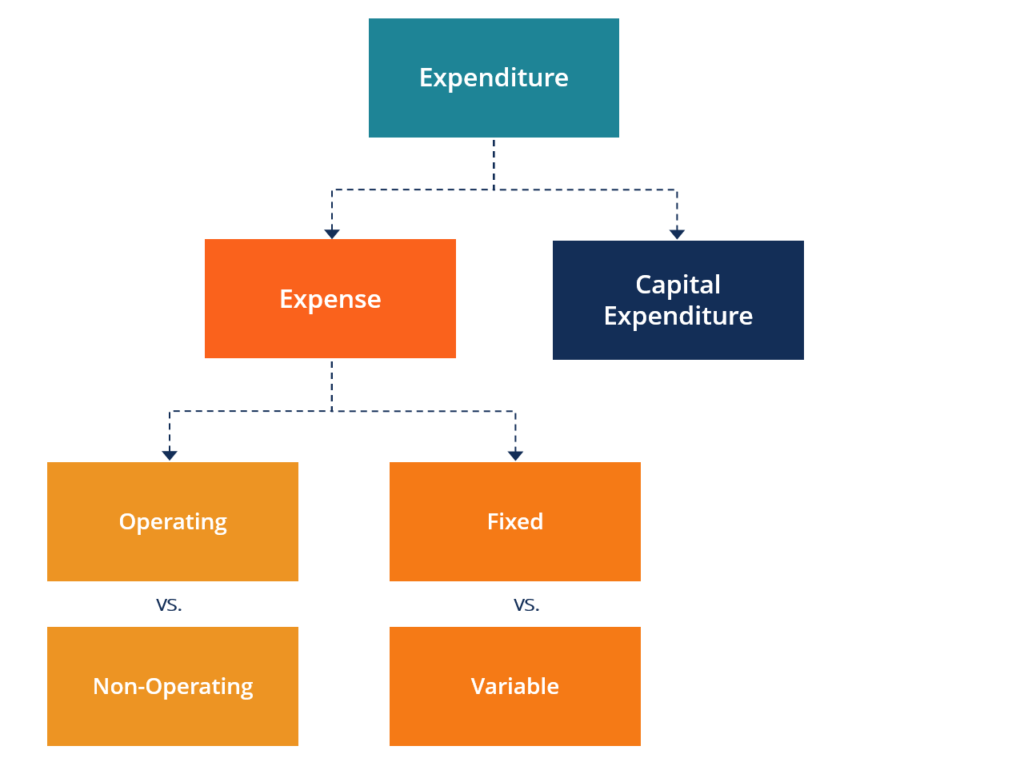
Types of Expenses
As the diagram above illustrates, there are several types of expenses. The most common way to categorize them is into operating vs. non-operating and fixed vs. variableFixed and Variable CostsCost is something that can be classified in several ways depending on its nature. One of the most popular methods is classification according.
- Operating
- Cost of Goods Sold (COGS)Cost of Goods Sold (COGS)Cost of Goods Sold (COGS) measures the “direct cost” incurred in the production of any goods or services. It includes material cost, direct
- Marketing, advertising, and promotion
- Salaries, benefits, and wages
- Selling, general, and administrative (SG&A)SG&ASG&A includes all non-production expenses incurred by a company in any given period. It includes expenses such as rent, advertising, marketing
- Rent and insurance
- Depreciation and amortizationDepreciation MethodsThe most common types of depreciation methods include straight-line, double declining balance, units of production, and sum of years digits.
- Other
- Non-operating
- Interest
- Taxes
- Impairment charges
- Fixed
- Rent
- Salaries, benefits, and wages (sometimes fixed and sometimes variable)
- Variable
- Transaction fees
- Commissions
- Marketing and advertising (sometimes fixed and sometimes variable)
Expenses vs Capital Expenditures
The only difference between an expense and a capital expenditureCapital ExpenditureA capital expenditure (“CapEx” for short) is the payment with either cash or credit to purchase long term physical or fixed assets used in a is that an expense has been recognized under the accrual principle and is reflected on the income statement, whereas a capital expenditure goes straight to the balance sheetBalance SheetThe balance sheet is one of the three fundamental financial statements. The financial statements are key to both financial modeling and accounting. as an asset.
Once a capital expenditure goes on the balance sheet as an asset, it can be expensed later as depreciation and amortization, which flows through the income statement.
The statement of cash flowsStatement of Cash FlowsThe Statement of Cash Flows (also referred to as the cash flow statement) is one of the three key financial statements that report the cash is where the actual timing of cash payments for all expenditures will be reflected. To learn more, check out CFI’s free tutorial on how to link the three financial statements in ExcelCFI Webinar - Link the 3 Financial StatementsThis CFI quarterly webinar provides a live demonstration of how to link the 3 financial statements in Excel. Learn the formulas and proper linking procedure.
Expenses Example – Amazon
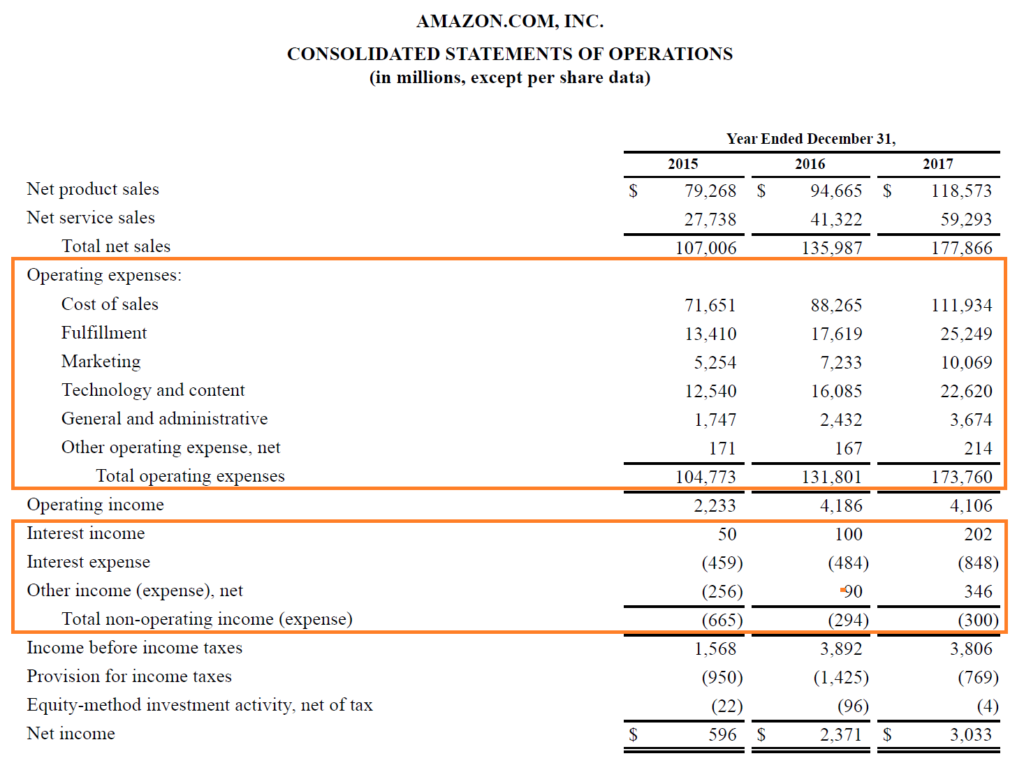
Below is an example of Amazon’s 2017 income statement (statement of operation) which lists their main categories of expense. As you can see, Amazon separates its costs into two categories.
Operating expenses consist of the cost of sales, fulfillment, marketing, technology and content, general and administrative, and others.
Non-operating expenses comprise interest expense (and income), and other expenses (income). Finally, Amazon has charged a provision for income taxes and accounted for equity method investment activity.
To learn more, check out CFI’s Free Accounting Courses.
Tax Deductible Types of Expenses
Most, but not all, expenses are deductible from a company’s income (revenues) to arrive at its taxable income. The most common tax-deductible expenses include depreciation and amortization, rent, salaries, benefits, and wages, marketing, advertising, and promotion.
Items that are not tax-deductible vary by region and country. It’s important to consult a professional tax advisor to learn about what expenses are deductible and not deductible in your or your company’s situation.
Additional Resources
Thank you for reading CFI’s explanation of Types of Expenses. CFI offers the Financial Modeling & Valuation Analyst (FMVA)®Become a Certified Financial Modeling & Valuation Analyst (FMVA)®CFI's Financial Modeling and Valuation Analyst (FMVA)® certification will help you gain the confidence you need in your finance career. Enroll today! certification program for those looking to take their careers to the next level. To keep learning and advancing your career, the following CFI resources will be helpful:
- Capitalizing R&D ExpensesCapitalizing R&D ExpensesGuide to R&D capitalization vs R&D expense. Under the GAAP, firms are required to expense research and development (R&D) in the year they are
- Depreciation MethodsDepreciation MethodsThe most common types of depreciation methods include straight-line, double declining balance, units of production, and sum of years digits.
- Goodwill Impairment AccountingGoodwill Impairment AccountingGoodwill is acquired and recorded on the books when an entity purchases another entity for more than the fair market value of its assets.
- Projecting Income Statement Line ItemsProjecting Income Statement Line ItemsWe discuss the different methods of projecting income statement line items. Projecting income statement line items begins with sales revenue, then cost
-
Understanding Revenue: A Comprehensive Guide for Businesses
Revenue is the value of all sales of goods and services recognized by a company in a period. Revenue (also referred to as Sales or Income) forms the beginning of a company’s income statementInco
-
Revenue vs. Income: Understanding the Key Differences
This guide provides an overview of the main differences between revenue vs income. RevenueSales RevenueSales revenue is the income received by a company from its sales of goods or the provision of ser
Accounting
- Understanding Discretionary Expenses: Definition & Examples
- Understanding Schedule A: Itemized Deductions Explained
- Understanding Accounts Expenses: A Comprehensive Guide
- Accrued Expenses: Definition, Examples & Accounting Explained
- Understanding the Income Statement: A Comprehensive Guide
- Understanding the Multi-Step Income Statement: A Detailed Guide
- Understanding Non-Interest Expenses in Banking
- Understanding Non-Operating Expenses: Definition & Examples
- Understanding Variable Expenses: A Comprehensive Guide
-
 Understanding Profit: A Key Financial Metric
Profit is the value remaining after a company’s expenses have been paid. It can be found on an income statement. If the value that remains after expenses have been deducted from revenue is posit...
-
 Understanding Rent Expense: Definition & Significance
Rent expense refers to the total cost of using rental property for each reporting period. It is typically among the largest expenses that companies report. Only two expenses are usually larger than re...