
Analyzing Financial Statements for Banks: A Comprehensive Guide
While the general structure of financial statements Analysis of Financial StatementsHow to perform Analysis of Financial Statements. This guide will teach you to perform financial statement analysis of the income statement,for banks isn’t that much different from a regular company, the nature of banking operations means that there are significant differences in the sub-classification of accounts. Banks use much more leverage than other businesses and earn a spread between the interest income they generate on their assets (loans) and their cost of funds (customer deposits).
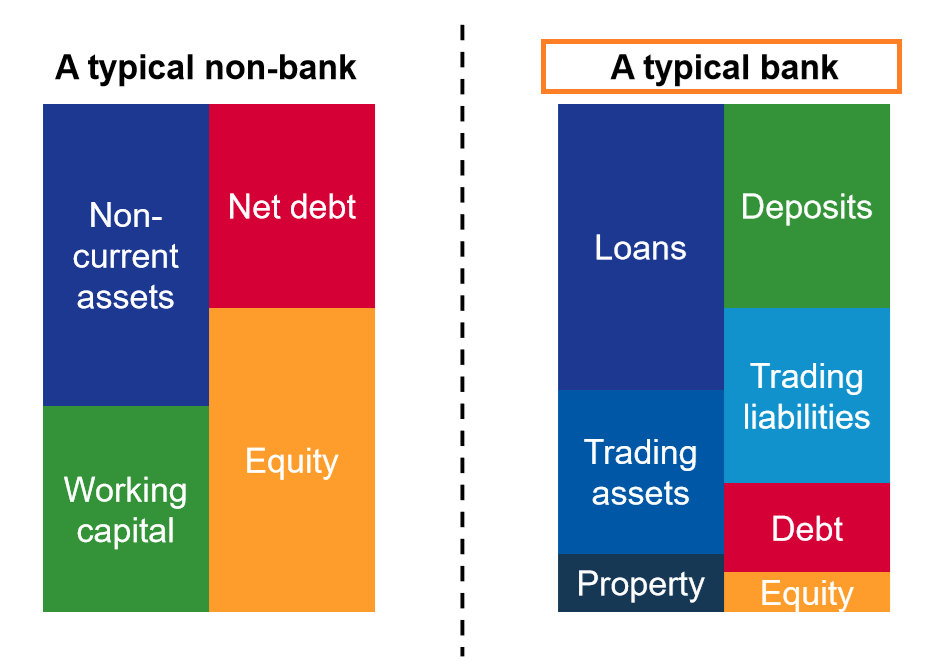
Typical Balance Sheet
A typical balance sheetBalance SheetThe balance sheet is one of the three fundamental financial statements. The financial statements are key to both financial modeling and accounting. consists of the core accounting equation, assets equal liabilities plus equity. Under these accounts, non-banking companies may have other large classes such as PP&EPP&E (Property, Plant and Equipment)PP&E (Property, Plant, and Equipment) is one of the core non-current assets found on the balance sheet. PP&E is impacted by Capex,, intangible assetsIntangible AssetsAccording to the IFRS, intangible assets are identifiable, non-monetary assets without physical substance. Like all assets, intangible assets, current assets, accounts receivablesAccountingOur Accounting guides and resources are self-study guides to learn accounting and finance at your own pace. Browse hundreds of guides and resources., accounts payables, and such.
A bank, however, has unique classes of balance sheet line items that other companies won’t. The typical structure of a balance sheet for a bank is:
- Assets
- Property
- Trading assets
- Loans to customers
- Deposits to the central bank
- Liabilities
- Loans from the central bank
- Deposits from customers
- Trading liabilities
- Misc. debt
- Equity
- Common and preferred shares
Recall from CFI’s Balance Sheet GuideBalance SheetThe balance sheet is one of the three fundamental financial statements. The financial statements are key to both financial modeling and accounting. that ASSETS = LIABILITIES + EQUITY.
Financial Statements for Banks: Balance Sheet
A bank’s balance sheet has certain unique items. We visit each unique line itemProjecting Balance Sheet Line ItemsProjecting balance sheet line items involves analyzing working capital, PP&E, debt share capital and net income. This guide breaks down how to calculate in the subsections below.
To learn more, launch our finance courses online!
Loans and Deposits to Customers
The main operations and source of revenue for banks are their loan and deposit operations. Customers deposit money at the bank for which they receive a relatively small amount of interest. The bank then lends funds out at a much higher rate, profiting from the difference in interest rates.
As such, loans to customers are classified as assets. This is because the bank expects to receive interest and principal repaymentsDebt ScheduleA debt schedule lays out all of the debt a business has in a schedule based on its maturity and interest rate. In financial modeling, interest expense flows for loans in the future, and thus generate economic benefit from the loans.
Deposits, on the other hand, are expected to be withdrawn by customers or also pay out interest payments, generating an economic outflow in the future. Deposits to customers are, thus, classified as liabilities.
Loans and Deposits to Central Bank
In the questions of financial statements for banks, where do these banks store their money? It’s like the age-old question: do barbers cut their own hair?
The answer isn’t too crazy. Most countries have a central bank, where most (or all) national banks will store their money and profits. Deposits from a bank in a central bank are considered assets, similar to cash and equivalents for a regular company. This is because the bank can withdraw these deposits rather easily. It also expects to receive a small interest payment, using the central bank’s prime rate.
Loans from the central bank are considered liabilities, much like normal debt.Senior DebtSenior Debt is money owed by a company that has first claims on the company’s cash flows. It is more secure than any other debt, such as subordinated debt
Trading Assets and Liabilities
Banks may hold marketable securitiesMarketable SecuritiesMarketable securities are unrestricted short-term financial instruments that are issued either for equity securities or for debt securities of a publicly listed company. The issuing company creates these instruments for the express purpose of raising funds to further finance business activities and expansion. or certain currenciesCryptocurrencyCryptocurrency is a form of digital currency that is based on blockchain networking. Cryptocurrency like Bitcoin and Ethereum are becoming widely accepted. for the purposes of trading. These will naturally be considered trading assets. They may have trading liabilities, which consists of derivative liabilities and short positions.
Typical Income Statement for Banks
Again, the overall structure of an income statement for a bank doesn’t stray too far from a regular income statementIncome StatementThe Income Statement is one of a company's core financial statements that shows their profit and loss over a period of time. The profit or. The top of the income statement is revenue and the bottom is net income.
However, revenue is derived differently from that of regular companies. The income statement will generally look as follows:
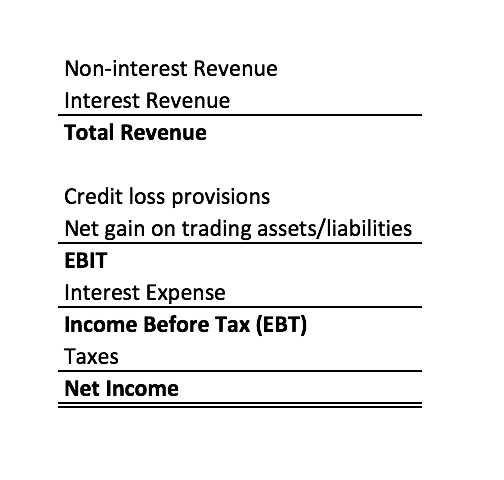
Financial Statements for Banks: Income Statement
Again, let’s walk through the unique line itemsProjecting Income Statement Line ItemsWe discuss the different methods of projecting income statement line items. Projecting income statement line items begins with sales revenue, then cost not found in common income statements.
To learn more, launch our finance courses online!
Non-interest Revenue
Non-interest revenues consist of ancillary revenue the bank makes in supporting its services. This can consist of:
- Broker fees
- Commissions and fees from products and services
- Underwriting fees
- Gain on sale of trading assets
- Other customer fees (NSF fees, swipe fees, overdrawn fees)
These revenues come from anything that does not constitute interest revenue.
To learn more, launch our finance courses online!
Interest Revenue
Interest revenue captures the interest payments the bank receives on the loans it issues. Sometimes, this line item will only state gross interest revenue. Other times, this line will consolidate gross interest revenue and deduct interest expense to find net interest revenue. This interest expenseInterest ExpenseInterest expense arises out of a company that finances through debt or capital leases. Interest is found in the income statement, but can also is the direct interest expense paid to the deposits used to fund the loans, and does not include interest expense from general debt.
Credit Loss Provisions
Just like accounts receivables and bad debt expense, a company must prepare in the event that borrowers are not able to pay off their loans. These bad pieces of credit are written off in the income statement as a provision for credit loss.
To learn more, launch our finance courses online!
Learn More
Thank you for reading CFI’s guide to financial statements for banks. CFI is the official global provider of the Financial Modeling & Valuation Analyst®Become a Certified Financial Modeling & Valuation Analyst (FMVA)®CFI's Financial Modeling and Valuation Analyst (FMVA)® certification will help you gain the confidence you need in your finance career. Enroll today! designation, designed to transform anyone into a world-class financial analyst. To advance your career, these additional CFI resources will be helpful:
- Three Financial Statement ModelThree Financial StatementsThe three financial statements are the income statement, the balance sheet, and the statement of cash flows. These three core statements are
- How the Three Models are LinkedHow the 3 Financial Statements are LinkedHow are the 3 financial statements linked together? We explain how to link the 3 financial statements together for financial modeling and
- How to be a Great Financial AnalystThe Analyst Trifecta® GuideThe ultimate guide on how to be a world-class financial analyst. Do you want to be a world-class financial analyst? Are you looking to follow industry-leading best practices and stand out from the crowd? Our process, called The Analyst Trifecta® consists of analytics, presentation & soft skills
- Balance SheetsBalance SheetThe balance sheet is one of the three fundamental financial statements. The financial statements are key to both financial modeling and accounting.
-

Understanding the Drawbacks of Commercial Banks
Commercial banks, despite their reputation, have a number of disadvantages. Commercial banks, especially commercial banks which are large and well-established, are usually a person's firs
-

Choosing the Right Bank: A Comprehensive Guide
Choosing a financial institution to look after your money is one of the most important financial decisions you can make. Different banks offer widely different levels of service, charge different le
Accounting
- The Crucial Role of Banks in Financial Intermediation
- Decoding Financial Statements: What Investors Really Look For
- Commercial Banks: Services, Loans & How They Work
- Understanding Banks: Types, Functions, and Regulations
- Correspondent Banks: Your Guide to International Banking Relationships
- Merchant Banks: Services, Functions & Corporate Finance
- Essential Financial Statements for Small Businesses: A Guide & Samples
- Understanding Audited Financial Statements: A Comprehensive Guide
- Analyzing Financial Statements for Banks: A Comprehensive Guide
-
 Nationwide Banks in the U.S.: A Comprehensive List
The U.S. has a dual banking system of state and nationally chartered institutions. In today's day and age, if you're looking to open a new bank account, you're going to want to lo...
-
 Bank SWOT Analysis: Strengths, Weaknesses, Opportunities & Threats
A SWOT analysis of a bank formally evaluates the financial institutions strengths, weaknesses, opportunities and threats. A SWOT analysis of a bank formally evaluates the financial institutio...