
Understanding Financial Statements: A Comprehensive Guide
Financial statements are the records of a company’s financial condition and activities during a period of time. Financial statements show the financial performance and strength of a companyCorporationA corporation is a legal entity created by individuals, stockholders, or shareholders, with the purpose of operating for profit. Corporations are allowed to enter into contracts, sue and be sued, own assets, remit federal and state taxes, and borrow money from financial institutions.. The three core financial statements are the income statementIncome StatementThe Income Statement is one of a company's core financial statements that shows their profit and loss over a period of time. The profit or, balance sheetBalance SheetThe balance sheet is one of the three fundamental financial statements. The financial statements are key to both financial modeling and accounting., and cash flow statementCash Flow StatementA cash flow Statement contains information on how much cash a company generated and used during a given period.. These three statements are linkedHow the 3 Financial Statements are LinkedHow are the 3 financial statements linked together? We explain how to link the 3 financial statements together for financial modeling and together to create the three statement financial model3 Statement ModelA 3 statement model links the income statement, balance sheet, and cash flow statement into one dynamically connected financial model. Examples, guide. Analyzing financial statements can help an analyst assess the profitability and liquidity of a company. Financial statements are complex. It is best to become familiar with them by looking at financial statements examples.
In this article, we will take a look at some financial statement examples from Amazon.com, Inc. for a more in-depth look at the accounts and line items presented on financial statements.
Learn to analyze financial statements with Corporate Finance Institute’s Reading Financial Statements course!
#1 Financial Statements Example – Cash Flow Statement
The first of our financial statements examples is the cash flow statement. The cash flow statement shows the changes in a company’s cash position during a fiscal period. The cash flow statement uses the net incomeNet IncomeNet Income is a key line item, not only in the income statement, but in all three core financial statements. While it is arrived at through figure from the income statement and adjusts it for non-cash expenses. This is done to find the change in cash from the beginning of the period to the end of the period.
Most companies begin their financial statements with the income statement. However, Amazon (NASDAQ: AMZN) begins their financial statements section in their annual 10-K report with their cash flow statement.
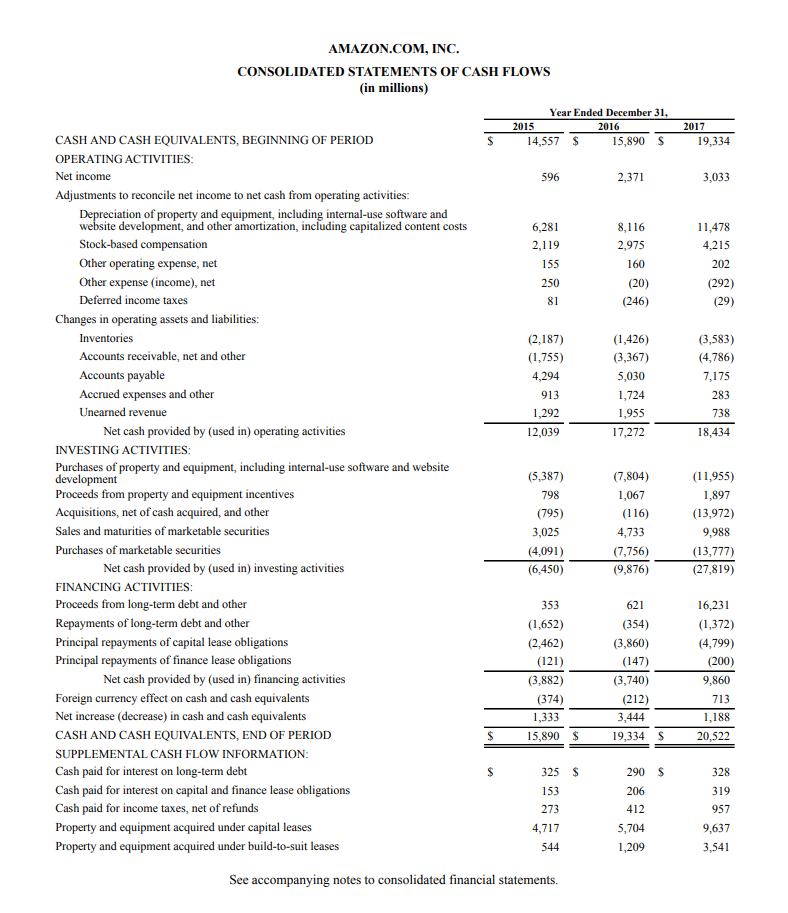
The cash flow statement begins with the net income and adjusts it for non-cash expenses, changes to balance sheet accounts, and other usages and receipts of cash. The adjustments are grouped under operating activitiesCash Flow from OperationsCash flow from operations is the section of a company’s cash flow statement that represents the amount of cash a company generates (or consumes) from carrying out its operating activities over a period of time. Operating activities include generating revenue, paying expenses, and funding working capital., investing activitiesCash Flow from Investing ActivitiesCash Flow from Investing Activities is the section of a company's cash flow statement that displays how much money has been used in (or, and financing activitiesCash Flow from Financing ActivitiesCash Flow from Financing Activities is the net amount of funding a company generates in a given time period. Finance activities include the.
The following are explanations for the line items listed in Amazon’s cash flow statement. Please note that certain items such as “Other operating expenses, net” are often defined differently by different companies:
Operating Activities:
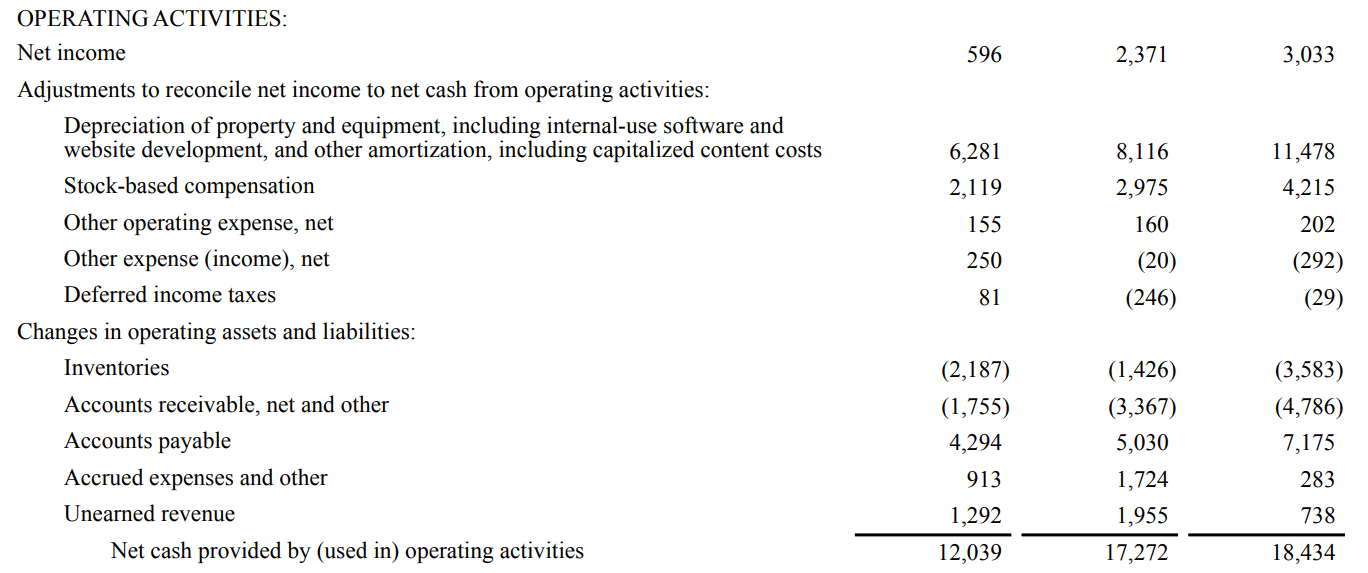
Depreciation of property and equipment (…)Depreciation ExpenseWhen a long-term asset is purchased, it should be capitalized instead of being expensed in the accounting period it is purchased in.: a non-cash expense representing the deterioration of an asset (e.g. factory equipment). An addition to net cash.
Stock-based compensationStock Based CompensationStock Based Compensation (also called Share-Based Compensation or Equity Compensation) is a way of paying employees and directors of a: a non-cash expense as a company awards stock optionsStock OptionA stock option is a contract between two parties which gives the buyer the right to buy or sell underlying stocks at a predetermined price and within a specified time period. A seller of the stock option is called an option writer, where the seller is paid a premium from the contract purchased by the stock option buyer. or other stock-based forms of compensation to employees as part of their compensation and wage agreements. An addition to net cash.
Other operating expense, net: a non-cash expense primarily relating to the amortization of Amazon’s intangible assetsIntangible AssetsAccording to the IFRS, intangible assets are identifiable, non-monetary assets without physical substance. Like all assets, intangible assets. An addition to net cash.
Other expense (income), net: a non-cash expense relating to foreign currency and equity warrantStock WarrantsStock warrants are options issued by a company that trade on an exchange and give investors the right (but not obligation) to purchase company stock at a specific price within a specified time period. When an investor exercises a warrant, they purchase the stock, and the proceeds are a source of capital for the company. valuations.
Deferred income taxesDeferred Tax Liability/AssetA deferred tax liability or asset is created when there are temporary differences between book tax and actual income tax.: temporary differences between book tax and actual income tax. The amount of tax the company pays may be different from what it owes.
Changes in operating assets and liabilitiesNet Working CapitalNet Working Capital (NWC) is the difference between a company's current assets (net of cash) and current liabilities (net of debt) on its balance sheet.: non-cash changes in operating assets or liabilities. For example, an increase in accounts receivable is a sale or a source of income where no actual cash was received, thus resulting in a deduction. Conversely, an increase in accounts payable is a purchase or use of income where no actual cash was used, resulting in an addition to net cash.
Investing Activities:

Purchases of property and equipmentPP&E (Property, Plant and Equipment)PP&E (Property, Plant, and Equipment) is one of the core non-current assets found on the balance sheet. PP&E is impacted by Capex, (…): purchases of plants, property, and equipment are usages of cash. A deduction from net cash.
Proceeds from property and equipment incentives: this line is added for additional detail on Amazon’s property and equipment purchases. Incentives received from property and equipment vendors are recorded as a reduction in Amazon’s costs and thus a reduction in cash usage.
AcquisitionsAcquisitionAn acquisition is defined as a corporate transaction where one company purchases a portion or all of another company's shares or assets. Acquisitions are typically made in order to take control of, and build on, the target company's strengths and capture synergies., net of cash acquired, and other: cash used toward acquisitions of other companies, net of cash acquired as a result of the acquisition. A deduction from net cash.
Sales and maturities of marketable securitiesMarketable SecuritiesMarketable securities are unrestricted short-term financial instruments that are issued either for equity securities or for debt securities of a publicly listed company. The issuing company creates these instruments for the express purpose of raising funds to further finance business activities and expansion.: the sale or proceeds obtained from holding marketable securities (short-term financial instruments that mature within a year) to maturity. An addition to net cash.
Purchases of marketable securities: the purchase of marketable securities. A deduction from net cash.
Financing Activities:
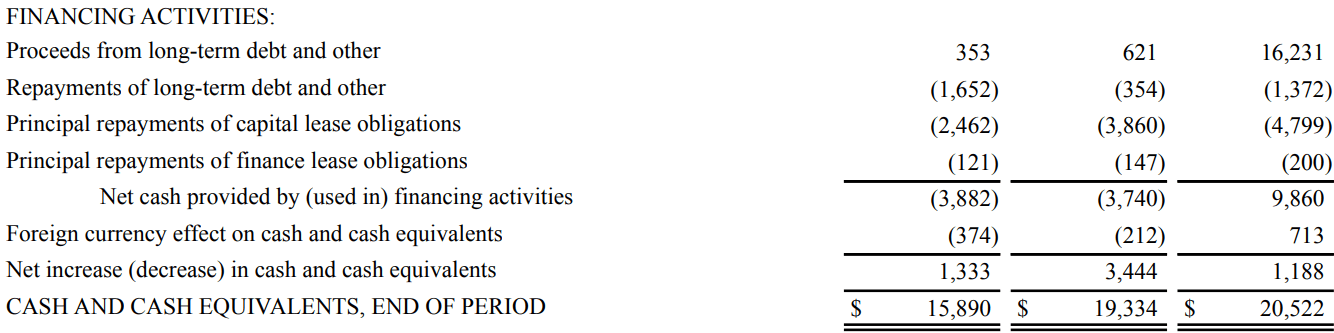
Proceeds from long-term debtLong Term DebtLong Term Debt (LTD) is any amount of outstanding debt a company holds that has a maturity of 12 months or longer. It is classified as a non-current liability on the company’s balance sheet. The time to maturity for LTD can range anywhere from 12 months to 30+ years and the types of debt can include bonds, mortgages and other: cash obtained from raising capital by issuing long-term debt. An addition to net cash.
Repayments of long-term debt and other: cash used to repay long-term debt obligations. A deduction from net cash.
PrincipalPrincipalPrincipal in bonds is their par value. It is the initial investment paid for a security or bond and does not include interest derived. repayments of capital leaseLease ClassificationsLease classifications include operating leases and capital leases. A lease is a type of transaction undertaken by a company to have the right to use an asset. In a lease, the company will pay the other party an agreed upon sum of money, not unlike rent, in exchange for the ability to use the asset. obligations: cash used to repay the principal amount of capital lease obligations. A deduction from net cash.
Principal repaymentsPrincipal PaymentA principal payment is a payment toward the original amount of a loan that is owed. In other words, a principal payment is a payment made on a loan that reduces the remaining loan amount due, rather than applying to the payment of interest charged on the loan. of finance lease obligations: cash used to repay the principal amount of finance lease obligations. A deduction from net cash.
Foreign currency effect on cash and cash equivalentsCurrency RiskCurrency risk, or exchange rate risk, refers to the exposure faced by investors or companies that operate across different countries, in regard to unpredictable gains or losses due to changes in the value of one currency in relation to another currency.: the effect of foreign exchange rates on cash held in foreign currencies.
Supplemental Cash Flow Information:

Cash paid for interest on long-term debt: cash usages to pay accumulated interest from long-term debt.
Cash paid for interest on capital and finance lease obligations: cash usages to pay accumulated interest from capital and finance lease obligations.
Cash paid for income taxesAccounting For Income TaxesIncome taxes and their accounting is a key area of corporate finance. There are several objectives in accounting for income taxes and optimizing a company's valuation., net of refunds: cash usages to pay income taxes.
Property and equipment acquired under capital leases: the value of property and equipment acquired under new capital leases in the fiscal period.
Property and equipment acquired under build-to-suit leases: the value of property and equipment acquired under new build-to-suit leases in the fiscal period.
#2 Financial Statements Example – Income Statement
The next statement in our financial statements examples is the income statement. The income statement is the first place for an analyst to look at if they want to assess a company’s profitabilityProfitability RatiosProfitability ratios are financial metrics used by analysts and investors to measure and evaluate the ability of a company to generate income (profit) relative to revenue, balance sheet assets, operating costs, and shareholders' equity during a specific period of time. They show how well a company utilizes its assets to produce profit.
Want to learn more about financial analysis and assessing a company’s profitability? Financial Modeling & Valuation Analyst (FMVA)® Certification ProgramBecome a Certified Financial Modeling & Valuation Analyst (FMVA)®CFI's Financial Modeling and Valuation Analyst (FMVA)® certification will help you gain the confidence you need in your finance career. Enroll today! will teach you everything you need to know to become a world-class financial analyst!
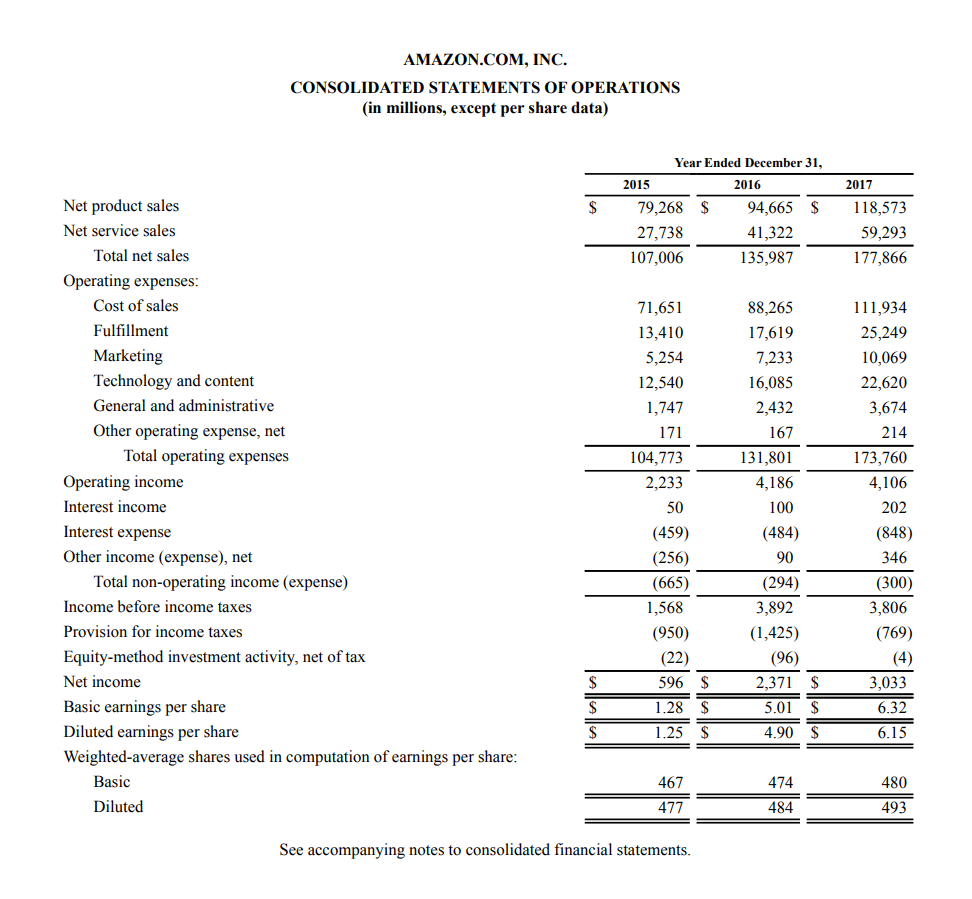
The income statement provides a look at a company’s financial performance throughout a certain period, usually a fiscal quarter or year. This period is usually denoted at the top of the statement, as can be seen above. The income statement contains information regarding salesRevenueRevenue is the value of all sales of goods and services recognized by a company in a period. Revenue (also referred to as Sales or Income), costs of salesCost of Goods Sold (COGS)Cost of Goods Sold (COGS) measures the “direct cost” incurred in the production of any goods or services. It includes material cost, direct, operating expenses, and other expenses.
The following are explanations for the line items listed in Amazon’s income statement:
Operating Income (EBIT):
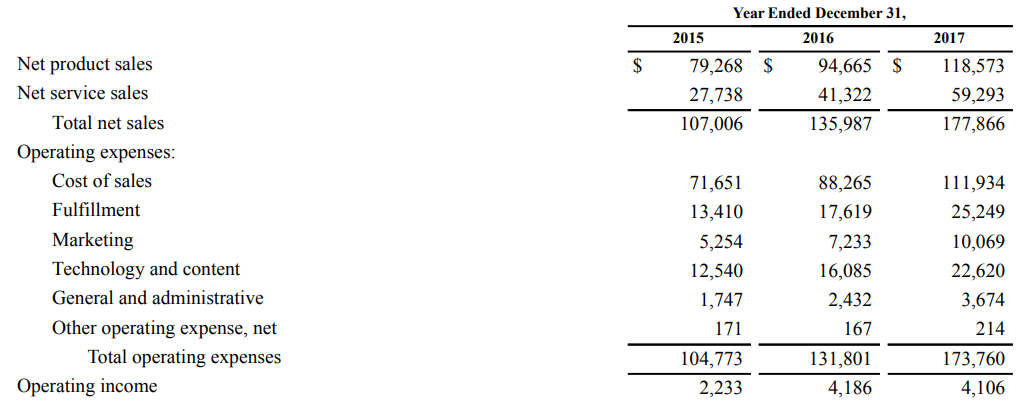
Net product sales: revenue derived from Amazon’s product sales such as Amazon’s first-party retail sales and proprietary products (e.g., Amazon Echo)
Net services sales: revenue generated from the sale of Amazon’s services. This includes proceeds from Amazon Web Services (AWS), subscription services, etc.
Cost of sales: costs directly associated with the sale of Amazon products and services. For example, the cost of raw materials used to manufacture Amazon products is a cost of sales.
Fulfillment: expenses relating to Amazon’s fulfillment process. Amazon’s fulfillment process includes storing, picking, packing, shipping, and handling customer service for products.
Marketing5 P's of MarketingThe 5 P's of Marketing – Product, Price, Promotion, Place, and People – are key marketing elements used to position a business strategically. The 5 P's of: expenses pertaining to advertising and marketing for Amazon and its products and services. Marketing expense is often grouped with selling, general, and administrative expenses (SG&A) but Amazon has chosen to break it out as its own line item.
Technology and content: costs relating to operating Amazon’s AWS segment.
General and administrativeSG&ASG&A includes all non-production expenses incurred by a company in any given period. It includes expenses such as rent, advertising, marketing: operating expenses that are not directly related to producing Amazon’s products or services. These expenses are sometimes referred to as non-manufacturing costs or overhead costs. These include rent, insurance, managerial salaries, utilities, and other similar expenses.
Other operating expenses, net: expenses primarily relating to the amortization of Amazon’s intangible assets.
Operating incomeOperating IncomeOperating income is the amount of revenue left after deducting the operational direct and indirect costs from sales revenue.: the income left over after all operating expenses (expenses directly related to the operation of the business) are deducted. Also known as EBITEBIT GuideEBIT stands for Earnings Before Interest and Taxes and is one of the last subtotals in the income statement before net income. EBIT is also sometimes referred to as operating income and is called this because it's found by deducting all operating expenses (production and non-production costs) from sales revenue..
Net Income:
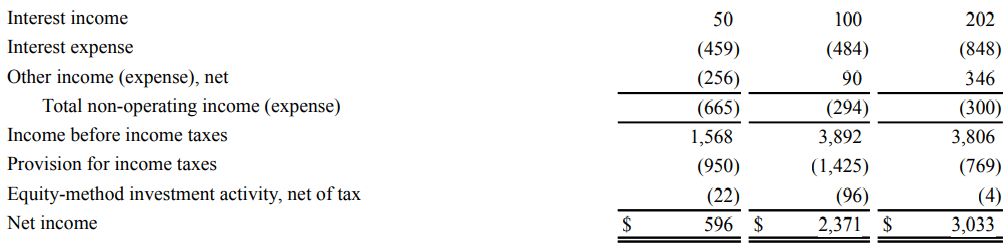
Interest income: income generated by Amazon from investing excess cash. Amazon typically invests excess cash in investment-gradeBond RatingsBond ratings are representations of the creditworthiness of corporate or government bonds. The ratings are published by credit rating agencies and provide evaluations of a bond issuer’s financial strength and capacity to repay the bond’s principal and interest according to the contract., short to intermediate-term fixed income securitiesFixed Income SecuritiesFixed income securities are a type of debt instrument that provides returns in the form of regular, or fixed, interest payments and repayments of the, and AAA-rated money marketMoney MarketThe money market is an organized exchange market where participants can lend and borrow short-term, high-quality debt securities. funds.
Interest expenseInterest ExpenseInterest expense arises out of a company that finances through debt or capital leases. Interest is found in the income statement, but can also: expenses relating to accumulated interest from capital and finance lease obligations and long-term debt.
Other income (expense), net: income or expenses relating to foreign currency and equity warrant valuations.
Income before income taxesEarnings Before Tax (EBT)Earnings before tax, or pre-tax income, is the last subtotal found in the income statement before the net income line item. EBT is found: Amazon’s income after operating and interest expenses have been deducted.
Provision for income taxes: the expense relating to the amount of income tax Amazon must pay within the fiscal yearFiscal Year (FY)A fiscal year (FY) is a 12-month or 52-week period of time used by governments and businesses for accounting purposes to formulate annual.
Equity-methodEquity MethodThe equity method is a type of accounting used in investments. It is used when the investor holds significant influence over investee but does investment activity, net of tax: proportionate losses or earnings from companies where Amazon owns a minority stakeMinority InterestMinority interest refers to having a stake in a company that is less than 50% of the total shares in terms of voting rights..
Net income: the amount of income left over after Amazon has paid off all its expenses.
Earnings per Share (EPS):

Basic earnings per shareEarnings Per Share (EPS)Earnings per share (EPS) is a key metric used to determine the common shareholder's portion of the company’s profit. EPS measures each common share's profit: earnings per share calculated using the basic number of shares outstanding.
Diluted earnings per share: earnings per share calculated using the diluted number of shares outstanding.
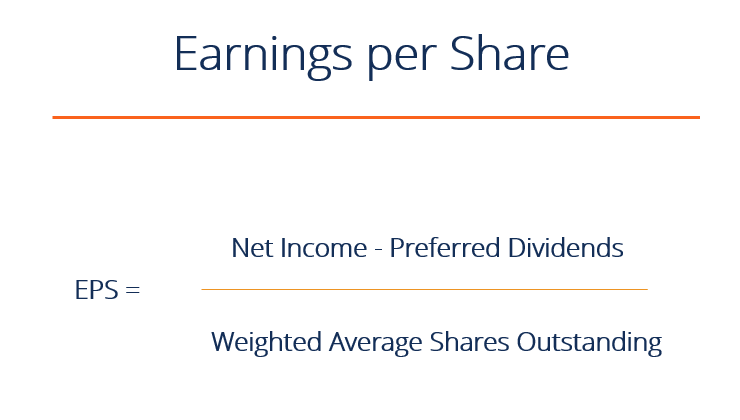
Weighted-average sharesWeighted Average Shares OutstandingWeighted average shares outstanding refers to the number of shares of a company calculated after adjusting for changes in the share capital over a reporting period. The number of weighted average shares outstanding is used in calculating metrics such as Earnings per Share (EPS) on a company's financial statements used in the computation of earnings per share: a weighted average number of shares to account for new stock issuances throughout the year. The way the calculation works is by taking the weighted average number of shares outstanding during the fiscal period covered.
For example, a company has 100 shares outstanding at the beginning of the year. At the end of the first quarter, the company issues another 50 shares, bringing the total number of shares outstanding to 150. The calculation for the weighted average number of shares would look like below:
100*0.25 + 150*0.75 = 131.25
Basic: the number of shares outstanding in the market at the date of the financial statement.
DilutedDiluted Shares OutstandingFully diluted shares outstanding is the total number of shares a company would have if all dilute securities were exercised and converted into shares.: the number of shares outstanding if all convertible securities (e.g. convertible preferred stock, convertible bondsConvertible BondA convertible bond is a type of debt security that provides an investor with a right or an obligation to exchange the bond for a predetermined number of shares in the issuing company at certain times of a bond’s lifetime. A convertible bond is a hybrid security) are exercised.
#3 Financial Statements Example – Balance Sheet
The last statement we will look at with our financial statements examples is the balance sheet. The balance sheet shows the company’s assetsTypes of AssetsCommon types of assets include current, non-current, physical, intangible, operating, and non-operating. Correctly identifying and, liabilitiesLiabilityA liability is a financial obligation of a company that results in the company’s future sacrifices of economic benefits to other entities or businesses. A liability can be an alternative to equity as a source of a company’s financing., and stockholders’ equityStockholders EquityStockholders Equity (also known as Shareholders Equity) is an account on a company's balance sheet that consists of share capital plus at a specific point in time.
Learn how a world-class financial analyst uses these three financial statements with CFI’s Financial Modeling & Valuation Analyst (FMVA)® Certification ProgramBecome a Certified Financial Modeling & Valuation Analyst (FMVA)®CFI's Financial Modeling and Valuation Analyst (FMVA)® certification will help you gain the confidence you need in your finance career. Enroll today!!
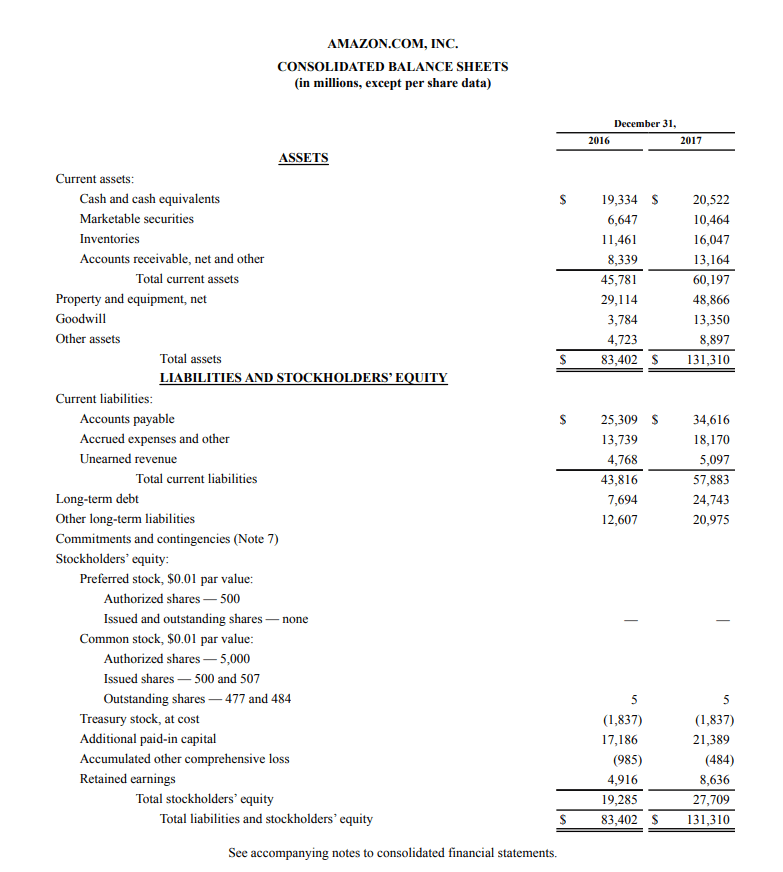
Unlike the income statement and the cash flow statement, which display financial information for the company during a fiscal period, the balance sheet is a snapshot of the company’s finances at a specific point in time. It can be seen above in the line regarding the date.
Compared to the Cash Flow Statement and Statement of Income, it states ‘December 31, 2017’ as opposed to ‘Year Ended December 31, 2017’. By displaying snapshots from different periods, the balance sheet shows changes in the accounts of a company.
The following are explanations for the line items listed in Amazon’s balance sheet:
Assets:
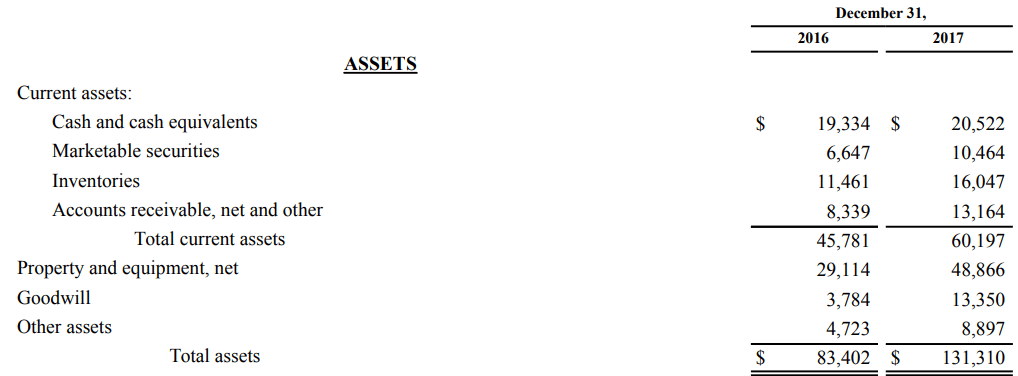
Cash and cash equivalentsCash EquivalentsCash and cash equivalents are the most liquid of all assets on the balance sheet. Cash equivalents include money market securities, banker's acceptances: cash or highly liquid assets and short-term commitments that can be quickly converted into cash.
Marketable securities: short-term financial instruments that mature within a year.
InventoriesInventoryInventory is a current asset account found on the balance sheet, consisting of all raw materials, work-in-progress, and finished goods that a: goods currently held in stock for sale, in-process goods, and materials to be used in the production of goods or services.
Accounts receivableAccounts ReceivableAccounts Receivable (AR) represents the credit sales of a business, which have not yet been collected from its customers. Companies allow, net and other: credit sales of a business that have not yet been fully paid by customers.
GoodwillGoodwillIn accounting, goodwill is an intangible asset. The concept of goodwill comes into play when a company looking to acquire another company is: the difference between the price paid in an acquisition of a company and the fair market value of the target company’s net assets.
Other assets: Amazon’s acquired intangible assets, net of amortization. This includes items such as video, music content, and long-term deferred tax assets.
Liabilities:
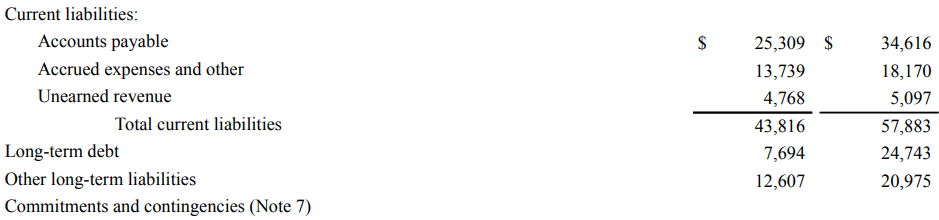
Accounts payableAccounts PayableAccounts payable is a liability incurred when an organization receives goods or services from its suppliers on credit. Accounts payables are: short-term liabilities incurred when Amazon purchases goods from suppliers on credit.
Accrued expensesAccrued ExpensesAccrued expenses are expenses that are recognized even though cash has not been paid. They are usually paired up against revenue via the matching principle and other: liabilities primarily related to Amazon’s unredeemed gift cards, leases and asset retirement obligations, current debt, acquired digital media content, etc.
Unearned revenueDeferred RevenueDeferred revenue is generated when a company receives payment for goods and/or services that it has not yet earned. In accrual accounting,: revenue generated when payment is received for goods or services that have not yet been delivered or fulfilled. Unearned revenue is a result of revenue recognition principlesRevenue Recognition PrincipleThe revenue recognition principle dictates the process and timing by which revenue is recorded and recognized as an item in a company's outlined by the U.S. GAAP and IFRS.
Long-term debt: the amount of outstanding debt a company holds that has a maturity of 12 months or longer.
Other long-term liabilities: Amazon’s other long-term liabilities, which include long-term capital and finance lease obligations, construction liabilities, tax contingencies, long-term deferred tax liabilities, etc. (Note 6 of Amazon’s 2017 annual report).
Stockholders’ Equity:
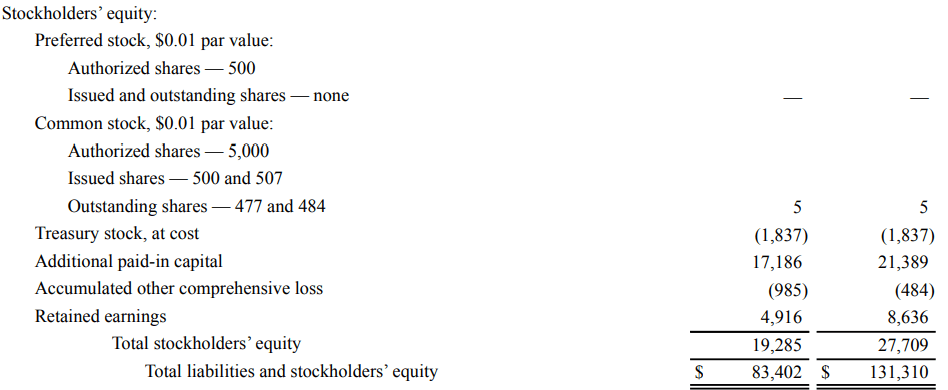
Preferred stockPreferred SharesPreferred shares (preferred stock, preference shares) are the class of stock ownership in a corporation that has a priority claim on the company’s assets over common stock shares. The shares are more senior than common stock but are more junior relative to debt, such as bonds.: stock issued by a corporation that represents ownership in the corporation. Preferred stockholders have a priority claim on the company’s assets and earnings over common stockholders. Preferred stockholders are prioritized with regards to dividendsDividendA dividend is a share of profits and retained earnings that a company pays out to its shareholders. When a company generates a profit and accumulates retained earnings, those earnings can be either reinvested in the business or paid out to shareholders as a dividend. but do not have any voting rights in the corporation.
Common stockCommon StockCommon stock is a type of security that represents ownership of equity in a company. There are other terms – such as common share, ordinary share, or voting share – that are equivalent to common stock.: stock issued by a corporation that represents ownership in the corporation. Common stockholders can participate in corporate decisions through voting.
Treasury stockTreasury StockTreasury stock, or reacquired stock, is a portion of previously issued, outstanding shares of stock that a company repurchased from shareholders., at cost: also known as reacquired stock, treasury stock represents outstanding shares that have been repurchasedShare RepurchaseA share repurchase refers to when the management of a public company decides to buy back company shares that were previously sold to the public. A company may decide to repurchase its sharesto send a market signal that its stock price is likely to increase, to inflate financial metrics denominated by the number of shares outstanding (e.g., earnings per share or EPS), or simply because it wants to increase its own equity stake in the company. from the stockholder by the company.
Additional paid-in capitalAdditional Paid In CapitalAdditional Paid In Capital (APIC) is the value of share capital above its stated par value and is listed under Shareholders' Equity on the balance sheet.: the value of share capitalShare CapitalShare capital (shareholders' capital, equity capital, contributed capital, or paid-in capital) is the amount invested by a company’s above its stated par valuePar ValuePar Value is the nominal or face value of a bond, or stock, or coupon as indicated on a bond or stock certificate. It is a static value in the above line item for common stock ($0.01 in the case of Amazon). In Amazon’s case, the value of its issued share capital is $17,186 million more than the par value of its common stock, which is worth $5 million.
Accumulated other comprehensive loss: accounts for foreign currency translation adjustments and unrealized gains and losses on available-for-sale/marketable securities.
Retained earningsRetained EarningsThe Retained Earnings formula represents all accumulated net income netted by all dividends paid to shareholders. Retained Earnings are part: the portion of a company’s profits that is held for reinvestment back into the business, as opposed to being distributed as dividends to stockholders.
Conclusion
As you can see with the above financial statements examples, financial statements are complex and closely linked. There are many accounts in financial statements that can be used to represent amounts regarding different business activities. Many of these accounts are typically labeled “other” type accounts, such as “Other operating expenses, net”. In our financial statements examples, we examined how these accounts functioned for Amazon.
Additional Resources
Now that you have become more proficient in reading the financial statements examples, round out your skills with some of our other resources. Corporate Finance Institute has resources that will help you expand your knowledge and advance your career! Check out the links below:
- Financial Modeling & Valuation Analyst (FMVA)® Certification ProgramBecome a Certified Financial Modeling & Valuation Analyst (FMVA)®CFI's Financial Modeling and Valuation Analyst (FMVA)® certification will help you gain the confidence you need in your finance career. Enroll today!
- Financial Analysis Fundamentals
- Three Financial Statements SummaryThree Financial StatementsThe three financial statements are the income statement, the balance sheet, and the statement of cash flows. These three core statements are
- Free CFI Accounting eBookAccounting BookCFI's Principles of Accounting book is free, available for anyone to download as a PDF. Read about bookkeeping, accounting principles, financial statements, with 66 pages of lessons and tutorials. From general transaction recording conventions to the full accounting cycle and finally to important accounts, the book
-

Understanding Financial Markets: A Comprehensive Guide
Financial markets, from the name itself, are a type of marketplace that provides an avenue for the sale and purchase of assets such as bondsBondsBonds are fixed-income securities that are issued by co
-

Why Do You Save Money? Understanding Your Savings Goals
Last week, I wrote about a conversation with my investment adviser. In the article, I mentioned that my current income roughly covers my current spending except that Ive been spending an average
Accounting
- Understanding Financial Barriers: How Costs Impact Your Lifestyle
- Financial Covenants: Definition, Types & Importance
- Robo-Advisors: A Comprehensive Guide to Automated Investment Management
- Understanding Audit Assertions: A Comprehensive Guide
- Understanding Cash Equivalents: Definition & Examples
- Understanding Financial Assets: Definitions & Types
- Understanding Financial Statement Notes: A Comprehensive Guide
- Understanding Intersegment Sales: Definition & Reporting
- Understanding Financial Services: A Comprehensive Guide
-
![Marketable Securities: Definition & Types | [Your Brand/Company Name]](https://www.etffin.com/article/uploadfiles/202110/2021100815155870_S.jpg) Marketable Securities: Definition & Types | [Your Brand/Company Name]
Marketable Securities: Definition & Types | [Your Brand/Company Name]Marketable securities are unrestricted short-term financial instruments that are issued either for equity securitiesStockWhat is a stock? An individual who owns stock in a company is ca...
-
 Understanding Review Engagements: Limited Assurance on Financial Statements
A review engagement is also known as a limited assurance or negative engagement. Auditors conduct a review engagement after an accountant’s completed an audit of a company’s financial stat...