
Understanding Freight Expenses: A Comprehensive Guide
Freight expense refers to the price that is charged by a carrier for sending out cargo from the source location to the destination location. The expense is paid by the person who wants the goods transported from one location to another. The amount of freight expense charged depends on the mode of transportation used to deliver the cargo.
Some of the common modes of transport that can be used include ship, airplane, train, or truck. Also, freight companies charge different freight costs depending on the weight of the cargo.
Factors that Affect Freight Costs
Companies that hold inventoryInventoryInventory is a current asset account found on the balance sheet, consisting of all raw materials, work-in-progress, and finished goods that a see freight expense as one of the key costs of doing business. The cost may be incurred when transporting goods from the manufacturer’s warehouse to the company’s warehouse or from the company’s warehouse to the retail or customer site. The shipping cost may be invoiced either beforehand or after the delivery of the cargo.
Some of the factors that affect freight expense include:
1. Fuel costs
Some shipping companies include a fuel cost component in the freight cost pricing model. The cost of road and maritime shipping is dependent on the cost of fuelOil & Gas PrimerThe oil & gas industry, also known as the energy sector, relates to the process of exploration, development, and refinement of crude oil and natural gas. It, and the final cost charged to the consumer must factor in the cost of fuel at the time of shipping.
If the price of fuel is low, road and maritime transport will be cheaper to use, and the benefit will be passed on to the consumer as cost savings. However, if the price of fuel increases, road and maritime transport prices will increase, and the additional cost will be passed on to the consumer.
2. Demand for freight
The cost of freight is also affected by the demand for freight services. There will be large volumes of products for shipping during periods of higher demand for shipping space, and users will be competing for the limited space. As a result, shipping companies can sell the limited space at a premium price.
On the other hand, when the demand for freight services is low, shipping companies will lower their prices in order to compete for the fewer users looking to ship cargo.
3. Emerging events
Emerging events such as terrorism, piracy, and a rogue government can result in increased freight costs as shipping companies attempt to recover losses incurred. Costs may also increase due to shippers opting to use longer shipping routes that offer more safety. For example, maritime shipping passing through pirate-prone shipping routes such as Somalia are forced to charge a higher cost to cover the increased risk, higher insurance premiums, and longer shipping routes.
When using trucks to transport cargo through areas prone to terrorism and criminal gangs, shipping companies may charge a higher fee in order to hire security or shift cargo to safer modes of transport in such areas.
4. Government regulation
In some countries, the government may introduce a policy that directly affects shipping companies. For example, government authorities may limit truck drivers’ maximum driving hours at certain periods of the year. This means that the cargo will take longer to get to the destination point.
Shipping companies raise the freight costs charged to their customers to cover expected losses. Other government regulations that may affect freight costs include a ban on night driving, emission tax laws, limiting the volume of cargo that trucks can carry, etc.
How to Record Freight Expenses in Accounting
For businesses that ship cargo on a regular basis, freight expense will be a significant cost for the business. They must record it appropriately in order for their financial books to be accurate. Usually, freight expenses are recorded as other “general expenses.” How the cost is recorded may depend on who is paying the freight cost and whether the cost is included in the asset’s value/price.
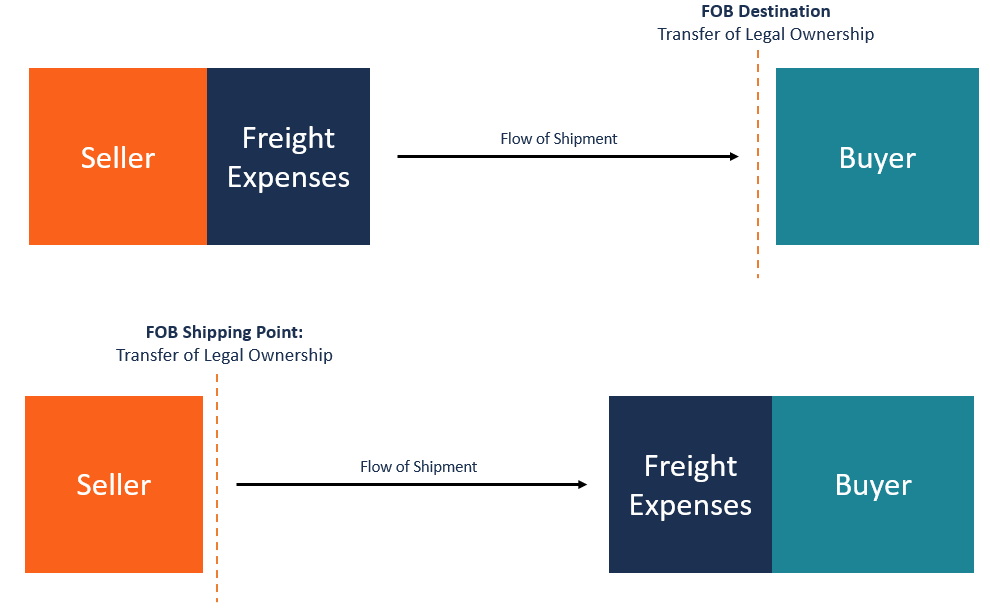
FOB shipping point
For the FOB shipping point, the sale occurs at the shipping point, and the buyer is responsible for the freight costs to the destination. On the buyer’s side, the transaction is classified as a freight-in and includes all costs from the shipping point to the destination. In this case, the seller will not book any delivery expense in its books.
The goods transfer from the seller to the buyer after the goods have been placed on the delivery truck or ship. Prior to the arrival of the goods at the point of origin (shipping point), the seller must cover all costs, such as taxes, customs, and other fees. The buyer only becomes responsible for freight expense after the cargo has reached the point of origin (shipping point).
FOB destination
FOB destination means that the sale and transfer of responsibility for the goods occur when the goods have been delivered to the buyer’s designating receiving point (such as a port or warehouse). The seller will record the freight cost as a delivery expense, and it will be debited to the freight-in account and credited to accounts payableAccounts PayableAccounts payable is a liability incurred when an organization receives goods or services from its suppliers on credit. Accounts payables are.
The seller still legally owns the goods during the shipping process. The title of ownership changes from the seller to the buyer when the goods have been delivered to the buyer’s specified location.
More Resources
Thank you for reading CFI’s explanation of Freight Expense. CFI is the official provider of the Financial Modeling and Valuation Analyst (FMVA)®Become a Certified Financial Modeling & Valuation Analyst (FMVA)®CFI's Financial Modeling and Valuation Analyst (FMVA)® certification will help you gain the confidence you need in your finance career. Enroll today! certification program, designed to transform anyone into a world-class financial analyst.
To keep learning and developing your knowledge of financial analysis, we highly recommend the additional CFI resources listed below:
- Activity-Based Costing GuideActivity-Based CostingActivity-based costing is a more specific way of allocating overhead costs based on “activities” that actually contribute to overhead costs. An activity is
- Cost of Goods Sold (COGS)Cost of Goods Sold (COGS)Cost of Goods Sold (COGS) measures the “direct cost” incurred in the production of any goods or services. It includes material cost, direct
- Freight on Board (FOB)Freight on Board (FOB)Freight on Board (FOB), also referred to as Free on Board, is an international commercial law term published by the International Chamber of Commerce (ICC).
- OverheadsOverheadsOverheads are business costs that are related to the day-to-day running of the business. Unlike operating expenses, overheads cannot be
-
![Expense Management Automation: Streamline & Save | [Your Company Name]](https://www.etffin.com/article/uploadfiles/202110/2021100811441421_S.jpg)
Expense Management Automation: Streamline & Save | [Your Company Name]
After employee payroll and benefits, corporate travel and entertainment (T&E) is the second-largest controllable expense for companies. Because it makes up such a large chunk of a company’s
-
Expense Ratios: Understanding Investment Fund Fees
An expense ratio is a fee charged by an investment company to manage the shareholders’ funds. Investment companies such as mutual fundsMutual FundsA mutual fund is a pool of money collected from
Accounting
- Economy Ground Shipping: A Comprehensive Guide
- Understanding Discretionary Expenses: Definition & Examples
- Understanding Depreciation Expense: A Comprehensive Guide
- Understanding Business Expenses: A Comprehensive Guide
- Understanding Insurance Expense: Definition & Accounting
- Understanding Rent Expense: Definition & Significance
- Understanding Utilities Expense: Definition & Accounting
- Understanding Wage Expense: Definition, Types & Accounting
- Understanding Warranty Expense: Definition & Impact
-
 Expense Management Software: Streamline Spending & Reimbursements
Managing business expenses is a key concern for all companies, and one that’s difficult to orchestrate with manual processes, paper receipts and handwritten notes. By using software to track and...
-
 Understanding Variable Expenses: A Comprehensive Guide
What is a variable expense? Officially, a variable expense is a cost that changes month to month or occurs irregularly. Unofficially, variable expenses are probably the most likely culprit for ...