
Understanding Wage Expense: Definition, Types & Accounting
Wage expense refers to the cost incurred by an organization to compensate employees and contractors for work performed over a specific time period.
Summary
- Wage expense is a type of variable-rate cost.
- There are three main types of wage expenses: (1) times wages, (2) piece wages, and (3) contract wages.
- Wage expense is typically combined with other expenses on the income statement.
Wage Expense vs. Salary Expense
The difference between wages and salaries is often poorly understood. Understanding the difference between wage expense and salary expense allows an analyst to better forecast the costs of an organization.
- Wage expense is a variable-rate cost, which depends on the type of wage (e.g., a time wage, piece wage, or contract wage).
- Salary expense is a fixed-rate cost and depends on each employee’s salary contract terms.
Example: The following illustrates the amount paid to an employee by an organization over the past three months. Is it an example of wage expense or salary expense?

Answer: Given the variable nature of the payment each month, the above is an example of wage expense.
Types of Wage Expenses
There are three main types of wage expenses:
- Time wages are based on the amount of time worked – for example, an hourly wage of $10.
- Piece wages are based on the number of units produced – for example, a piece wage of $5 per widget produced.
- Contract wages are based on the number of completed works under a contract – for example, a wage of $10,000 per house built under a development contract.
Practical Example
Background Information: A company currently employs five individuals. Employees 1 and 2 are each paid $6,000 per month, while Employees 3, 4, and 5 are paid $15 per hour. The following shows the number of hours worked by each employee for the month of January:
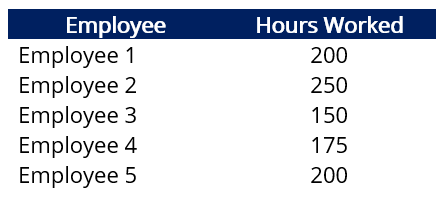
Question: Determine the wage expense and salary expense for the month of January.
Answer: Employees 1 and 2 are each paid $6,000 per month (salary). The salary expense for the month of January is $12,000. Employees 3, 4, and 5 are paid $15 per hour. In aggregate, they worked 525 hours. The wage expense for the month of January is 525 x $15 = $7,875.
Wage Expense on the Income Statement
Wage expense on the income statement is typically combined with similar expenses, as shown below.
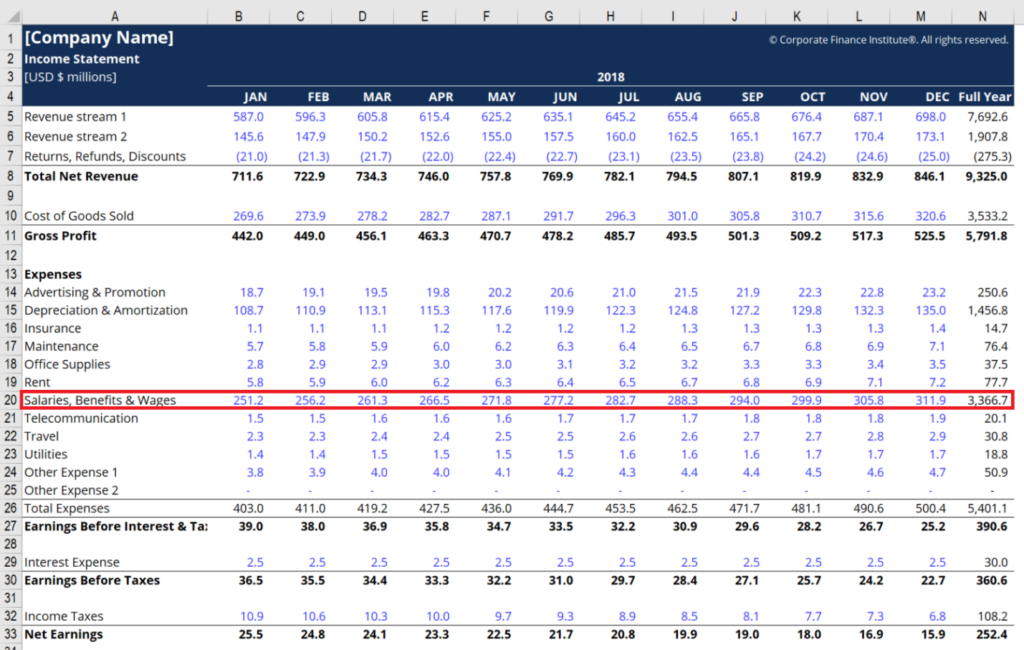
For companies that produce goods (i.e., manufacturing companies), a portion of their wage expense may be aggregated into costs of goods sold (COGS)Cost of Goods Sold (COGS)Cost of Goods Sold (COGS) measures the “direct cost” incurred in the production of any goods or services. It includes material cost, direct on the income statement. As you may recall, COGS refers to direct costs related to the production of goods, which include the cost of materials, labor, and manufacturing overhead.
As an example, assume that a manufacturing company incurred a wage expense of $200,000 for the fiscal year 2020. Of the $200,000, 25% relate to wages for factory workers while the remaining relate to wages for workers at the head office.
In such a scenario, only $150,000 would be classified as wage expense on the company’s income statement. The remaining $50,000 would be aggregated into COGS (assuming the products produced by the factory workers are sold in the same year).
Accrual Method of Accounting for Wage Expense
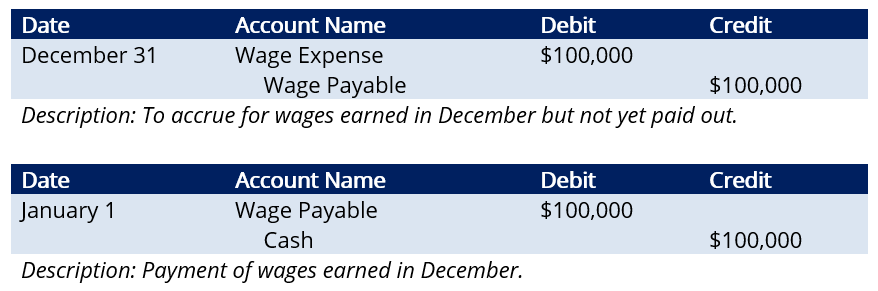
Companies commonly prepare financial statements on an accrual basis. Below, we illustrate the journal entries for wage expense.
Background Information: Company A pays its employees on the first day of the next month. For example, wages for work done in the month of December are paid on the first day of January.
Question: Wages for employees in the month of December totaled $100,000. What would be the relevant journal entries?
Answer:
Related Readings
CFI offers the Commercial Banking & Credit Analyst (CBCA)™Program Page - CBCAGet CFI's CBCA™ certification and become a Commercial Banking & Credit Analyst. Enroll and advance your career with our certification programs and courses. certification program for those looking to take their careers to the next level. To keep learning and developing your knowledge base, please explore the additional relevant resources below:
- Accrued ExpenseAccrued ExpenseAccrued expense is a concept in accrual accounting that refers to expenses that are recognized when incurred but not yet paid. In some
- Direct CostDirect CostDirect cost is an accounting term that describes any type of expenditure that can be directly attributable to a cost object. Cost objects can
- RemunerationRemunerationRemuneration is any type of compensation or payment that an individual or employee receives as payment for their services or the work that they do for an organization or company. It includes whatever base salary an employee receives, along with other types of payment that accrue during the course of their work, which
- Fixed and Variable CostsFixed and Variable CostsCost is something that can be classified in several ways depending on its nature. One of the most popular methods is classification according
-
Expense Ratios: Understanding Investment Fund Fees
An expense ratio is a fee charged by an investment company to manage the shareholders’ funds. Investment companies such as mutual fundsMutual FundsA mutual fund is a pool of money collected from
-
Understanding Wage Expense: Definition, Types & Accounting
Wage expense refers to the cost incurred by an organization to compensate employees and contractors for work performed over a specific time period. SummaryWage expense is a type of variable
Accounting
- Understanding Discretionary Expenses: Definition & Examples
- Understanding Depreciation Expense: A Comprehensive Guide
- Understanding Business Expenses: A Comprehensive Guide
- Understanding Freight Expenses: A Comprehensive Guide
- Understanding Insurance Expense: Definition & Accounting
- Understanding Rent Expense: Definition & Significance
- Understanding Utilities Expense: Definition & Accounting
- Understanding Warranty Expense: Definition & Impact
- Wage Garnishment: Understanding & Prevention | [Your Company Name]
-
 Expense Management Software: Streamline Spending & Reimbursements
Managing business expenses is a key concern for all companies, and one that’s difficult to orchestrate with manual processes, paper receipts and handwritten notes. By using software to track and...
-
 Understanding Variable Expenses: A Comprehensive Guide
What is a variable expense? Officially, a variable expense is a cost that changes month to month or occurs irregularly. Unofficially, variable expenses are probably the most likely culprit for ...