
Free Cash Flow to Equity (FCFE): Understanding & Calculation
Free Cash Flow to Equity (FCFE)Free Cash Flow to Equity (FCFE)Free cash flow to equity (FCFE) is the amount of cash a business generates that is available to be potentially distributed to shareholders. It is calculated as Cash from Operations less Capital Expenditures. This guide will provide a detailed explanation of why it’s important and how to calculate it and several is the amount of cash generated by a company that can be potentially distributed to its shareholders – you can calculate FCFE from CFO (cash flow from operations). FCFE is a key metric in one of the approaches in the Discounted Cash Flow (DCF) valuation modelDiscounted Cash Flow DCF FormulaThis article breaks down the DCF formula into simple terms with examples and a video of the calculation. Learn to determine the value of a business.. Using the FCFE, an analyst can determine the Net Present Value (NPV)Net Present Value (NPV)Net Present Value (NPV) is the value of all future cash flows (positive and negative) over the entire life of an investment discounted to the present. of a company’s equity, which can be subsequently used to calculate the company’s theoretical share price.
FCFE is different from Free Cash Flow to Firm (FCFF)Free Cash Flow to Firm (FCFF)FCFF, or Free Cash Flow to Firm, is cash flow available to all funding providers in a business. debt holders, preferred stockholders, common shareholders, which indicates the amount of cash generated to all holders of the company’s securities (both investors and lenders).
FCFE from CFO Formula
One of the approaches to calculating free cash flow to equity is based on the use of cash flow from operations (CFO) from the company’s cash flow statementCash Flow StatementA cash flow Statement contains information on how much cash a company generated and used during a given period.. Cash flow from operations (also known as operating cash flow) is the amount of cash generated by a company from its ongoing business activities, excluding any financing and investing activities.
Essentially, the abovementioned approach is a shortcut to the FCFE from net income approach. Recall that the cash from operations is calculated using the formula below:
CFO = Net Income + Depreciation & Amortization – ΔWorking Capital
Where:
- CFO – Cash flow from operations
- ΔWorking Capital – Change in working capital
At the same time, FCFE from net income is calculated through the following formula:
FCFE = Net Income + Depreciation & Amortization – ΔWorking Capital – CapEx + Net Borrowing
Thus, we can rewrite the formula above by substituting the first three variables with the cash flow from operations (CFO) figure:
FCFE = CFO – CapEx + Net Borrowing
The formula above provides a simpler approach for calculating FCFE as it reduces the number of variables employed. Due to this reason, the calculation method is more suitable in a financial model as it makes the model more coherent and comprehensible by simplifying the calculations within a model.
FCFE from CFO Formula and Financial Statements
An analyst who calculates the free cash flows to equity in a financial model must quickly navigate a company’s financial statements. The primary reason is that all inputs required to calculate the metric are taken from the financial statements. The guidance below will help you to quickly and correctly incorporate the FCFE from CFO calculation into a financial model.
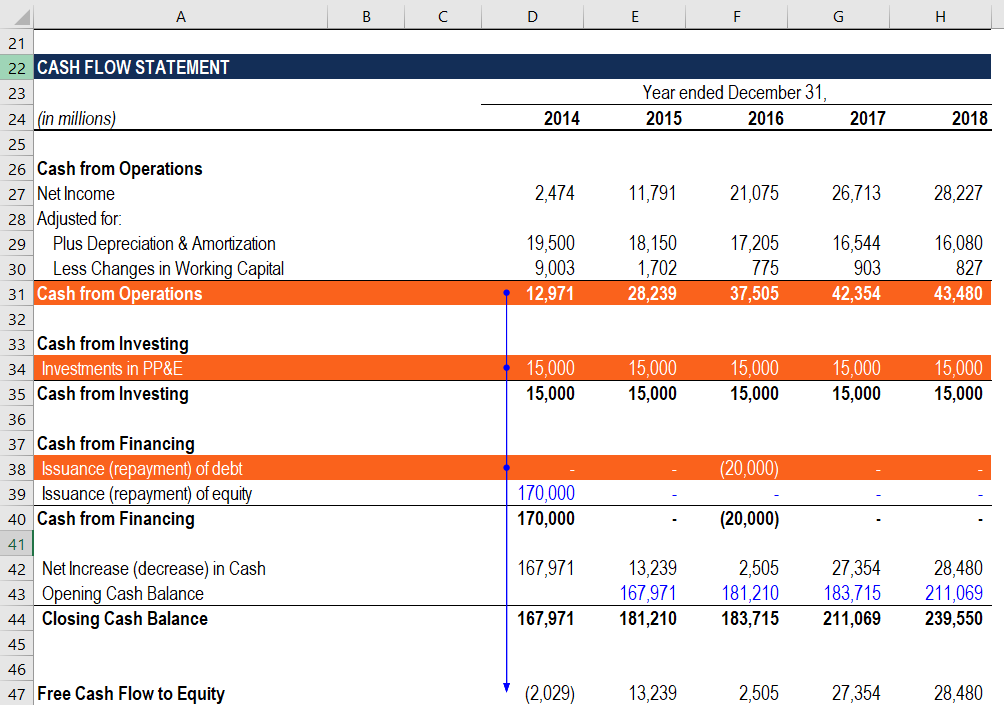
- Cash flow from operations (CFO): The CFO metric is calculated in the first section of the company’s cash flow statement.
- CapEx: The capital expenditure (CapEx) can be found on the cash flow statement within the Cash from Investing section.
- Net borrowing: Net debt amount is also located on the cash flow statement under the Cash from Financing section.
Related Readings
Thank you for reading CFI’s guide to how to calculate FCFE from CFO. CFI offers the Financial Modeling & Valuation Analyst (FMVA)®Become a Certified Financial Modeling & Valuation Analyst (FMVA)®CFI's Financial Modeling and Valuation Analyst (FMVA)® certification will help you gain the confidence you need in your finance career. Enroll today! certification program for those looking to take their careers to the next level. To keep learning and advancing your career, the following CFI resources will be helpful:
- Capital ExpenditureCapital ExpenditureA capital expenditure (“CapEx” for short) is the payment with either cash or credit to purchase long term physical or fixed assets used in a
- Financial Modeling Best PracticesFinancial Modeling Best PracticesThis article is to provide readers information on financial modeling best practices and an easy to follow, step-by-step guide to building a financial model.
- Stockholders EquityStockholders EquityStockholders Equity (also known as Shareholders Equity) is an account on a company's balance sheet that consists of share capital plus
- Three Financial StatementsThree Financial StatementsThe three financial statements are the income statement, the balance sheet, and the statement of cash flows. These three core statements are
-

Understanding the Cash Flow Statement: A Comprehensive Guide
One question is fundamental to any business: How much money is coming in versus how much is going out? A cash flow statement answers that and provides a clear picture of whe
-

Understanding Conventional Cash Flow: Definitions and Examples
Conventional cash flow is a series of cash flows which, over time, go in one direction. It means that if the initial transaction is an outflow, then it will be followed by successive periods of inward
Accounting
- Levered Free Cash Flow (LFCF): Definition & Importance
- Free Cash Flow (FCF): Definition & Importance for Business Growth
- Calculating Free Cash Flow to Equity (FCFE): A Comprehensive Guide
- Understanding Cash Flow from Financing Activities: A Comprehensive Guide
- Understanding Cash Flow from Investing Activities: A Comprehensive Guide
- Understanding Cash Flow from Operations: A Comprehensive Guide
- Calculating Free Cash Flow to Equity (FCFE) from EBITDA: A Step-by-Step Guide
- Calculate Free Cash Flow to Equity (FCFE) from Net Income: A Step-by-Step Guide
- Free Cash Flow (FCF): A Comprehensive Guide for Investors
-
 24 Essential Cash Flow Metrics & KPIs for Business Success
Understanding cash flow is one of the primary steps in making sure your business finances are sustainable. Cash flow is the amount of money coming into and leaving your company during a specified time...
-
 Mastering Cash Flow Statements: A Comprehensive Guide
Cash flow statements are one of your most importa...