
Understanding the Interrelationship of Financial Statements
The 3 financial statements are all linked and dependent on each other. In financial modelingWhat is Financial ModelingFinancial modeling is performed in Excel to forecast a company's financial performance. Overview of what is financial modeling, how & why to build a model., your first job is to link all three statements together in Excel, so it’s critical to understand how they’re connected. This is also a common question for investment banking interviews, FP&A interviews, and equity research interviews. See CFI’s free interview guidesInterviewsAce your next interview! Check out CFI's interview guides with the most common questions and best answers for any corporate finance job position. Interview questions and answer for finance, accounting, investment banking, equity research, commercial banking, FP&A, more! Free guides and practice to ace your interview to learn more.
In this tutorial, we will break it down for you step-by-step, although we assume you already have a basic understanding of accounting fundamentals and know how to read financial statements.
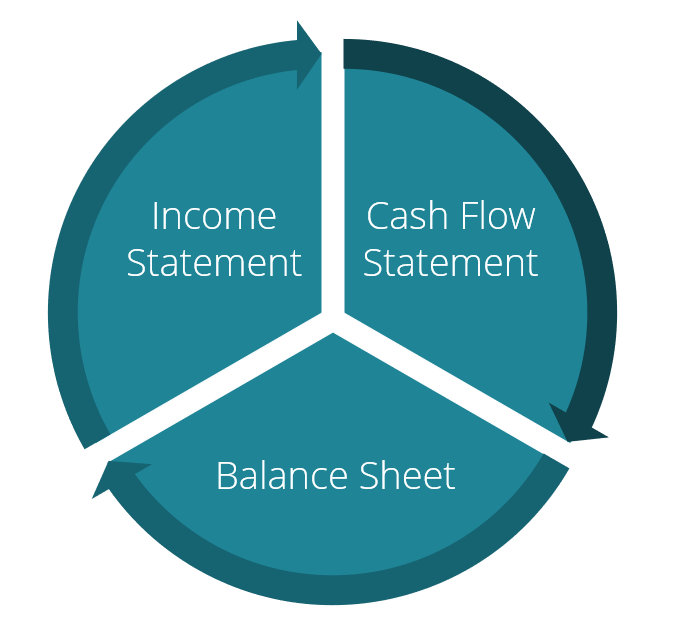
Want to see a live demonstration? Watch CFI’s free webinar on how to link the 3 financial statements in ExcelCFI Webinar - Link the 3 Financial StatementsThis CFI quarterly webinar provides a live demonstration of how to link the 3 financial statements in Excel. Learn the formulas and proper linking procedure.
Accounting Principles
The income statement is not prepared on a cash basis – that means accounting principles such as revenue recognition, matching, and accruals can make the income statement very different from the cash flow statement of the business. If a company prepared its income statement entirely on a cash basis (i.e., no accounts receivable, nothing capitalized, etc.) it would have no balance sheet other than shareholders’ equity and cash.
It’s the creation of the balance sheet through accounting principles that leads to the rise of the cash flow statement.
Net Income & Retained Earnings
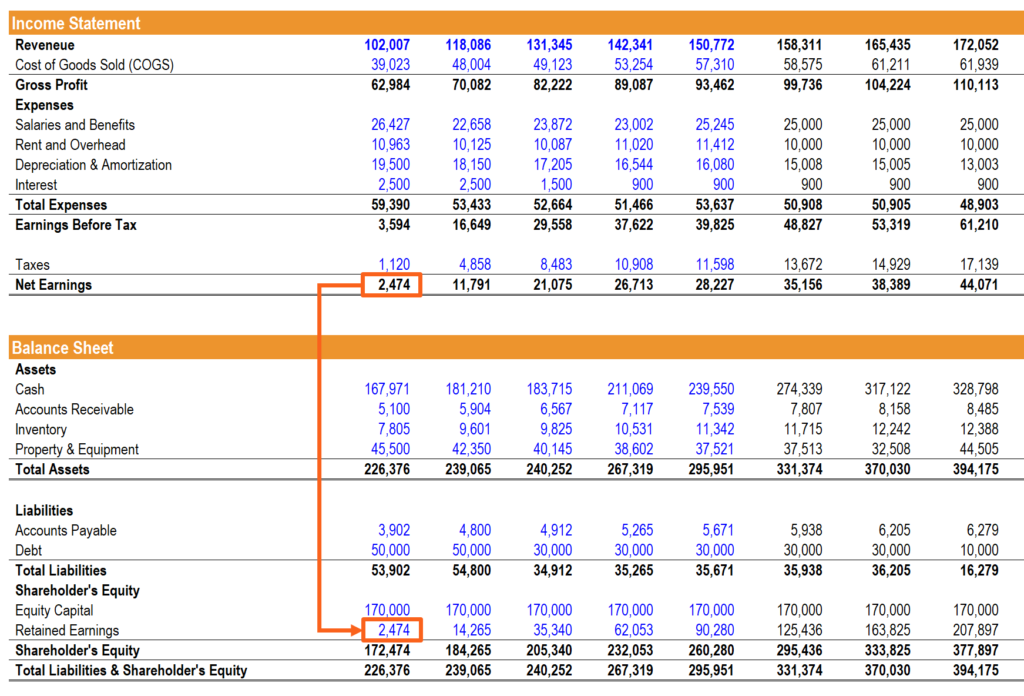
Net incomeNet IncomeNet Income is a key line item, not only in the income statement, but in all three core financial statements. While it is arrived at through from the bottom of the income statement links to the balance sheet and cash flow statement. On the balance sheet, it feeds into retained earnings and on the cash flow statement, it is the starting point for the cash from operations section.
PP&E, Depreciation, and Capex
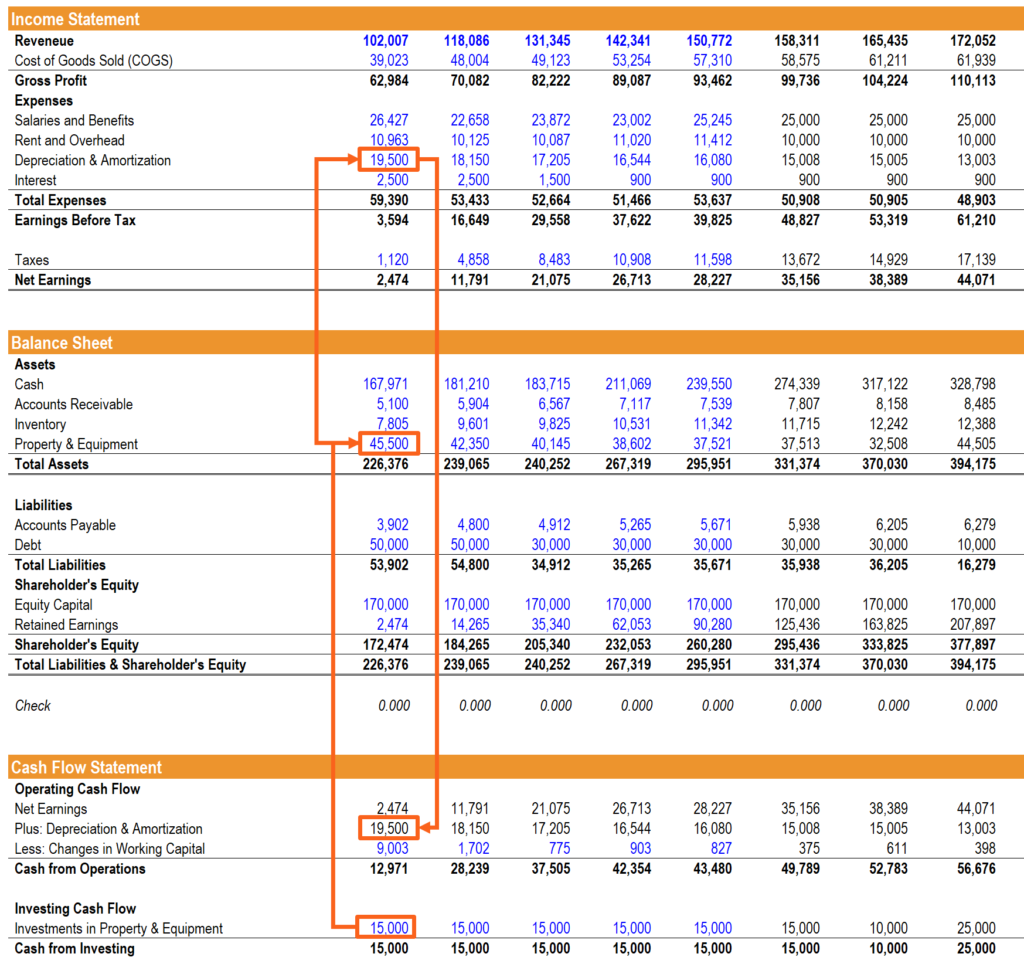
DepreciationDepreciation ExpenseWhen a long-term asset is purchased, it should be capitalized instead of being expensed in the accounting period it is purchased in. and other capitalized expenses on the income statement need to be added back to net income to calculate the cash flow from operations. Depreciation flows out of the balance sheet from Property Plant and EquipmentPP&E (Property, Plant and Equipment)PP&E (Property, Plant, and Equipment) is one of the core non-current assets found on the balance sheet. PP&E is impacted by Capex, (PP&E) onto the income statement as an expense, and then gets added back in the cash flow statement.
For this section of linking the 3 financial statements, it’s important to build a separate depreciation scheduleDepreciation ScheduleA depreciation schedule is required in financial modeling to link the three financial statements (income, balance sheet, cash flow) in Excel..
Capital expenditures add to the PP&E account on the balance sheet and flow through cash from investing on the cash flow statement.
Working Capital
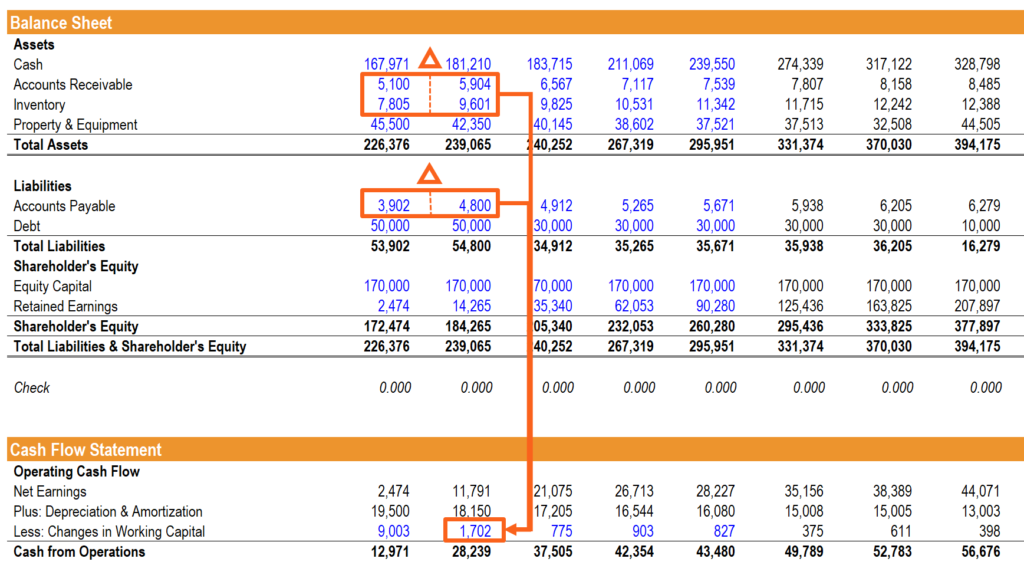
Modeling net working capitalNet Working CapitalNet Working Capital (NWC) is the difference between a company's current assets (net of cash) and current liabilities (net of debt) on its balance sheet. can sometimes be confusing. Changes in current assets and current liabilities on the balance sheet are related to revenues and expenses on the income statement but need to be adjusted on the cash flow statement to reflect the actual amount of cash received or spent by the business. In order to do this, we create a separate section that calculates the changes in net working capital.
Financing
This can be a tricky part of linking the three statements and requires some additional schedules. Financing events such as issuing debt affect all three statements in the following way: the interest expense appears on the income statement, the principal amount of debt owed sits on the balance sheet, and the change in the principal amount owed is reflected on the cash from financing section of the cash flow statement.
In this section, it’s often necessary to model a debt scheduleDebt ScheduleA debt schedule lays out all of the debt a business has in a schedule based on its maturity and interest rate. In financial modeling, interest expense flows to build in the necessary detail that’s required.
Cash Balance
This is the final step in linking the 3 financial statements. Once all of the above items are linked up properly, the sum of cash from operations, cash from investing, and cash from financing are added to the prior period closing cash balance, and the result becomes the current period closing cash balance on the balance sheet.
This is the moment of truth when you discover whether or not your balance sheet balances!
How to Answer the Question in an Interview
If you get an interview questionInterviewsAce your next interview! Check out CFI's interview guides with the most common questions and best answers for any corporate finance job position. Interview questions and answer for finance, accounting, investment banking, equity research, commercial banking, FP&A, more! Free guides and practice to ace your interview along the lines of, “How are the 3 financial statements linked together?” in an interview you shouldn’t go into as much detail as above, but instead simply hit the main points, which are:
- Net income from the income statement flows to the balance sheet and cash flow statement
- Depreciation is added back and CapEx is deducted on the cash flow statement, which determines PP&E on the balance sheet
- Financing activities mostly affect the balance sheet and cash from finalizing, except for interest, which is shown on the income statement
- The sum of the last period’s closing cash balance plus this periods cash from operations, investing, and financing is the closing cash balance on the balance sheet
If you want to see a video-based example, watch CFI’s webinar on linking the 3 statementsCFI Webinar - Link the 3 Financial StatementsThis CFI quarterly webinar provides a live demonstration of how to link the 3 financial statements in Excel. Learn the formulas and proper linking procedure.
How to Link the Financial Statements for Financial Modeling
If you’re building a financial model in Excel it’s critical to be able to quickly link the three statements. In order to do this, there are a few basic steps to follow:
- Enter at least 3 years of historical financial information for the 3 financial statements.
- Calculate the drivers/ratios of the business for the historical period.
- Enter assumptions about what the drivers will be in the future.
- Build and link the financial statements following the principles discussed above.
The model essentially inverts, where the historical period is hardcoded for the statements and calculations for the drivers, and then the forecast is hardcodes for the drivers and calculations for the financial statements.
Check out CFI’s step-by-step courses to learn how to build financial models in Excel.
Video of Linking the 3 Statements
Watch CFI’s live video demonstration of linking the statements together in Excel.
More Financial Resources
We hope this has been a helpful guide on how the 3 financial statements are linked together. To keep learning more, please check out these relevant CFI resources:
- Free Cash FlowCash FlowCash Flow (CF) is the increase or decrease in the amount of money a business, institution, or individual has. In finance, the term is used to describe the amount of cash (currency) that is generated or consumed in a given time period. There are many types of CF
- EBITDAEBITDAEBITDA or Earnings Before Interest, Tax, Depreciation, Amortization is a company's profits before any of these net deductions are made. EBITDA focuses on the operating decisions of a business because it looks at the business’ profitability from core operations before the impact of capital structure. Formula, examples
- Debt ScheduleDebt ScheduleA debt schedule lays out all of the debt a business has in a schedule based on its maturity and interest rate. In financial modeling, interest expense flows
- Complete Financial Modeling GuideFree Financial Modeling GuideThis financial modeling guide covers Excel tips and best practices on assumptions, drivers, forecasting, linking the three statements, DCF analysis, more
- 3 Statement Model3 Statement ModelA 3 statement model links the income statement, balance sheet, and cash flow statement into one dynamically connected financial model. Examples, guide
- DCF Model GuideDCF Model Training Free GuideA DCF model is a specific type of financial model used to value a business. The model is simply a forecast of a company’s unlevered free cash flow
- Types of Financial ModelsTypes of Financial ModelsThe most common types of financial models include: 3 statement model, DCF model, M&A model, LBO model, budget model. Discover the top 10 types
-
CPA vs. CFA: Understanding the Differences & Choosing the Right Finance Designation
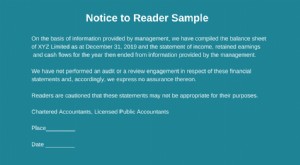
The notice to reader report is a compilation of financial statements using financial data provided by the management. The report is prepared by an external chartered accountantCPA vs CFA®When cons
-

Understanding Asset Types: A Comprehensive Guide
An asset is a resource owned or controlled by an individual, corporationCorporationA corporation is a legal entity created by individuals, stockholders, or shareholders, with the purpose of operating
Accounting
- Financial Statement Analysis: Pros, Cons & Key Statements
- Understanding Audited Financial Statements: A Comprehensive Guide
- Understanding Cash Equivalents: Definition & Examples
- Understanding Financial Statement Notes: A Comprehensive Guide
- Understanding Financial Statements: A Comprehensive Guide
- Understanding the Three Core Financial Statements
- Mastering FP&A: A Guide to Understanding the Core Financial Statements
- Understanding Financial Statements: A Beginner's Guide
- Mastering the Indirect Method: A Guide to Creating a Cash Flow Statement
-
 Understanding Financial Statement Analysis: Income Statement, Balance Sheet & Cash Flow
Spreading of Financial Statements There are three primary financial statements. They are the income statement, balance sheet and cash flow statement. All three are reported on a quarterly and...
-
 Understanding Financial Statement Footnotes: A Comprehensive Guide
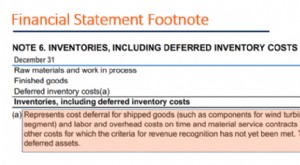
Financial statement footnotes are used as additional information to individuals reading a financial statement. Otherwise known as explanatory notes or notes to the financial statements, the footnotes ...