
IFRS vs. US GAAP: A Comprehensive Comparison for Financial Reporting
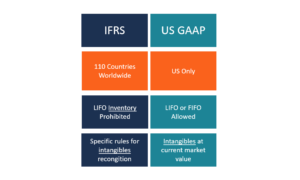
The IFRS vs US GAAP refers to two accounting standards and principles adhered to by countries in the world in relation to financial reporting. More than 110 countries follow the International Financial Reporting Standards (IFRS)IFRS StandardsIFRS standards are International Financial Reporting Standards (IFRS) that consist of a set of accounting rules that determine how transactions and other accounting events are required to be reported in financial statements. They are designed to maintain credibility and transparency in the financial world, which encourages uniformity in preparing financial statements.
On the other hand, the Generally Accepted Accounting Principles (GAAP) are created by the Financial Accounting Standards Board to guide public companies in the United States when compiling their annual financial statementsThree Financial StatementsThe three financial statements are the income statement, the balance sheet, and the statement of cash flows. These three core statements are.
Definition of Terms
1. IFRS
The IFRS is a set of standards developed by the International Accounting Standards Board (IASB). The IFRS governs how companies around the world prepare their financial statements. Unlike the GAAP, the IFRS does not dictate exactly how the financial statements should be prepared but only provides guidelines that harmonize the standards and make the accounting process uniform across the world.
Both individual and corporate investors can analyze a company’s financial statements and make an informed decision on whether or not to invest in the company. The IFRS is used in the European Union, South America, and some parts of Asia and Africa.
2. GAAP
The GAAP is a set of principles that companies in the United States must follow when preparing their annual financial statements. The measures take an authoritative approach to the accounting process so that there will be minimal or no inconsistency in the financial statements submitted by public companies to the US Securities and Exchange Commission (SEC)Securities and Exchange Commission (SEC)The US Securities and Exchange Commission, or SEC, is an independent agency of the US federal government that is responsible for implementing federal securities laws and proposing securities rules. It is also in charge of maintaining the securities industry and stock and options exchanges. It enables investors to make cross-comparisons of financial statements of various publicly-traded companies in order to make an educated decision regarding investments.
Key Differences between IFRS vs. US GAAP
The following are some of the ways in which IFRS and GAAP differ:
1. Treatment of inventory
One of the key differences between these two accounting standards is the accounting method for inventory costs. Under IFRS, the LIFO (Last in First out)Last-In First-Out (LIFO)The Last-in First-out (LIFO) method of inventory valuation is based on the practice of assets produced or acquired last being the first to be method of calculating inventory is not allowed. Under the GAAP, either the LIFO or FIFO (First in First out)First-In First-Out (FIFO)The First-In First-Out (FIFO) method of inventory valuation accounting is based on the practice of having the sale or usage of goods follow method can be used to estimate inventory.
The reason for not using LIFO under the IFRS accounting standard is that it does not show an accurate inventory flow and may portray lower levels of income than is the actual case. On the other hand, the flexibility to use either FIFO or LIFO under GAAP allows companies to choose the most convenient method when valuing inventory.
2. Intangibles
The treatment of intangible assets, such as research and goodwill, also feature when differentiating between IFRS vs US GAAP standards. Under IFRS, intangible assets are only recognized if they will have a future economic benefit. In such a way, the asset can be assessed and given a monetary value. On the other hand, GAAP recognizes intangible assets at their current fair market value, and no additional (future) considerations are made.
3. Rules vs. Principles
The other distinction between IFRS and GAAP is how they assess the accounting processes – i.e., whether they are based on fixed rules or principles that allow some space for interpretations. Under GAAP, the accounting process is prescribed highly specific rules and procedures, offering little room for interpretation. The measures are devised as a way of preventing opportunistic entities from creating exceptions to maximize their profits.
On the contrary, IFRS sets forth principles that companies should follow and interpret to the best of their judgment. Companies enjoy some leeway to make different interpretations of the same situation.
4. Recognition of revenue
With regards to how revenue is recognized, IFRS is more general, as compared to GAAP. The latter starts by determining whether revenue has been realized or earned, and it has specific rules on how revenue is recognized across multiple industries.
The guiding principle is that revenue is not recognized until the exchange of a good or service has been completed. Once a good’s been exchanged and the transaction recognized and recorded, the accountant must then consider the specific rules of the industry in which the business operates.
Conversely, IFRS is based on the principle that revenue is recognized when the value is delivered. It groups all transactions of revenues into four categories, i.e., the sale of goods, construction contracts, provision of services, or use of another entity’s assets. Companies using IFRS accounting standards use the following two methods of recognizing revenues:
- Recognize revenues as the cost that can be recovered during the reporting period
- For contracts, revenue is recognized based on the percentage of the whole contract completed, the estimated total cost, and the value of the contract. The amount of revenue recognized should be equal to the percentage of work that has been completed.
5. Classification of liabilities
When preparing financial statements based on the GAAP accounting standards, liabilities are classified into either current or non-current liabilities, depending on the duration allotted for the company to repay the debts.
Debts that the company expects to repay within the next 12 months are classified as current liabilities, while debts whose repayment period exceeds 12 months are classified as long-term liabilities.
However, there is no plain distinction between liabilities in IFRS, so short-term and long-term liabilities are grouped together.
Additional Resources
Thank you for reading CFI’s guide to IFRS vs US GAAP accounting standards. CFI is the official provider of the Financial Modeling and Valuation Analyst (FMVA)®Become a Certified Financial Modeling & Valuation Analyst (FMVA)®CFI's Financial Modeling and Valuation Analyst (FMVA)® certification will help you gain the confidence you need in your finance career. Enroll today! certification program, designed to transform anyone into a world-class financial analyst.
To keep learning and developing your knowledge of financial analysis, we highly recommend the additional CFI resources below:
- Accrual PrincipleAccrual PrincipleThe accrual principle is an accounting concept that requires transactions to be recorded in the time period in which they occur, regardless of
- Audited Financial StatementsAudited Financial StatementsPublic companies are obligated by law to ensure that their financial statements are audited by a registered CPA. The purpose of the
- Due DiligenceDue DiligenceDue diligence is a process of verification, investigation, or audit of a potential deal or investment opportunity to confirm all relevant facts and financial information, and to verify anything else that was brought up during an M&A deal or investment process. Due diligence is completed before a deal closes.
- Types of SEC FilingsTypes of SEC FilingsThe US SEC makes it mandatory for publicly traded companies to submit different types of SEC filings, forms include 10-K, 10-Q, S-1, S-4, see examples. If you are a serious investor or finance professional, knowing and being able to interpret the various types of SEC filings will help you in making informed investment decisions.
-

Comprehensive Financial Planning: Your Path to Financial Security
A financial plan is a document that covers an individual’s current financial situation, short-term and long-term economic goals, and an in-depth strategy to achieve the goals. A finan
-

Understanding Financial Systems: Institutions & Key Players
A financial system is a network of financial institutions – such as insurance companies, stock exchanges, and investment banksList of Top Investment BanksList of the top 100 investment banks in
Accounting
- Understanding Financial Hardship: Causes, Impacts & Relief
- Understanding Auditors: Roles, Responsibilities & Audit Processes
- EBITDARM Explained: A Comprehensive Guide to Financial Analysis
- Eurocurrency Explained: What It Is & How It Works
- Accounting Explained: Understanding Financial Records & Reporting
- Understanding Financial Audits: A Comprehensive Guide
- Understanding Finance: A Comprehensive Overview
- GAAP Explained: Understanding Generally Accepted Accounting Principles
- Understanding IFRS Standards: A Comprehensive Guide
-
 Financial Mathematics: Applications & Quantitative Finance Explained
Financial mathematics describes the application of mathematics and mathematical modeling to solve financial problems. it is sometimes referred to as quantitative financeQuantitative FinanceQuantitativ...
-
 Understanding Financial Performance: A Comprehensive Overview
Financial performance is a complete evaluation of a company’s overall standing in categories such as assets, liabilities, equity, expenses, revenue, and overall profitability. It is measured thr...