
EBITDARM Explained: A Comprehensive Guide to Financial Analysis
EBITDARM stands for Earnings Before Interest, Taxes, Depreciation, Amortization, Rent, and Management Fees. It is a financial metricAnalysis of Financial StatementsHow to perform Analysis of Financial Statements. This guide will teach you to perform financial statement analysis of the income statement, for the evaluation of a company’s operating performance. In most aspects, EBTIDARM is similar to EBITDAEBITDAEBITDA or Earnings Before Interest, Tax, Depreciation, Amortization is a company's profits before any of these net deductions are made. EBITDA focuses on the operating decisions of a business because it looks at the business’ profitability from core operations before the impact of capital structure. Formula, examples. It is appropriate to use when rent and management fees represent a substantial percentage of the company’s operating costs.

This financial metric is frequently used by private equity firmsTop 10 Private Equity FirmsWho are the top 10 private equity firms in the world? Our list of the top ten largest PE firms, sorted by total capital raised. Common strategies within P.E. include leveraged buyouts (LBO), venture capital, growth capital, distressed investments and mezzanine capital. to evaluate a target company for possible investment and by credit rating agencies to assess the company’s debt servicing ability.
EBITDARM Formula

The figure can be derived from EBITDA by adding rent and management fees:

Reasons to Use EBITDARM
EBITDARM is a viable alternative to EBITDA for companies in which lease and management fees account for a large part of their operating costs. With private companies that have an owner-operator, there may be excessive management fees charged that need to be “normalized” out of the financial statements. The reason they are backed-out is because the future operator of the business would not have to pay such excessive fees when the current owner is no longer there.
Like EBITDA, EBITDARM is a proxy for the company’s cash flow. It can be used for the evaluation of non-profitable companies. It is also useful in comparing the core operations of companies within the same industry but with different operations (e.g., one company occupies its own property, another uses a rental property).
Problems With EBITDARM
Although it is a quite popular measure among professionals, there are many critics of EBITDARM. Generally, it comes with the same drawbacks as EBITDA.
EBITDARM is not a recognized metric by Generally Accepted Accounting Principles (GAAP)GAAPGAAP, Generally Accepted Accounting Principles, is a recognized set of rules and procedures that govern corporate accounting and financial or International Financing Reporting Standards (IFRS). Many critics point out that it does not provide an accurate overview of the company’s cash flows, as some recurring expenses are not included in its computation. In addition, it can be easily manipulated by the company’s management.
Still, EBITDARM is a useful financial metric. However, an analyst must be aware of its limitations. Using the metric in conjunction with the other financial performance measures, such as the company’s cash flows and net earnings, is advised to get a clear insight into a company’s financial strength.
Related Readings
Thank you for reading CFI’s explanation of EBITDARM. CFI is the official global provider of the Financial Modeling and Valuation Analyst (FMVA)™Become a Certified Financial Modeling & Valuation Analyst (FMVA)®CFI's Financial Modeling and Valuation Analyst (FMVA)® certification will help you gain the confidence you need in your finance career. Enroll today! designation, a leading financial analyst certification program. To continue learning and advancing your career, these additional CFI resources will be helpful:
- Fixed and Variable CostsFixed and Variable CostsCost is something that can be classified in several ways depending on its nature. One of the most popular methods is classification according
- Projecting Income Statement Line ItemsProjecting Income Statement Line ItemsWe discuss the different methods of projecting income statement line items. Projecting income statement line items begins with sales revenue, then cost
- Retained EarningsRetained EarningsThe Retained Earnings formula represents all accumulated net income netted by all dividends paid to shareholders. Retained Earnings are part
- Valuation MethodsValuation MethodsWhen valuing a company as a going concern there are three main valuation methods used: DCF analysis, comparable companies, and precedent transactions
-

Understanding Financial Hardship: Causes, Impacts & Relief
Different programs make hardship decisions based on different criteria. Financial hardship usually refers to a situation in which a person cannot keep up with debt payments and bills. This pa
-

Understanding Financial Exposure: Investment Risk & Potential Losses
Financial exposure is a term used to describe investment risk. It is a calculation of the amount of money that an investor might potentially lose from an investment. An investor’s financial expo
finance
- Understanding Auditors: Roles, Responsibilities & Audit Processes
- Eurocurrency Explained: What It Is & How It Works
- Factset: Financial Data & Analytics Solutions for Investment Professionals
- Understanding Finance: A Comprehensive Overview of Key Concepts
- Understanding Financial Crises: Causes, Impacts, and Examples
- Financial Engineering: Principles, Applications & Career Paths
- Understanding Your Financial Health: A Comprehensive Guide
- Financial Inclusion: Definition, Benefits & Impact
- Financial Literacy: Understanding Key Concepts & Skills
-
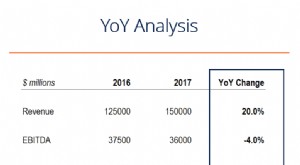 YoY Analysis: Understanding Year-over-Year Growth & Financial Insights
YoY stands for Year over Year and is a type of financial analysisAnalysis of Financial StatementsHow to perform Analysis of Financial Statements. This guide will teach you to perform financial stateme...
-
 Defining Financial Success: Goals & Strategies for a Secure Future
Monetary success is difficult to define in concrete terms. Even though everyone has their own definitions, there is plenty of advice on how to plan for a better financial futu...