
Understanding Markup: Definition, Calculation & Importance
Markup refers to the difference between the selling price of a good or service and its cost. It is expressed as a percentage above the cost. In other words, it is the premium over the total cost of the goodCost of Goods Manufactured (COGM)Cost of Goods Manufactured (COGM) is a term used in managerial accounting that refers to a schedule or statement that shows the total or service that provides the seller with a profitGross ProfitGross profit is the direct profit left over after deducting the cost of goods sold, or cost of sales, from sales revenue. It's used to calculate the gross profit margin..

Image: CFI’s Free Financial Analyst Courses.
Markup Percentage Formula
The formula for calculating markup percentage can be expressed as:
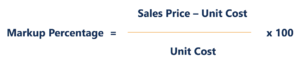
For example, if a product costs $10 and the selling price is $15, the markup percentage would be ($15 – $10) / $10 = 0.50 x 100 = 50%.
Learn more in CFI’s Financial Analysis Fundamentals Course.
Example
John is the owner of a company that specializes in the manufacturing of office computers and printers. He recently received a large order from a company for 30 computers and 5 printers. In addition, the company tasked John with installing software into each of the computers.
The cost per computer is $500 and the cost per printer is $100. The cost of installing the software to run on all the computers is $2,000. If John wants to earn a 20% profit for the order, what would be the price he needs to charge?
Step 1: Calculate the total cost of the order (computers + printers + installation of software). $500 x 30 + $100 x 5 + $2,000 = $17,500 (total cost).
Step 2: Determine the selling price by using the desired percentage of 20%. 20% = (Selling Price – $17,500) / $17,500 therefore Selling price must be: $21,000 (selling price).
Therefore, for John to achieve the desired markup percentage of 20%, John would need to charge the company $21,000.
Download the Free Template
Enter your name and email in the form below and download the free template now!
The Importance of Understanding Markup
Understanding markup is very important for a business. For example, establishing a good pricing strategy is one of the most important tools a profitable business can have. The markup of a good or service must be enough to offset all business expenses and generate a profit.Net Profit MarginNet Profit Margin (also known as "Profit Margin" or "Net Profit Margin Ratio") is a financial ratio used to calculate the percentage of profit a company produces from its total revenue. It measures the amount of net profit a company obtains per dollar of revenue gained.
The Difference Between Markup and Gross Margin
A lot of people use the terms markup and gross margin interchangeably. Although both terms are used to help determine profitabilityProfit MarginIn accounting and finance, profit margin is a measure of a company's earnings relative to its revenue. The three main profit margin metrics, they are different!
Markup is the difference between a product’s selling price and cost as a percentage of the cost. For example, if a product sells for $125 and costs $100, the additional price increase is ($125 – $100) / $100) x 100 = 25%.
Gross marginGross Margin RatioThe Gross Margin Ratio, also known as the gross profit margin ratio, is a profitability ratio that compares the gross profit of a company to its revenue. is the difference between a product’s selling price and the cost as a percentage of revenue. For example, if a product sells for $125 and costs $100, the gross margin is ($125 – $100) / $125 = 0.2(20%) = 20%.
Recall the example above. The gross margin would be ($21,000 – $17,500) / $21,000 = 0.1667 = 16.67%. While the markup was 20%
Intuitively, the markup is always larger, as compared to the gross margin, as shown in the table below. (As long as you charge more than what the product costs.)
Markup Margin 11%10%25%20%66.7%40%100%50%
Markups in Different Industries
Markup percentage varies greatly depending on the industry. In some industries, the increase is a tiny percentage (5%-10%) of the total cost of the product or service, while other industries are able to mark up their products or services by an extraordinarily high amount.
Therefore, there is no “normal” markup percentage that applies to all products, although there may be an average for a particular industry. Learn more about industry analysis in CFI’s Financial Analyst Training ProgramBecome a Certified Financial Modeling & Valuation Analyst (FMVA)®CFI's Financial Modeling and Valuation Analyst (FMVA)® certification will help you gain the confidence you need in your finance career. Enroll today!.
Related Reading
Thank you for reading this CFI guide to Markup. At CFI, our mission is to help anyone in the world become a first-class financial analyst and master the art of financial modelingWhat is Financial ModelingFinancial modeling is performed in Excel to forecast a company's financial performance. Overview of what is financial modeling, how & why to build a model. and valuation. To keep learning and advancing your career, these additional CFI resources will be helpful:
- Net IncomeNet IncomeNet Income is a key line item, not only in the income statement, but in all three core financial statements. While it is arrived at through
- Operating MarginOperating MarginOperating margin is equal to operating income divided by revenue. It is a profitability ratio measuring revenue after covering operating and
- Sales RevenueSales RevenueSales revenue is the income received by a company from its sales of goods or the provision of services. In accounting, the terms "sales" and
- Projecting Income Statement Line ItemsProjecting Income Statement Line ItemsWe discuss the different methods of projecting income statement line items. Projecting income statement line items begins with sales revenue, then cost
-

Margin Calls Explained: Understanding and Avoiding Them
A margin call occurs when the value of a margin account falls below the account’s maintenance margin requirement. It is a demand by a brokerage firm to bring the margin account’s balance u
-

Margin of Safety: A Powerful Investment Principle
The margin of safety is an investment principle where the investor buys stocks when the market price is below their actual value. It is evaluated as the change between the price of a financial in
Accounting
- EBITDA Margin: Definition, Calculation & Importance
- Margin of Safety: Definition, Calculation & Importance
- Segment Margin: Definition, Calculation & Importance | [Your Brand Name]
- Understanding Maintenance Margin: A Guide for Investors
- Margin Trading Explained: Borrowing Money to Invest
- Margin Accounts: Borrowing to Invest & Increase Buying Power
- Margin Debt Explained: Understanding Brokerage Loans for Investing
- Understanding Sellouts in Investing: Non-Economic Forced Liquidations
- Profit Margin Explained: Types & How to Calculate
-
 Understanding Margin Calls: What They Are & How to Respond
A house call is an order by a brokerage firm demanding an account holder to increase the margin account’s equity when it is below the requirement. The call is often preceded by losses in the sec...
-
 Initial Margin Explained: A Comprehensive Guide for Investors
Initial margin refers to the percentage of equity a margin account holder must contribute to the purchase of securitiesPublic SecuritiesPublic securities, or marketable securities, are investments tha...