
EBITDA Margin: Definition, Calculation & Importance
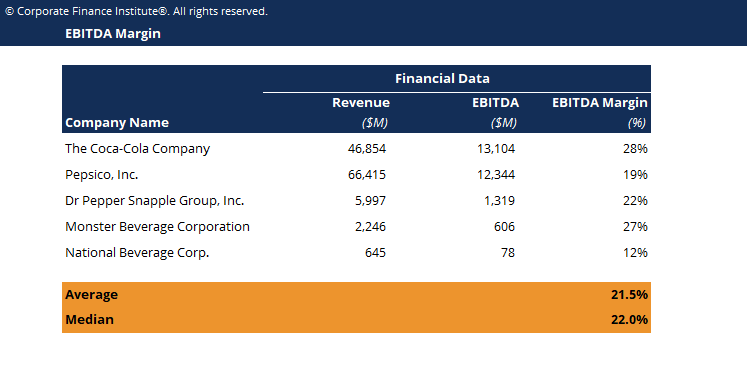
EBITDA margin is a profitability ratio that measures how much in earnings a company is generating before interest, taxes, depreciation, and amortization, as a percentage of revenue. EBITDA Margin = EBITDA / Revenue.
The earnings are calculated by taking sales revenue and deducting operating expenses, such as the cost of goods soldAccountingOur Accounting guides and resources are self-study guides to learn accounting and finance at your own pace. Browse hundreds of guides and resources. (COGS), selling, general, & administrative expenses (SG&A), but excluding depreciation and amortization.
The margin does not include the impact of the company’s capital structure, non-cash expenses, and income taxes. This ratio may be used in conjunction with other leverageLeverage RatiosA leverage ratio indicates the level of debt incurred by a business entity against several other accounts in its balance sheet, income statement, or cash flow statement. Excel template and profitability ratios to evaluate a company. To learn more, launch CFI’s online finance courses now!
Download the Free Template
Enter your name and email in the form below and download the free template now!
What is the Formula for EBITDA Margin?
The first step to calculate EBITDAEBITDAEBITDA or Earnings Before Interest, Tax, Depreciation, Amortization is a company's profits before any of these net deductions are made. EBITDA focuses on the operating decisions of a business because it looks at the business’ profitability from core operations before the impact of capital structure. Formula, examples is to get the earnings before interest and tax (EBIT) from the income statement. The next step is to add back the depreciation and amortization expenses (to learn more, compare EBIT vs EBITDAEBIT vs EBITDAEBIT vs EBITDA - two very common metrics used in finance and company valuation. There are important differences, pros/cons to understand.).
EBITDA = Operating Income (EBIT) + Depreciation + Amortization
To compute the EBITDA ratio the following formula is used:
EBITDA Margin = EBITDA / Net Sales
To learn more, launch our online finance courses now!
Example Calculation
LMN company declared a net profit, before taxes and interest, of $3M for year-end 2015. Net sales reported in the income statement shows an amount of $5M. Depreciation and amortization total $100,000.
Given the figures, the EBITDA margin is calculated as 62%, implying that the remaining 38% of sales revenue accounts for the operating expenses (excluding depreciation and amortization).
The higher the EBITDA margin, the smaller a company’s operating expenses in relation to total revenue, increasing its bottom line and leading to a more profitable operation.
What are the Benefits of Using EBITDA Margin in Determining Business Profitability?
EBITDA margin is considered to be the cash operating profit margin of a business before capital expendituresHow to Calculate CapEx - FormulaThis guide shows how to calculate CapEx by deriving the CapEx formula from the income statement and balance sheet for financial modeling and analysis., taxes, and capital structureCapital StructureCapital structure refers to the amount of debt and/or equity employed by a firm to fund its operations and finance its assets. A firm's capital structure are taken into account. It eliminates the effects of non-cash expenses such as depreciation and amortization. Investors and owners can get a sense of how much cash is generated for every dollar of revenue earned and use the margin as a benchmark in comparing various companies.
EBITDA is widely used in mergers and acquisitionsMergers Acquisitions M&A ProcessThis guide takes you through all the steps in the M&A process. Learn how mergers and acquisitions and deals are completed. In this guide, we'll outline the acquisition process from start to finish, the various types of acquirers (strategic vs. financial buys), the importance of synergies, and transaction costs of small businesses, the middle marketMiddle Market Investment BanksMiddle market investment banks help mid-market firms raise equity, debt, and complete M&A. Here is a list of the top mid-market banks serving mid-size businesses having annual revenues from $10M up to $500M and 100 to 2000 employees., and large public companies. It is not unusual for adjustments to be made to EBITDA to normalize the measurement, allowing buyers to compare the performance of one business to another.
A low EBITDA margin indicates that a business has profitability problems as well as issues with cash flow. On the other hand, a relatively high EBITDA margin means that the business earnings are stable.
To learn more, launch our online finance courses now!
What are the Drawbacks of EBITDA Margin?
Since EBITDA excludes interest on debtCost of DebtThe cost of debt is the return that a company provides to its debtholders and creditors. Cost of debt is used in WACC calculations for valuation analysis., non-cash expenses, capital expenditures, and taxesAccounting For Income TaxesIncome taxes and their accounting is a key area of corporate finance. There are several objectives in accounting for income taxes and optimizing a company's valuation., it does not necessarily provide a clear estimate of what cash flow generation for the business is. As an alternative, investors should look at cash flow from operations on the cash flow statement, or calculate Free Cash Flow (learn more in CFI’s Ultimate Cash Flow GuideThe Ultimate Cash Flow Guide (EBITDA, CF, FCF, FCFE, FCFF)This is the ultimate Cash Flow Guide to understand the differences between EBITDA, Cash Flow from Operations (CF), Free Cash Flow (FCF), Unlevered Free Cash Flow or Free Cash Flow to Firm (FCFF). Learn the formula to calculate each and derive them from an income statement, balance sheet or statement of cash flows).
For companies with high debt capitalization, the EBITDA margin should not be applied, because the larger mix of debt over equity increases interest payments, and this should be included in the ratio analysis for this kind of business.
A positive EBITDA does not necessarily mean a business is generating cash. This is because EBITDA ignores changes in working capital, which is usually needed in growing a business. Additionally, it does not take into account capital expenditures which are needed to replace assets on the balance sheetBalance SheetThe balance sheet is one of the three fundamental financial statements. The financial statements are key to both financial modeling and accounting..
Lastly, EBITDA margin is not recognized in generally accepted accounting principles – GAAP.
Famous investor Warren Buffet has expressed his disinterestWarren Buffett - EBITDAWarren Buffett is well known for disliking EBITDA. Warren Buffett is credited for saying “Does management think the tooth fairy pays for CapEx?" in the use of EBITDA as a valuation methodValuation MethodsWhen valuing a company as a going concern there are three main valuation methods used: DCF analysis, comparable companies, and precedent transactions.
Video Explanation of the EBITDA Margin
Watch this short video to quickly understand the main concepts covered in this guide, including the definition of EBITDA, the formula for EBITDA, and an example of EBTIDA calculation.
More Resources
Thank you for reading this guide to EBITDA margin. To continue advancing your career as a certified Financial Modeling and Valuation Analyst (FMVA),Become a Certified Financial Modeling & Valuation Analyst (FMVA)®CFI's Financial Modeling and Valuation Analyst (FMVA)® certification will help you gain the confidence you need in your finance career. Enroll today! these additional CFI resources will be helpful in your journey:
- Marginal CostMarginal Cost FormulaThe marginal cost formula represents the incremental costs incurred when producing additional units of a good or service. The marginal cost
- Margin of SafetyMargin of Safety FormulaThe margin of safety formula is equal to current sales minus the breakeven point, divided by current sales; the result is expressed as a percentage.
- EBITDA MultipleEBITDA MultipleThe EBITDA multiple is a financial ratio that compares a company's Enterprise Value to its annual EBITDA. This multiple is used to determine the value of a company and compare it to the value of other, similar businesses. A company's EBITDA multiple provides a normalized ratio for differences in capital structure,
- Buying on MarginBuying on MarginMargin trading or buying on margin means offering collateral, usually with your broker, to borrow funds to purchase securities. In stocks, this can also mean purchasing on margin by using a portion of profits on open positions in your portfolio to purchase additional stocks.
-

Margin of Safety: A Powerful Investment Principle
The margin of safety is an investment principle where the investor buys stocks when the market price is below their actual value. It is evaluated as the change between the price of a financial in
-

Margin Trading Explained: Risks, Benefits & How It Works
Margin trading is the act of borrowing funds from a broker with the aim of investing in financial securitiesMarketable SecuritiesMarketable securities are unrestricted short-term financial instru
finance
- EBITDA Explained: Understanding Earnings Before Interest, Taxes, Depreciation & Amortization
- Margin of Safety: Definition, Calculation & Importance
- Segment Margin: Definition, Calculation & Importance | [Your Brand Name]
- Understanding Maintenance Margin: A Guide for Investors
- Margin Trading Explained: Borrowing Money to Invest
- Margin Accounts: Borrowing to Invest & Increase Buying Power
- Margin Debt Explained: Understanding Brokerage Loans for Investing
- Understanding Sellouts in Investing: Non-Economic Forced Liquidations
- Understanding Markup: Definition, Calculation & Importance
-
 Initial Margin Explained: A Comprehensive Guide for Investors
Initial margin refers to the percentage of equity a margin account holder must contribute to the purchase of securitiesPublic SecuritiesPublic securities, or marketable securities, are investments tha...
-
 Margin Calls Explained: Understanding and Avoiding Them
A margin call occurs when the value of a margin account falls below the account’s maintenance margin requirement. It is a demand by a brokerage firm to bring the margin account’s balance u...