
Margin of Safety: Definition, Calculation & Importance
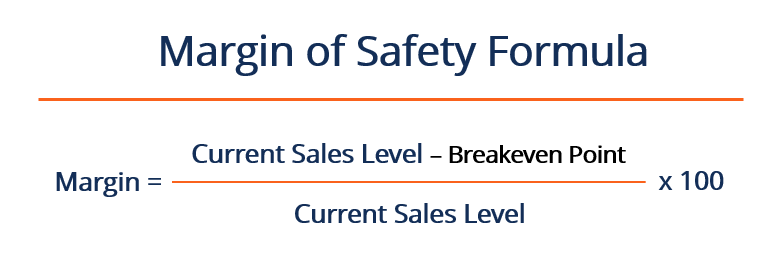
The margin of safety is the difference between the amount of expected profitability and the break-even point. The margin of safety formula is equal to current sales minus the breakeven point, divided by current sales.
Understanding Margin of Safety
There are two applications to define the margin of safety:
1. Budgeting
In budgeting and break-even analysis, the margin of safety is the gap between the estimated sales output and the level by which a company’s sales could decrease before the company becomes unprofitable. It signals to the management the risk of loss that may happen as the business is subjected to changes in sales, especially when a significant amount of sales are at risk of decline or unprofitability.
A low percentage of margin of safety might cause a business to cut expenses, while a high spread of margin assures a company that it is protected from sales variability.
2. Investing
In the principle of investing, the margin of safety is the difference between the intrinsic value of a stock against its prevailing market price. Intrinsic value is the actual worth of a company’s asset or the present value of an asset when adding up the total discounted future income generated.
When applied to investing, the margin of safety is calculated by assumptions, meaning an investor would only buy securities when the market price is materially below its estimated intrinsic value. Determining the intrinsic value or true worth of a security is highly subjective because each investor uses a different way of calculating intrinsic value, which may or may not be accurate.
The fair market price of the security must be known in order to use the discounted cash flow analysis method then to give an objective, fair value of a business.
What is the Margin of Safety Formula?
In accounting, the margin of safety is calculated by subtracting the break-even point amount from the actual or budgeted sales and then dividing by sales; the result is expressed as a percentage.
Margin of Safety = (Current Sales Level – Breakeven Point) / Current Sales Level x 100
The margin of safety formula can also be expressed in dollar amounts or number of units:
Margin of Safety in Dollars = Current Sales – Breakeven Sales
Margin of Safety in Units = Current Sales Units – Breakeven Point
Practical Example
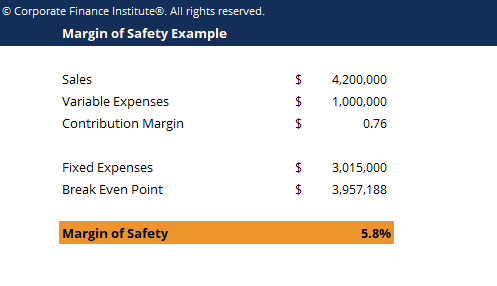
Ford Co. purchased a new piece of machinery to expand the production output of its top-of-the-line car model. The machine’s costs will increase the operating expenses to $1,000,000 per year, and the sales output will likewise augment.
After the machine was purchased, the company achieved a sales revenue of $4.2M, with a breakeven point of $3.95M, giving a margin of safety of 5.8%.
Download the Free Template
Enter your name and email in the form below and download the free template now!
What is the Ideal Margin of Safety for Investing Activities?
The extent of margin of safety depends on investor preference and the type of investment he chooses. Some of the various scenarios an investor may find interest in with a substantial spread of margin are:
- Deep value investing – Buying stocks in seriously undervalued businesses. The main goal is to search for significant mismatches between current stock prices and the intrinsic valueIntrinsic ValueThe intrinsic value of a business (or any investment security) is the present value of all expected future cash flows, discounted at the appropriate discount rate. Unlike relative forms of valuation that look at comparable companies, intrinsic valuation looks only at the inherent value of a business on its own. of these stocks. Such type of investing requires a large amount of margin to invest with and takes lots of guts, as it is risky.
- Growth at reasonable price investing – Choosing companies with positive growth trading rates that are somehow below the intrinsic value.
How Important is the Margin of Safety?
A high safety margin is preferred, as it indicates sound business performance with a wide buffer to absorb sales volatility. On the other hand, a low safety margin indicates a not-so-good position. It must be improved by increasing the selling price, increasing sales volume, improving contribution margin by reducing variable cost, or adopting a more profitable product mix.
For investors, the margin of safety serves as a cushion against errors in calculation. Since fair value is difficult to predict accurately, safety margins protect investors from poor decisions and downturns in the market.
Video Explanation of the Margin of Safety
Below is a short video tutorial that explains the components of the margin of safety formula, why the margin of safety is an important metric, and an example calculation.
Additional Resources
CFI is the official provider of the Financial Modeling and Valuation Analyst (FMVA)®Become a Certified Financial Modeling & Valuation Analyst (FMVA)®CFI's Financial Modeling and Valuation Analyst (FMVA)® certification will help you gain the confidence you need in your finance career. Enroll today! certification, designed to transform anyone into a world-class financial analyst.
Learn more about the use of the margin of safety in these contexts:
- Financial Planning and AnalysisFP&A AnalystBecome an FP&A Analyst at a corporation. We outline the salary, skills, personality, and training you need for FP&A jobs and a successful finance career. FP&A analysts, managers, and directors are responsible for providing executives with the analysis and information they need
- Analysis of Financial StatementsAnalysis of Financial StatementsHow to perform Analysis of Financial Statements. This guide will teach you to perform financial statement analysis of the income statement,
- Valuation MethodsValuation MethodsWhen valuing a company as a going concern there are three main valuation methods used: DCF analysis, comparable companies, and precedent transactions
- Financial Modeling GuideFree Financial Modeling GuideThis financial modeling guide covers Excel tips and best practices on assumptions, drivers, forecasting, linking the three statements, DCF analysis, more
-

Margin Trading Explained: Risks, Benefits & How It Works
Margin trading is the act of borrowing funds from a broker with the aim of investing in financial securitiesMarketable SecuritiesMarketable securities are unrestricted short-term financial instru
-

Variation Margin Explained: A Comprehensive Guide for Futures Traders
The term variation margin refers to a margin payment made by a clearing member to a clearinghouse based on the price movements of futures contractsFutures ContractA futures contract is an agreement to
finance
- EBITDA Margin: Definition, Calculation & Importance
- Segment Margin: Definition, Calculation & Importance | [Your Brand Name]
- Understanding Maintenance Margin: A Guide for Investors
- Margin Trading Explained: Borrowing Money to Invest
- Margin Accounts: Borrowing to Invest & Increase Buying Power
- Margin Debt Explained: Understanding Brokerage Loans for Investing
- Margin of Safety: A Powerful Investment Principle
- Understanding Sellouts in Investing: Non-Economic Forced Liquidations
- Understanding Markup: Definition, Calculation & Importance
-
 Initial Margin Explained: A Comprehensive Guide for Investors
Initial margin refers to the percentage of equity a margin account holder must contribute to the purchase of securitiesPublic SecuritiesPublic securities, or marketable securities, are investments tha...
-
 Margin Calls Explained: Understanding and Avoiding Them
A margin call occurs when the value of a margin account falls below the account’s maintenance margin requirement. It is a demand by a brokerage firm to bring the margin account’s balance u...