
Initial Margin Explained: A Comprehensive Guide for Investors
Initial margin refers to the percentage of equity a margin account holder must contribute to the purchase of securitiesPublic SecuritiesPublic securities, or marketable securities, are investments that are openly or easily traded in a market. The securities are either equity or debt-based.. In other words, initial margin refers to the proportion of the total market value of the securities purchased that must be paid in cash by the investor.
Understanding Initial Margin
An investor that is looking to open a margin accountMargin TradingMargin trading is the act of borrowing funds from a broker with the aim of investing in financial securities. The purchased stock serves as collateral for the loan. The primary reason behind borrowing money is to gain more capital to invest, which is an account that allows investors to purchase securities with borrowed funds, must contribute a certain amount of cash or unmargined securities. The amount is known as the initial margin. Essentially, it is the collateral amount that enables the investor to borrow additional money to purchase securities.
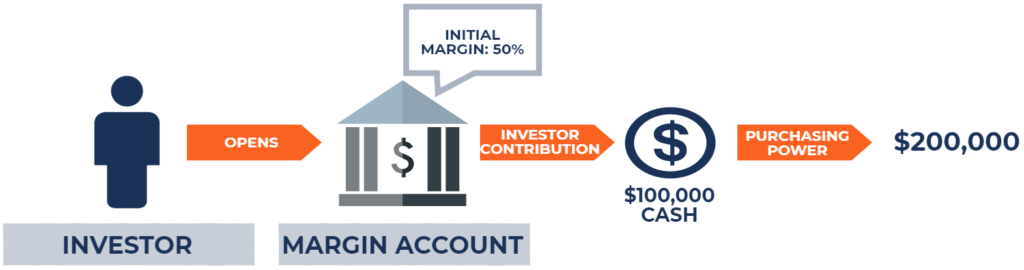
For example, with an initial margin of 50%, a cash contribution of $100,000 in a margin account would allow the investor to borrow up to $100,000 from a broker and have $200,000 in purchasing power. The image below illustrates the example:
Initial Margin in the United States
Regulation T governs the amount of credit that brokers and dealers can provide to investors for the purchase of securities in the United States. In the US, the initial margin is set at 50% of the purchase price of a security. With that said, brokers and dealers may require a higher margin if they deem the investor to be riskier.
Purchasing Power and the Initial Margin
The following formula can be used to determine the purchasing power multiplier given the initial margin percentage:

For example:
- An initial margin of 50% would have a purchasing power multiplier of 2x (1 / 50%). Therefore, an investor who contributes $100,000 in cash would have a total purchasing power of $200,000 ($100,000 x 2) – $100,000 in the investor’s cash and $100,000 in borrowed funds;
- An initial margin of 40% would have a purchasing power multiplier of 2.5x (1 / 40%). Therefore, an investor that contributes $100,000 in cash would have a total purchasing power of $250,000 ($100,000 x 2.5) – $100,000 in the investor’s cash and $150,000 in borrowed funds; and
- An initial margin of 20% would have a purchasing power multiplier of 5x (1 / 20%). Therefore, an investor that contributes $100,000 in cash would have a total purchasing power of $500,000 ($100,000 x 5) – $100,000 in the investor’s cash and $400,000 in borrowed funds.
Practical Example
John is an investor based in the United States who is looking to open a margin account and purchase 100 shares of ABC Company at $50 per share. According to Regulation T, the initial margin requirement is 50%. To purchase 100 shares of ABC Company at $50 per share, how much equity (cash) must John contribute?
To purchase 100 shares of ABC Company at $50 per share, a total market value of $5,000, John must contribute a 50% initial) margin. Therefore, the amount of equity (cash) that John must contribute is $5,000 x 50% =$2,500.
More Resources
CFI is the official provider of the Financial Modeling and Valuation Analyst (FMVA)™Become a Certified Financial Modeling & Valuation Analyst (FMVA)®CFI's Financial Modeling and Valuation Analyst (FMVA)® certification will help you gain the confidence you need in your finance career. Enroll today! certification program, designed to transform anyone into a world-class financial analyst.
To keep learning and developing your knowledge of financial analysis, we highly recommend the additional resources below:
- Buying on MarginBuying on MarginMargin trading or buying on margin means offering collateral, usually with your broker, to borrow funds to purchase securities. In stocks, this can also mean purchasing on margin by using a portion of profits on open positions in your portfolio to purchase additional stocks.
- Options: Puts and CallsOptions: Calls and PutsAn option is a derivative contract that gives the holder the right, but not the obligation, to buy or sell an asset by a certain date at a specified price.
- Trading MechanismsTrading MechanismsTrading mechanisms refer to the different methods by which assets are traded. The two main types of trading mechanisms are quote driven and order driven trading mechanisms
- Investing: A Beginner’s GuideInvesting: A Beginner's GuideCFI's Investing for Beginners guide will teach you the basics of investing and how to get started. Learn about different strategies and techniques for trading
-

Margin Equity Percentage: Understanding Your Brokerage Loan Limits
A brokerage margin account allows an investor to buy stocks and other securities with a portion of the purchase price paid with a margin loan from the broker. A brokerage margin account allow
-
EBIAT Explained: Understanding Earnings Before Interest and Taxes
EBIAT, or Earnings Before Interest After Taxes, is a financial metric that measures a company’s profitability and operating efficiency. The calculation of EBIAT removes the tax benefits gained f
invest
- Initial Margin Explained: What You Need to Know
- EBITDA Margin: Definition, Calculation & Importance
- Margin of Safety: Definition, Calculation & Importance
- Segment Margin: Definition, Calculation & Importance | [Your Brand Name]
- Understanding Maintenance Margin: A Guide for Investors
- Margin Trading Explained: Borrowing Money to Invest
- Margin Accounts: Borrowing to Invest & Increase Buying Power
- Margin Debt Explained: Understanding Brokerage Loans for Investing
- Understanding Sellouts in Investing: Non-Economic Forced Liquidations
-
 Margin Trading Explained: Risks, Benefits & How It Works
Margin trading is the act of borrowing funds from a broker with the aim of investing in financial securitiesMarketable SecuritiesMarketable securities are unrestricted short-term financial instru...
-
 Variation Margin Explained: A Comprehensive Guide for Futures Traders
The term variation margin refers to a margin payment made by a clearing member to a clearinghouse based on the price movements of futures contractsFutures ContractA futures contract is an agreement to...