
Understanding Personal Checks: How They Work & Usage
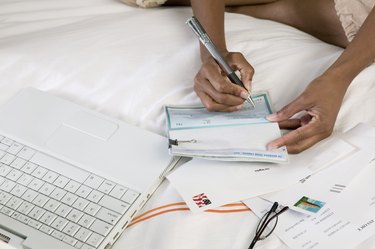
A personal check is a slip of paper that allows you to make payments from your bank account to companies or individuals. You can use it to reimburse a friend, pay your gardener or buy groceries. Unlike an official bank check or a teller's check, there's no guarantee to the recipient when you write it that the money is in your account. The payment doesn't come out of your account immediately, as it would if you paid using a debit card; instead, the check must be presented, processed and accepted.
Features of a Check
The essential features of a personal check identify the check writer and the bank. A check typically contains your name and address and the name of the issuing bank, often with the address and phone number. A personal check also includes:
- the date
- the payee's name after "Pay to the order of"
- the amount written numerically
- the amount written out in words
- additional information on the "Memo" line, if desired
- the signature of the account holder
- along the bottom, the numbers necessary for processing
–
the bank routing number, account number and check number
You can order checks from your bank or online. You typically record the payment information in small register book, but you can also order checks that make carbon copies.
Understanding Your Check Register
Since personal checks are not debited from your account instantaneously, you'll need to keep track of them in a check register. This keeps you apprised of your current balance, so you know how much money you have remaining for other bills and expenditures. A check register includes the following lines:
- the check number
- the date
- the check description
- withdrawals
- a check for reconciling
- deposits
- balance
Personal Check Processing
Some checks never arrive at the bank in paper form at all because the person receiving them deposits them via smartphone. In other cases, a retailer converts them to e-checks at the cash register.
Almost all checks are now cleared electronically, so it's risky to write a check today and deposit the money for it two days later. The entire process often takes less than one day.
Paper to Digital
When paper checks are presented at a bank, the bank sorts them by machine and codes the payment amount electronically. Machines create digital files containing all information on the check, enabling digital processing. Paper checks usually are shredded within months.
Processing at One Bank
If the person writing the check and the recipient have the same bank, the check is called an "on-us" check. The institution simply takes the money out of the issuer's account and credits it to the other party.
Clearinghouse Processing Procedures
When two banks are involved, the check goes to a clearinghouse, such as a Federal Reserve Bank branch or a large commercial bank. If there's enough money in the account and no stop-payment order exists, the check clears. The money comes out of the issuer's account and flows into the recipient's account.
If there's a problem, the clearinghouse informs the bank that accepted the check that it's bad. The bank then informs the customer who presented it. If the reason is insufficient funds, it's called a check that bounced.
As protection against fraud, many businesses require identification before accepting checks, or only take checks from customers living within a certain radius.
-
Understanding Bank Ratings: A Guide to Financial Stability
Bank rating is a measure of financial soundness for banks. Just like credit agencies such as Standard & Poor’s (S&P)S&P – Standard and PoorsStandard & Poor’s is an Am
-
Understanding Float in Banking: Definition & Impact
In banking, float refers to the money that is double counted due to delays in the process of deducting funds from the payer and the depositing of the payee. It is most common in paper checksHow to Wri
budgeting
- What Is the Importance of the Date on a Personal Check?
- Expired Paycheck? Here's What to Do (and What to Expect)
- Personal Bond Explained: Release from Jail Without Bail
- Personal Check vs. Bank Check: Key Differences Explained
- Bank Drafts vs. Checks: Understanding the Key Differences
- Understanding Official Bank Checks: A Comprehensive Guide
- Postdated Checks: Legality, Risks & State Laws Explained
- Understanding Bank Checks: Definition & How They Work
- Understanding Cleared Checks: What You Need to Know
-
 Understanding Bank Loans: Types, Terms & How They Work
Banks don't make money by taking your deposits and holding onto them until you need the cash. They make money largely through loans. A bank loan is an arrangement in which a bank gives you money t...
-
 Bank Drafts: Definition, How They Work & Usage
A bank draft is a convenient and secure instrument for making large payments without having to withdraw cash from one’s account. Bank drafts are guaranteed by financial institutions and can be u...