
Supplier Power: Understanding Its Impact on Business Strategy
The Bargaining Power of Suppliers, one of the forces in Porter’s Five Forces Industry Analysis Framework, is the mirror image of the bargaining power of buyers and refers to the pressure that suppliers can put on companies by raising their prices, lowering their quality, or reducing the availability of their products. This framework is a standard part of business strategyStrategyCorporate and business strategy guides. Read all CFI articles and resources on business and corporate strategy, important concepts for financial analysts to incorporate in their financial modeling and analysis. First mover advantage, Porter's 5 Forces, SWOT, competitive advantage, bargaining power of suppliers.
The bargaining power of the supplier in an industry affects the competitive environmentBarriers to EntryBarriers to entry are the obstacles or hindrances that make it difficult for new companies to enter a given market. These may include and profit potentialNet Profit MarginNet Profit Margin (also known as "Profit Margin" or "Net Profit Margin Ratio") is a financial ratio used to calculate the percentage of profit a company produces from its total revenue. It measures the amount of net profit a company obtains per dollar of revenue gained. of the buyers. The buyers are the companies and the suppliers are those who supply the companies.
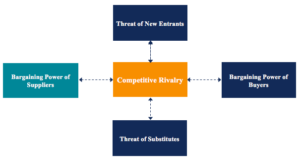
The bargaining power of suppliers is one of the forces that shape the competitive landscape of an industry and help determine the attractiveness of an industry. The other forces include competitive rivalry, bargaining power of buyers, the threat of substitutes, and the threat of new entrantsThreat of New EntrantsThe Threat of New Entrants refers to the threat that new competitors pose to current players within an industry. It is one of the forces that shape the.
Learn more in CFI’s Corporate & Business Strategy Course.
Types of Suppliers
Depending on the industry, there are various types of suppliers. A list of types includes:
- Manufacturers and Vendors: Sell products to distributors, wholesalers, and retailers
- Distributors and Wholesalers: Purchase goods in medium/high quantity for sale to retailers or local distributors
- Independent Suppliers / Independent Craftspeople: Sell unique products directly to retailers or agents
- Importers and Exporters: Purchase products from manufacturers in one country and exportBalance of PaymentsThe Balance of Payments is a statement that contains the transactions made by residents of a particular country with the rest of the world to a distributor in a different country
- Drop shippers: Suppliers of products for different kinds of companies
Determining Factors: Bargaining Power of Suppliers
There are five major factors when determining the bargaining power of suppliers:
- Number of suppliers relative to buyers
- Dependence of a supplier’s sale on a particular buyer
- Switching cost (switching costs of suppliers)
- Availability of suppliers for immediate purchase
- Possibility of forward integration by suppliers
When is Bargaining Power of Suppliers High/Strong?
- Switching costs of buyers are high
- Threat of forward integration is high
- Small number of suppliers relative to buyers
- Low dependence of a supplier’s sale on a particular buyer
- Switching costs of suppliers are low
- Substitutes are unavailable
- Buyer relies heavily on sales from suppliers
When is Bargaining Power of Suppliers is Low/Weak?
- Switching costs of buyers are low
- Threat of forward integration is low
- Large number of suppliers relative to buyers
- High dependence of a supplier’s sale on a particular buyer
- Switching costs of suppliers are high
- Substitutes are available
- Buyer does not rely heavily on sales from suppliers
Purpose of Bargaining Power of Suppliers Analysis
When doing an analysis of supplier power in an industry, low supplier power creates a more attractive industry and increases profit potential, as buyers are not constrained by suppliers. High supplier power creates a less attractive industry and decreases profit potential, as buyers rely more heavily on suppliers.
Learn more in CFI’s Corporate & Business Strategy Course.
Bargaining Supplier Power in the Fast Food Industry
To determine whether McDonald’s faces high or low bargaining power from suppliers in the fast-food industry, consider the following analysis:
- The number of suppliers relative to buyers: There are a significant amount of suppliers relative to buyers (companies). Therefore, supplier power is low.
- Dependence of a supplier’s sale on a particular buyer: If we assume that suppliers have few customers (e.g., a small/medium-sized firm), they are likely to give in to the demands of buyers. On the other hand, if we assume suppliers have several customers, they have more power over buyers. Since we do not know whether these suppliers have few or many buyers, a middle ground would be a reasonable answer. Therefore, supplier power is medium.
- Switching costs: Since there are a significant amount of suppliers in the fast-food industry, switching costs are low for buyers. Supplier power is low.
- Forward Integration: There is low forward integration in the fast-food industry.
Overall, McDonald’s faces low bargaining power of suppliers. Therefore, supplier power is not an issue for McDonald’s in the fast-food industry.
However, the bargaining power of suppliers alone does not determine the overall attractiveness of an industry. The remaining forces (bargaining power of buyers, rivalry among existing competitors, the threat of new entrantsThreat of New EntrantsThe Threat of New Entrants refers to the threat that new competitors pose to current players within an industry. It is one of the forces that shape the, and the threat of substitutes) must be taken into consideration when determining overall industry attractiveness.
More Resources
Thank you for reading this guide on the bargaining power of suppliers. CFI is the official provider of the FMVA Financial Analyst DesignationBecome a Certified Financial Modeling & Valuation Analyst (FMVA)®CFI's Financial Modeling and Valuation Analyst (FMVA)® certification will help you gain the confidence you need in your finance career. Enroll today!, using financial modeling courses to turn anyone into a great financial analyst. To learn more and advance your career, see the following CFI resources:
- Absolute AdvantageAbsolute AdvantageIn economics, absolute advantage refers to the capacity of any economic agent, either an individual or a group, to produce a larger quantity
- Market EconomyMarket EconomyMarket economy is defined as a system where the production of goods and services are set according to the changing desires and abilities of
- MonopolyMonopolyA monopoly is a market with a single seller (called the monopolist) but with many buyers. In a perfectly competitive market, which comprises
- Law of SupplyLaw of SupplyThe law of supply is a basic principle in economics that asserts that, assuming all else being constant, an increase in the price of goods
-
![Guerrilla Marketing: Definition, Tactics & Examples | [Your Brand/Site Name]](https://www.etffin.com/article/uploadfiles/202110/2021100815412062_S.jpeg)
Guerrilla Marketing: Definition, Tactics & Examples | [Your Brand/Site Name]
Guerrilla marketing refers to an advertising strategyAIDA ModelThe AIDA model, which stands for Attention, Interest, Desire, and Action model, is an advertising effect model that identifies the stages
-

Holacracy: A Decentralized Management Approach Explained
Holacracy is an organizational structure that embodies decentralized management where an organization comprises units or teams that work autonomously to achieve company-wide goals.Holacracy aims to di
Business strategy
- Understanding the 5 by 5 Power in Trust Documents: Protection & Flexibility
- Understanding Customer Bargaining Power: Strategies for Businesses
- Earnings Power Value (EPV): A Sustainable Earnings Valuation Method
- Affiliate Marketing: A Comprehensive Guide for Beginners
- Assemble-to-Order (ATO): Definition, Benefits & Implementation
- Buyer Power: Understanding its Impact on Businesses | [Your Brand/Website]
- Bootstrapping: How to Build a Business with Minimal Funding
- Brownfield Investment: Definition, Benefits & Examples
- Porter's Five Forces: A Comprehensive Guide to Competitive Analysis
-
 Franchise Explained: What is a Franchisee and How it Works
A franchisee is a business that operates under an existing business’s trademarks. They purchase the right to use a parent company’s brands, material, and other knowledge to sell the same g...
-
 Greenfield Investment: Definition, Advantages & Examples
In economics, a greenfield investment (GI) refers to a type of foreign direct investment (FDI)Foreign Direct Investment (FDI)Foreign direct investment (FDI) is an investment from a party in one countr...