
Porter's Five Forces: A Comprehensive Guide to Competitive Analysis
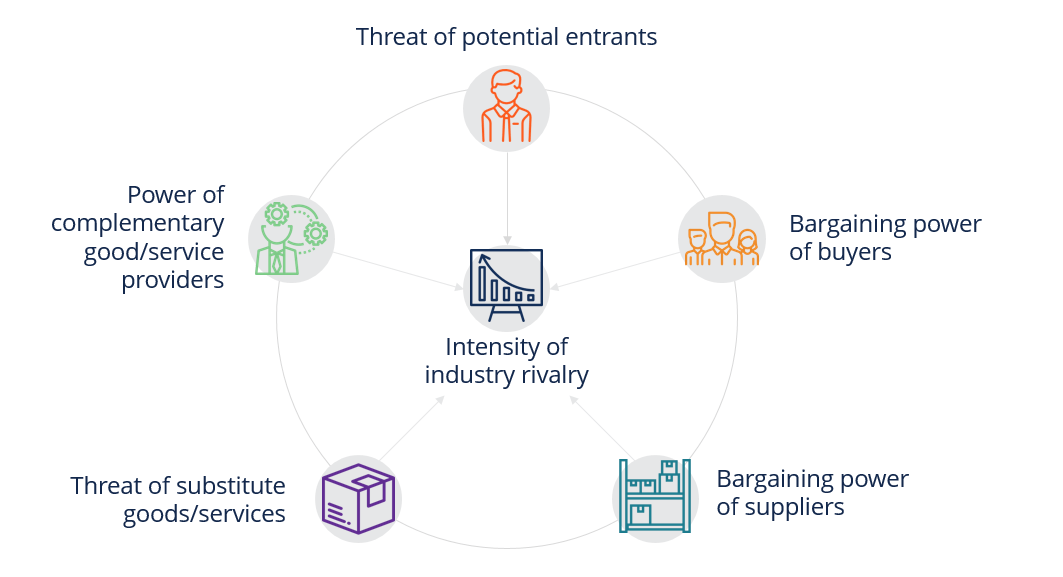
The Competitive Forces Model is an important tool used in strategic analysisStrategic AnalysisStrategic analysis refers to the process of conducting research on a company and its operating environment to formulate a strategy. The definition to analyze the competitiveness in an industry. The model is more commonly referred to as the Porter’s Five Forces Model, which includes the following five forces: intensity of rivalry, threat of potential new entrantsThreat of New EntrantsThe Threat of New Entrants refers to the threat that new competitors pose to current players within an industry. It is one of the forces that shape the, bargaining power of buyersBargaining Power of BuyersThe bargaining power of buyers, one of the forces in Porter’s Five Force Industry Analysis framework, refers to the pressure that customers/consumers can, bargaining power of suppliersBargaining Power of SuppliersThe Bargaining Power of Suppliers, one of the forces in Porter’s Five Forces Industry Analysis Framework, is the mirror image of the bargaining power, and threat of substitute goods and/or services.
In our competitive forces model, we include a sixth force, the power of complementary goods and/or services providers. The model helps a company understand the risks in the industry it is operating in and decide how it wants to execute its strategies in response to competition.
Download this Free Porter’s Five Forces Template from CFI Marketplace.
Intensity of Industry Rivalry
There are multiple factors that can impact the intensity of rivalry within an industry.
- Concentration of rivals – the more competitors, the more intense the rivalry
- Product homogeneity – industries selling very similar products are likely to be more competitive
- Consumer switching costs – if it costs consumers a lot to switch from one company’s product to a competitor’s, the company is likely to face less competition
- Excess production capacity – when there is excess production capacity available in an industry, there is a higher chance of increased rivalry as companies find the industry more attractive to enter
- Brand loyalty – rivalry is high when customers have low brand loyalty
- Network effects – refers to the positive effect on the value of a product when there is an additional user of the product. When a network effect exists, the value of a product or service increases as more people are using it.
Threat of Potential Entrants
The threat of potential entrantsThreat of New EntrantsThe Threat of New Entrants refers to the threat that new competitors pose to current players within an industry. It is one of the forces that shape the is impacted by things such as:
- Brand loyalty
- Cost advantage or economies of scale – The threat of potential entrants tends to be higher when companies can realize economies of scale by mass production
- Switching costs
- Network effects
- Excess production capacity
- Government regulation – industries with strict government regulation pose a higher barrier to potential new entrants
- Barriers to exit – when exiting an industry requires high costs, companies are less likely to enter the industry in the first place
- Investment in specialist equipment – companies also consider the amount of capital that needs to be invested in specialist equipment when entering an industry
- High fixed costs – things such as specialist equipment, properties, and land are examples of high fixed costs
- Specialized skills – when entering an industry requiring specialized skills or techniques, there is a higher barrier to entry for potential entrants
Bargaining Power of Buyers
The bargaining power of buyersBargaining Power of BuyersThe bargaining power of buyers, one of the forces in Porter’s Five Force Industry Analysis framework, refers to the pressure that customers/consumers can is high when:
- Buyers are large or concentrated, so their decisions to purchase a product/service have bigger impacts on the company
- Buyers purchase a large percentage of volume
- Buyers have good information about the product, such as product pricing and demand
Buyers are price-sensitive when:
- There are many industry competitors, giving the buyers more choices with lower prices and better product attributes
- There are many substitutes available
- Switching costs are low, so buyers are indifferent between purchasing products from a company or its rivals
- Product homogeneity is high
Bargaining Power of Suppliers
The bargaining power of suppliersBargaining Power of SuppliersThe Bargaining Power of Suppliers, one of the forces in Porter’s Five Forces Industry Analysis Framework, is the mirror image of the bargaining power is high when:
- Suppliers are large or concentrated
- Suppliers can credibly threaten forward integration in the industry
- Rivals purchase a small percentage of the suppliers’ products
Purchasers’ price elasticity is high when:
- There are few alternative suppliers available
- There are few substitute inputs available
- Switching costs are high for purchasers
Threat of Substitute Goods/Services
Companies are likely to experience a high threat of substitute goods/services when:
- Switching costs are low for customers
- Substitutes have superior pricing relative to the current products
- Substitutes have better attributes or performance characteristics
Power of Complementary Good/Service Providers
Complementary goods or services can add value to the existing products in an industry. However, when complements have unattractive features or do not provide any value to consumers, they can actually become an issue for the industry by slowing growth and limiting profitability.
When developing strategies for a business, decision-makers should consider how they can potentially encourage complement providers to integrate and become a part of the business. Successful integration with complement providers is likely to expand market opportunities and bring profit-enhancing benefits to the business.
More Related Resources
Thank you for visiting our resource on the competitive forces model. To learn more about external analysis and how to perform strategic analysis, enroll in our Corporate & Business Strategy course today!
Additional relevant CFI resources include:
- Bargaining Power of BuyersBargaining Power of BuyersThe bargaining power of buyers, one of the forces in Porter’s Five Force Industry Analysis framework, refers to the pressure that customers/consumers can
- Threat of New EntrantsThreat of New EntrantsThe Threat of New Entrants refers to the threat that new competitors pose to current players within an industry. It is one of the forces that shape the
- External AnalysisExternal AnalysisExternal analysis means examining the industry environment of the company, including factors such as competitive structure, competitive position, dynamics
- All Strategy ResourcesStrategyCorporate and business strategy guides. Read all CFI articles and resources on business and corporate strategy, important concepts for financial analysts to incorporate in their financial modeling and analysis. First mover advantage, Porter's 5 Forces, SWOT, competitive advantage, bargaining power of suppliers
-

Competitive Advantage: Definition & Key Metrics for Business Success
A competitive advantage is an attribute that enables a company to outperform its competitors. This allows a company to achieve superior marginsOperating MarginOperating margin is equal to operating in
-
Understanding the Experience Curve: Cost Reduction & Efficiency
Introduced by the Boston Consulting Group, Experience Curve is a concept that states that there is a consistent relationship between the cumulative production quantity of a company and the cost of pro
Business strategy
- Black-Scholes Model: Understanding Stock Option Pricing
- Understanding the Heath-Jarrow-Morton (HJM) Interest Rate Model
- Heston Model: Understanding Volatility in Financial Options
- 5C Analysis: A Comprehensive Framework for Business Strategy
- Buyer Power: Understanding its Impact on Businesses | [Your Brand/Website]
- Business Model Canvas: A Strategic Planning Tool Explained
- Understanding Competitive Intensity: A Guide for Financial Analysts
- Understanding the Industry Life Cycle: Stages & Dynamics
- McKinsey 7S Model: Understanding Organizational Effectiveness
-
 Supplier Power: Understanding Its Impact on Business Strategy
The Bargaining Power of Suppliers, one of the forces in Porter’s Five Forces Industry Analysis Framework, is the mirror image of the bargaining power of buyers and refers to the pressure that su...
-
 Business Strategy vs. Business Model: Understanding the Difference
Setting up and successfully running a business involves differentiating between business strategy vs business model. To reach their goals and achieve success, owners need to adopt the right strategy f...