
Assemble-to-Order (ATO): Definition, Benefits & Implementation
Assemble-to-order is a manufacturing strategy under which the manufacturer stocks up on sub-assembly parts and inventories and assembles the parts into the final product when a customer places an order. The strategy relies on the ability of the company to assemble and deliver goods quickly.

How Does It Work
In an assemble-to-order strategy, the manufacturer forecasts orders for the goodsProducts and ServicesA product is a tangible item that is put on the market for acquisition, attention, or consumption while a service is an intangible item, which arises from based on historical data, macroeconomic trends, and the overall condition of the market. Based on the forecasts, the manufacturer orders and stocks up on sub-assembly parts of the finished goods.
A customer then places an order, which can be customizable since the good is not finished. Based on the specific order, the manufacturer assembles the sub-assembly parts into the finished product that is delivered to the customer.
An assemble-to-order strategy is essentially a combination of the make-to-order and make-to-stock production strategies.
1. Make-to-order
The make-to-order strategy involves ordering parts and assembling them based on the specific orders placed by customers and takes a longer time to deliver the final good to the customer.
2. Make-to-stock
The make-to-stock strategy involves stocking up on inventory of the final good based on demand forecasts. However, the cost of holding large quantities of unsold inventory tends to be high – and so does the risk.
The assemble-to-order method combines the two strategies above to form a more efficient way to deliver customized goods, without incurring the extra costs of storing finished inventory.
Advantages of the Assemble-to-Order Strategy
1. Lower capital costs
By reducing storage and inventory needs, the assemble-to-order strategy substantially reduces capital costs, such as warehousing and investment in materials and raw supplies. It allows the manufacturer to adopt a lean business model, with fewer sunk costsSunk CostA sunk cost is a cost that has already occurred and cannot be recovered by any means. Sunk costs are independent of any event and should not.
2. Customizability of orders
Manufacturers often face a rising demand for customized goods from customers, and such needs cannot be met if they stock up on finished goods. The assemble-to-order strategy allows customers to order a customized product by keeping a variety of sub-assembly parts in stock, which can be put together to produce a unique finished good.
3. Quick delivery times, even with customization
The assemble-to-order method allows for quicker delivery times by keeping all the parts ready and taking time only for the final assembly. By optimizing final assembly times, manufacturers can deliver customized goods relatively quicker than if they were using the make-to-order strategy.
Disadvantages of the Assemble-to-Order Strategy
1. Unreliability of forecasts
Manufacturers using assemble-to-order stock up on sub-assembly parts based on historical sales data used to forecast demand. However, the forecasts do not account for demand shocks that can occur over time. It may lead to a shortage of inventory parts in case of unusually high demand and a surplus of parts in case of unusually low demand.
2. Management of sub-assembly parts
Manufacturers must monitor and exert control over the inventories of sub-assembly parts, and this may increase operational costs and lead to lower efficiency. It is important to monitor the status of inventories in order to achieve a smooth and streamlined supply chainSupply ChainSupply chain is the entire system of producing and delivering a product or service, from the very beginning stage of sourcing the raw materials to the final in times of higher demand.
3. Dependence on the quality of the final assembly
The assemble-to-order method places the most importance on the final assembly process since that determines the quality of the finished good. Therefore, manufacturers must ensure that workers who work on the final assembly are trained and efficient so that customers are satisfied.
Examples of Assemble-to-Order Strategy
- Consider a multi-national company that sells customizable smoothies. In order to avoid stocking up on finished smoothies that may perish over time, the company uses an assemble-to-order strategy whereby they stock up on all the ingredients but assemble the finished product (i.e., smoothie) when the customer places an order. Companies such as Body Energy Club (US) and Booster Juice (Canada) rely on such a business model.
- Dell Technologies follows an assemble-to-order business model for personal computers and laptops, whereby they allow customers to choose from a range of options for each part of the PC, including CPUs, monitors, processors, and other software and hardware. Once the customer places the order, the PC is assembled and shipped for delivery.
More Resources
CFI offers the Commercial Banking & Credit Analyst (CBCA)™Program Page - CBCAGet CFI's CBCA™ certification and become a Commercial Banking & Credit Analyst. Enroll and advance your career with our certification programs and courses. certification program for those looking to take their careers to the next level. To keep learning and advancing your career, the following CFI resources will be helpful:
- BackorderBackorderA backorder occurs when a consumer, either an individual or a company, purchases an item and the item is "out of stock". A stockout occurs when demand
- Cost of Goods Manufactured (COGM)Cost of Goods Manufactured (COGM)Cost of Goods Manufactured (COGM) is a term used in managerial accounting that refers to a schedule or statement that shows the total
- Inventory ShrinkageInventory ShrinkageInventory shrinkage occurs when the number of products in stock are fewer than those recorded on the inventory list. The discrepancy may
- Value ChainValue ChainA value chain is all the activities and processes within a company that help add value to the final product. In today’s business landscape, companies across
-

Martingale Strategy: Understanding Risk & Application
The Martingale Strategy involves doubling the trade size every time a loss is faced. A classic scenario for the strategy is to try and trade an outcome with a 50% probability of it occurring. The scen
-
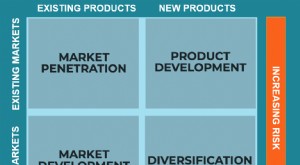
Ansoff Matrix: Strategic Growth Planning Explained
The Ansoff Matrix, also called the Product/Market Expansion Grid, is a tool used by firms to analyze and plan their strategies for growthSustainable Growth RateThe sustainable growth rate is the rate
Business strategy
- Financial Strategy: A Comprehensive Guide to Achieving Your Goals
- Trading Strategies: A Comprehensive Guide to Profitable Investing
- Vanilla Strategy: Definition, Benefits & Investment Approaches
- Assemble-to-Order (ATO): Definition, Benefits & Implementation
- Business Strategy vs. Business Model: Understanding the Difference
- Corporate Strategy: A Comprehensive Overview | [Your Company Name]
- Exit Strategy: A Comprehensive Guide for Business Owners
- Strategic Analysis: A Comprehensive Guide for Business Success
- Strategic Planning: A Comprehensive Guide to Long-Term Success
-
 Aggressive Investment Strategies: Risk, Reward & Suitability
An aggressive investment strategy is a high-risk, high-reward approach to investing. Such a kind of strategy is appropriate for younger investors or those with higher risk toleranceRisk ToleranceRisk ...
-
 Collar Option Strategy: A Comprehensive Guide for Risk Management
A collar option strategy, also referred to as a hedge wrapper or simply collar, is an optionsOptions: Calls and PutsAn option is a derivative contract that gives the holder the right, but not the obli...