
Choosing the Right Organizational Structure for Your Business
Organizational structures are essentially blueprints that reveal how companies are run and managed and how information is passed within the organization. An organizational structure is literally a chart or diagram that depicts the logistical organization of a company.

Finding the most appropriate organizational structure for a business depends on a number of factors. Below are three of the most important factors to consider in choosing among the best organizational structures for a business:
- The industry the company fits into
- The overall size of the company
- The company’s goals (what it hopes to achieve, whether that be in terms of finances or how the company intends to be of service to its customers)
Summary:
- Organizational structures are essentially blueprints that reveal how companies are run and how information is passed within the organization.
- Traditional line organizational structures are simplistic but rigid. It can take a good deal of time for information to pass through the company, with each link reporting to ONE direct supervisor. Such a structure is best suited to smaller companies.
- Functional organizational structures are similar to line structures; however, each tier may share information and offer direction horizontally (to one another). This structure is ideal for large companies with many departments and for those companies that need to meet strict deadlines.
Types of Organizational Structures
1. Traditional
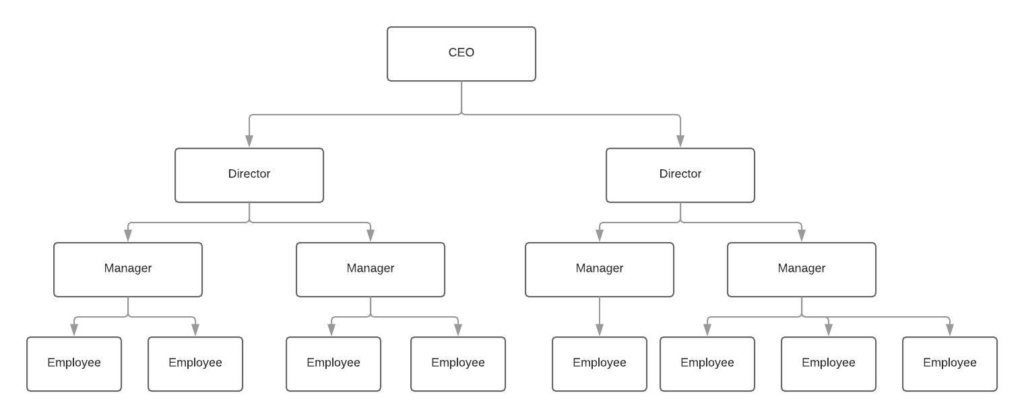
A traditional line organizational structure is truly the place to start for most companies, especially the smaller ones that don’t necessarily comprise a vast number of departments or require a major number of links in the chain of command/communication. The image above is an example of what a traditional line organizational structure looks like.
With the traditional structure, simplicity is the primary distinguishing feature. It is a top-down approach. Direction and communication start with the head of the company (in this example, the company is led by the chief executive officerCEOA CEO, short for Chief Executive Officer, is the highest-ranking individual in a company or organization. The CEO is responsible for the overall success of an organization and for making top-level managerial decisions. Read a job description). The next tier or link in the chain is a director. This is the individual (or office) that oversees a department or segment of the company. Finally, within each department, there are managers and employees.
With the traditional line organizational structure, the process of communicating information is very much narrowly focused. All information starts at the top and is passed down, typically from one individual to the next. While the practice keeps things simple, it’s a rather rigid organizational structure and, because there is no horizontal sharing of information, it can take a substantial amount of time to process information throughout the company. The traditional organizational structure is best suited to small businesses that, again, comprise a fairly small number of departments and a limited number of employees.
2. Functional
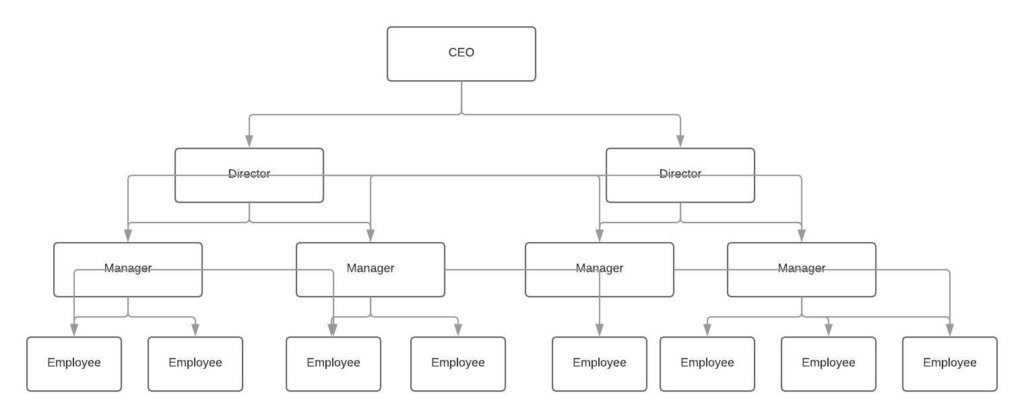
The image above reveals what a functional organizational structure looks like. It differs from the traditional line structure by means of the existence of established channels for the horizontal sharing of information and direction, with a substantial increase in the sheer number of lines of communicationCommunicationBeing able to communicate effectively is one of the most important life skills to learn. Communication is defined as transferring information to produce greater understanding. It can be done vocally (through verbal exchanges), through written media (books, websites, and magazines), visually (using graphs, charts, and maps) or non-verbally.
With the traditional structure, individual employees communicate directly with their immediate supervisors. With the functional structure, however, employees often communicate with individuals whose control they don’t fall immediately under.
The functional type of organizational structure is ideal for larger companies with a lot of departments and for companies that need to meet short timeframe deadlines.
3. Project-based
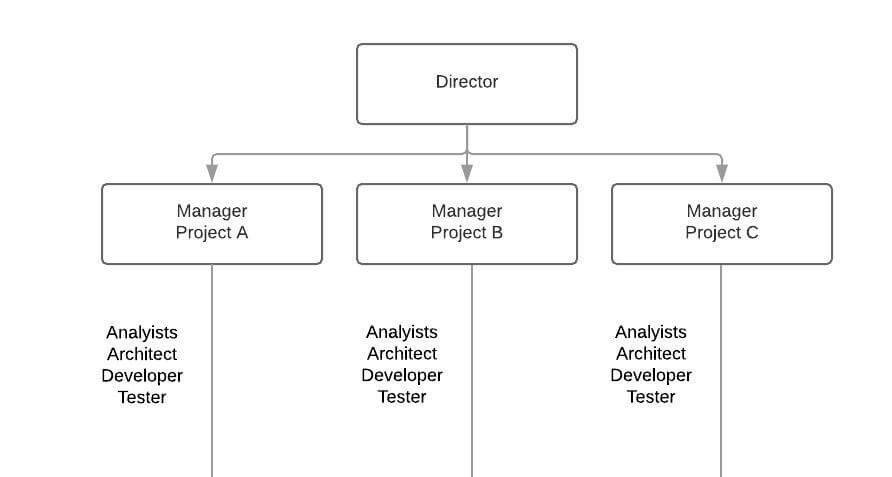
One final organizational structure to look at is the project-based structure. It breaks a company up into groups based upon the projects it needs to complete. There is, of course, a primary leader – the director. Then, there is a manager appointed to oversee the team assigned to complete each project.
The project-based structure features the best of both the traditional line and functional organizational structures: it’s simple, with the first tiers answering only to a direct supervisor. The final tier is the team responsible for completing whatever project is set before them. However, each member of the team can easily get information and assistance from the other members.
Related Readings
CFI offers the Financial Modeling & Valuation Analyst (FMVA)™Become a Certified Financial Modeling & Valuation Analyst (FMVA)®CFI's Financial Modeling and Valuation Analyst (FMVA)® certification will help you gain the confidence you need in your finance career. Enroll today! certification program for those looking to take their careers to the next level. To keep learning and advancing your career, the following CFI resources will be helpful:
- Board of DirectorsBoard of DirectorsA board of directors is a panel of people elected to represent shareholders. Every public company is required to install a board of directors.
- Key Performance Indicators (KPIs)Key Performance Indicators (KPIs)Key Performance Indicators (KPIs) are metrics used to periodically track and evaluate the performance of an organization toward the achievement of specific goals. They are also used to gauge the overall performance of a company
- How to Assess Effective ManagementHow to Assess Effective Management?Management is an integral part of any organization. How well an organization is managed under specific circumstances can make or break it. Hence, effective and efficient management is the sole reason for any organization’s success.
- Types of OrganizationsTypes of OrganizationsThis article on the different types of organizations explores the various categories that organizational structures can fall into. Organizational structures
-

LLC Tax Benefits: Maximize Your Savings & Business Growth
A limited liability company (LLC) is a type of business structure that combines some of the benefits of other kinds of businesses. An LLC is the most common type of business — 35% of all businesses us
-

Top College Savings Plans: Secure Your Future Education
I sure wish my family opened a 529 college savings plan for me when I was a kid. When I graduated from college in 2010, I owed more than $60,000 in student loans, which took me t
Business strategy
- Business Operations: Definition, Activities & Optimization
- Understanding Business Structures: A Comprehensive Guide
- Understanding Business Structures: A Comprehensive Guide
- Top Retirement States: Best Places to Live in Retirement for 2024
- Top 13 Business Ideas for Women: Start Your Entrepreneurial Journey
- Top Payment Gateways for Businesses: A Comprehensive Guide
- Inventory Management for Small Businesses: A Comprehensive Guide
- Beginner-Friendly Stocks: A Guide for New Investors
- Best Payday Loan Alternatives: Smart Financial Solutions
-
 Understanding Key Risks Facing Banks: A Comprehensive Overview
Major risks for banks include credit, operational, market, and liquidity risk. Since banksFinancial IntermediaryA financial intermediary refers to an institution that acts as a middleman between two p...
-
 Understanding Uniform Rules for Collections (URC): A Comprehensive Guide
The Uniform Rules for Collections is a set of rules that help assist in the process of collecting debtsCurrent DebtOn a balance sheet, current debt is debts due to be paid within one year (12 months) ...