
Understanding Business Structures: A Comprehensive Guide
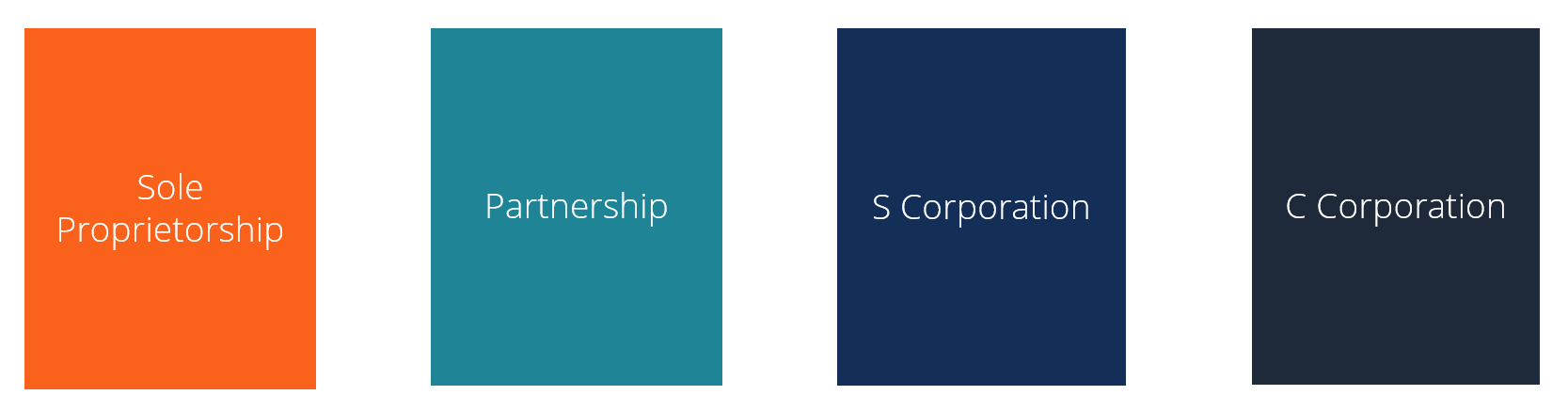
There are different types of businesses to choose from when forming a company, each with its own legal structure and rules. Typically, there are four main types of businesses: Sole ProprietorshipsSole ProprietorshipA sole proprietorship (also known as individual entrepreneurship, sole trader, or proprietorship) is a type of an unincorporated entity that is owned only, Partnerships, Limited Liability Companies (LLC)Limited Liability Company (LLC)A limited liability company (LLC) is a business structure for private companies in the United States, one that combines aspects of partnerships and corp, and CorporationsCorporationA corporation is a legal entity created by individuals, stockholders, or shareholders, with the purpose of operating for profit. Corporations are allowed to enter into contracts, sue and be sued, own assets, remit federal and state taxes, and borrow money from financial institutions.. Before creating a business, entrepreneursEntrepreneurAn entrepreneur is a person who starts, designs, launches, and runs a new business. Instead of being an employee and reporting to a supervisor should carefully consider which type of business structure is best suited to their enterprise.
This article will provide a quick overview of these four basic types of businesses to help entrepreneurs make one of their most important decisions.
Corporate Finance Institute offers financial analyst training that you can apply to manage the financials of your business. Check out our Financial Modeling & Valuation Analyst (FMVA)® certification programBecome a Certified Financial Modeling & Valuation Analyst (FMVA)®CFI's Financial Modeling and Valuation Analyst (FMVA)® certification will help you gain the confidence you need in your finance career. Enroll today!!

#1 Sole Proprietorship
A sole proprietorship is an unincorporated company that is owned by one individual only. While it is the most simple of the types of businesses, it also offers the least amount of financial and legal protection for the owner. Unlike partnerships or corporations, sole proprietorships do not create a separate legal identity for the business. Essentially, the owner of the business shares the same identity as the company. Therefore, the owner is fully liable for any and all liabilitiesLiabilityA liability is a financial obligation of a company that results in the company’s future sacrifices of economic benefits to other entities or businesses. A liability can be an alternative to equity as a source of a company’s financing. incurred by the company.
An entrepreneur may choose this option if they want to retain full control of the company. Additionally, it is a relatively easy and inexpensive process to establish a sole proprietorship. There are also tax benefits, as income is considered the owner’s personal incomeTaxable IncomeTaxable income refers to any individual's or business’ compensation that is used to determine tax liability. The total income amount or gross income is used as the basis to calculate how much the individual or organization owes the government for the specific tax period. and therefore only taxed once. Finally, there are relatively few regulation requirements for sole proprietorships.
#2 Partnership
As the name states, a partnership is a business owned by two or more people, known as partners. Like sole proprietorships, partnerships are able to take advantage of flow-through taxation. This means that the income is treated as the owners’ incomes so it is only taxed once. Owners in partnerships are responsible for the liabilities of the firm. However, there are some nuances to this. There are different types of partnerships: general partnerships, limited partnerships, and limited liability partnerships.
General PartnershipsGeneral PartnershipA General Partnership (GP) is an agreement between partners to establish and run a business together. It is one of the most common legal entities to form a business. All partners in a general partnership are responsible for the business and are subject to unlimited liability for business debts.: This is the easiest type of partnership to form, with few upkeep costs. Every partner is considered as participating in the operations of the business, and there is unlimited liability for every partner. This means that every partner’s personal assets can be used to repay the liabilities of the partnership. This also means that each partner is responsible for every other partner’s actions.
For example, John and Dave are in a general partnership. If John is sued for malpractice, Dave’s personal assets may also be claimed against in the lawsuit.
Limited Partnerships: This type of partnership has at least one general partner. This general partner takes on unlimited liability for the partnership and manages the operations of the company. Additionally, there are also limited partners in limited partnerships. Limited partners only take on as much liability as their financial stake in the business. However, as limited partners, they are not involved in management decisions and do not have any direct control over the company.
Limited Liability Partnerships (LLP): LLPs are similar to general partnerships, where multiple partners are each responsible for the operations of the business. However, partners in LLPs are not personally responsible for the actions of other partners or the debts of the business. Unfortunately, not all businesses can be LLPs. This type of business is often restricted to certain professions, such as lawyers or accountantsAccountantAn accountant plays a very crucial role in an organization, regardless of whether it is a multinational company or a small, domestic one..
In general, as compared to other types of businesses, partnerships offer more flexibility but also have greater exposure to risk.
#3 Limited Liability Company (LLC)
Limited liability companies (LLCs) are one of the most flexible types of businesses. LLCs combine aspects of both partnerships and corporations. They retain the tax benefits of sole proprietorships and the limited liability of corporations. LLCs are able to choose between different tax treatments. As long as the LLC chooses not to be treated as a C corporation, it retains its flow-through taxation status.
Additionally, LLCs benefit from limited liability status. In LLCs, the company exists as its own legal entity. This protects the owners of the LLCs from being personally liable for the operations and debts of the business.
#4 Corporation
Corporations are a separate legal entity created by shareholders. Incorporating a business protects owners from being personally liable for the company’s debts or legal disputes. A corporation is more complicated to create, as compared to the other three types of businesses. Articles of incorporation must be drafted, which include information such as the number of sharesDiluted Shares OutstandingFully diluted shares outstanding is the total number of shares a company would have if all dilute securities were exercised and converted into shares. to be issued, the name and location of the business, and the purpose of the businessMission StatementA mission statement defines what line of business a company is in, and why it exists or what purpose it serves..
In sole proprietorships and partnerships, if one of the owners passes away or declares bankruptcy, the company is dissolved. Corporations exist as a legally separate entity. Therefore, they are protected from this situation and will continue to exist even if the owner of the business passes away.
There are three main types of corporations:
C Corporation: This is the most common form of incorporation. The corporation is taxed as a business entity and owners receive profits that are then also taxed individually.
S Corporation: This is similar to a C corporation but may only consist of up to 100 shareholders. S corporations are pass-through entities like partnerships, so profits are not taxed twice.
Non-Profit Corporation: Often used by charitable organizations, non-profit corporations are tax exempt. All forms of incoming cash flow must be utilized to spend on the organization’s operations or future plansNon-Profit Business PlanA non-profit business plan is simply a roadmap of the non-profit organization that outlines its goals and objectives, how it can achieve its stated purpose.
Thinking of starting a company? Corporate Finance Institute’s corporate strategy course teaches tactics and strategies in running a successful business!
Examples of Types of Businesses
Many businesses begin as sole proprietorships, as this type of business is great for many new, small businesses. As they grow and expand, many businesses tend to convert to corporations. eBay is a very famous example of a sole proprietorship that eventually converted into a corporation.
Hewlett-Packard (HP) is an example of an incredibly successful and famous partnership. Like eBay, as they grew, they eventually incorporated in 1947. However, the company began as a business partnership between two friends.
Chrysler is one of the largest automobile manufacturers in the United States. Since its inception, Chrysler has maintained its status as a limited liability corporation (LLC).
Finally, among the most famous of companies is Apple. Like most large companies that are listed on stock exchanges, Apple, otherwise known as Apple Inc., was incorporated soon after the company began its operations. To this day, Apple remains one of the largest companies in the world. It has continued to exist despite one of its co-founders, Steve Jobs, passing away.
Additional Resources
Proper financial management is the backbone of any business. Corporate Finance Institute offers resources that will help you expand your knowledge, advance your career, and manage the financials of your company, as well as your personal financials. Check out the CFI resources below to learn more:
- Financial Modeling & Valuation Analyst (FMVA)® Certification ProgramBecome a Certified Financial Modeling & Valuation Analyst (FMVA)®CFI's Financial Modeling and Valuation Analyst (FMVA)® certification will help you gain the confidence you need in your finance career. Enroll today!
- Corporate & Business Strategy
- Three Financial Statements SummaryThree Financial StatementsThe three financial statements are the income statement, the balance sheet, and the statement of cash flows. These three core statements are
- Budgeting and Forecasting
-

Understanding Company Bylaws: A Comprehensive Guide
Company bylaws are the rules that govern how a company is run and one of the first items to be established by the board of directorsBoard of DirectorsA board of directors is a panel of people elected
-

Divestiture Explained: Definition, Types & Examples
A divestiture (or divestment) is the disposal of company’s assets or a business unit through a sale, exchange, closure, or bankruptcyBankruptcyBankruptcy is the legal status of a human or a
Business strategy
- Understanding Bank Drafts: Types, Security & How They Work
- Income Statement Limitations: Understanding What Your Profit & Loss Report Doesn't Show
- Understanding Corporate Stock Classes: Common vs. Preferred
- Understanding Security Types: A Comprehensive Guide
- Understanding Asset Types: A Comprehensive Guide
- Understanding Liability Types: Current, Non-Current & Contingent
- Business Operations: Definition, Activities & Optimization
- Understanding Life Insurance Types: Term vs. Whole Life & More
- Essential Business Metrics: 35 KPIs to Drive Growth & Profitability
-
![Strategic Alliances: Definition, Benefits & Examples | [Your Brand/Website Name]](https://www.etffin.com/article/uploadfiles/202110/2021100815415960_S.jpeg) Strategic Alliances: Definition, Benefits & Examples | [Your Brand/Website Name]
Strategic Alliances: Definition, Benefits & Examples | [Your Brand/Website Name]Strategic alliances are agreements between two or more independent companies to cooperate in the manufacturing, development, or sale of products AccountingOur Accounting guides and resources are self-...
-
 Strategic Management: Definition, Objectives & Implementation
Strategic management is the formulation and implementation of major objectives and projects, by an organization’s management on behalf of its shareholders (or owners).ShareholderA shareholder ca...