
Business Operations: Definition, Activities & Optimization
Business operations refer to activities that businesses engage in on a daily basis to increase the value of the enterprise and earn a profit. The activities can be optimized to generate sufficient revenuesRevenueRevenue is the value of all sales of goods and services recognized by a company in a period. Revenue (also referred to as Sales or Income) to cover expenses and earn a profit for the owners of the business. Employees help accomplish the business’ goals by performing certain functions such as marketing, accountingAccountingAccounting is a term that describes the process of consolidating financial information to make it clear and understandable for all, manufacturing, etc.
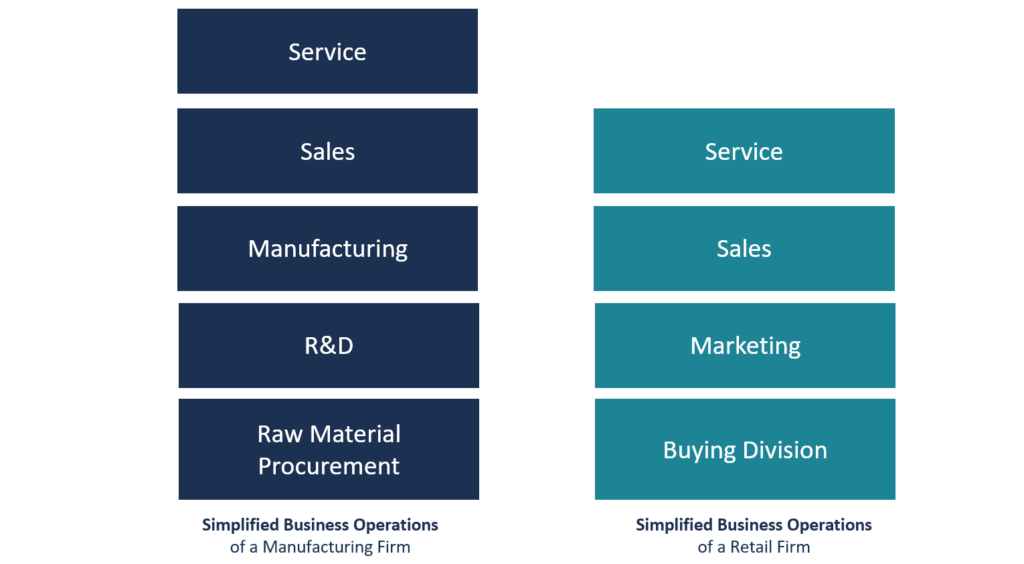
Business operations evolve as the business grows, and the management should plan to accommodate the changes to prevent glitches occurring in the system. For example, as a small businessSmall and Medium-sized Enterprises (SMEs)SMEs, or small and medium-sized enterprises, are defined differently around the world. The country a company operates in provides the grows, it must be ready to handle arising challenges such as legal, marketing, and capacity issues. If the business does not evolve with the changes in business operations, glitches such as errors and omissions will emerge.
Business Operations in Different Industries
The operations of a business vary across industries, and they are structured according to the requirements of the specific industries. Mastering the operations of a specific industry can help the business achieve success. Here is an analysis of business operations in different industries:
1. Retail industry
One of the main goals of a retail business is to stock products that customers are looking for and at a price that the customers are willing to pay. This means that the business must maintain an efficient inventory system so that it knows what is in stock at any given time, while reducing instances of dead stock. Deadstock refers to products that the company has in stock but that are not in high demand.
In order to maximize revenues, the business should stock fast-moving itemsFast-Moving Consumer Goods (FMCG)Fast-moving consumer goods (FMCG), also called consumer packaged goods (CPG), refer to products that are highly in-demand, sold quickly, and affordable that customers are willing and happy to pay for. The business should also negotiate friendly credit terms with suppliers so that they can get the required products on credit to prevent stock-outs.
2. Service industry
The business operations of a service business are divided into the front-end and back-end side of the business. The management must ensure that the two divisions are running efficiently to prevent laxity on one side, which can hinder the achievement of the company’s objectives. On the front end, the business should focus on streamlining the service delivery to customers to increase their satisfaction. It should also formulate a means of receiving feedback and complaints from customers to know their expectations and how to improve service delivery.
On the back end, the management should employ the right people in each department. For example, the company should appoint trained and experienced staff to prepare forecasts for client projects to prevent the actual costs from exceeding client budgets.
3. Manufacturing industry
Manufacturing companies are involved in turning raw materials into physical products, which are then sold to consumers. One of the things that a manufacturing company can do to achieve efficiency is to source quality raw materials from credible suppliers. For perishable and edible products, the business should look into how raw materials are stored, processed, and shipped to consumers.
The company can also eliminate bottlenecks that increase processing times to save time during manufacturing and shipping. If the company is struggling with shipping logistics, it can outsource shipping and concentrate on other areas of the business that it excels in.
4. Technology industry
The key to streamlining operations of a technology company is hiring the right staff and training them on how to execute the tasks they are assigned. This means that the company should put a hiring criterion in place that helps them hire the best candidates for the job. The company should also come up with an internal training and mentorship program where senior staff works hand-in-hand with junior staff to help them perfect their skills.
Another way of increasing efficiency is by collaborating the different tools such as apps, websites, and systems that the company uses. The company’s management should continually monitor internal and external processes to spot any glitches and address these issues quickly.
How to Improve Business Operations
The following are some suggestions that businesses can use to improve business operations:
1. Measure performance
A business should come up with realistic and actionable means of measuring its business milestones. The process of measuring performance starts from the goal-setting stage. The company’s management should set achievable objectives with clear targets. For example, the goal of achieving a 30% increase in revenues is more actionable than setting a goal to make more money in the next financial period. The company should then implement a measurement system that determines how well the business is doing against the goal targets.
2. Keep up with the latest trends
A business should stay up to date with what happens in the industry to get ideas on how to get better than the competition. Trends can take the form of new innovation, changing state and federal laws, or changes in the local economy. Knowing the latest trends and changes in operations can help the company find new systems that improve performance and cut costs, or that help the company stay compliant with new regulations.
3. Streamline processes
Another way of improving business operations is to evolve with changes in the industry to increase productivity. The management should continually be on the lookout for new tools, software, and equipment that improve and ease critical processes.
For example, where the business uses manual methods to manage inventory, the management can acquire an inventory management software program that automates most of the processes and saves both time and costs.
Related Readings
CFI offers the Financial Modeling & Valuation Analyst (FMVA)™Become a Certified Financial Modeling & Valuation Analyst (FMVA)®CFI's Financial Modeling and Valuation Analyst (FMVA)® certification will help you gain the confidence you need in your finance career. Enroll today! certification program for those looking to take their careers to the next level. To keep learning and advancing your career, the following CFI resources will be helpful:
- Current Good Manufacturing Processes (CGMP)Current Good Manufacturing Practices (CGMPs)Current Good Manufacturing Practices (CGMPs) refers to the regulations provided by the US Food and Drug Administration (FDA) that guide the design,
- LogisticsLogisticsLogistics, or logistical planning, refers to the process that a business uses in order to coordinate its supply chain operations. It includes a wide variety
- Operations ManagementOperations ManagementOperations management is a field of business concerned with the administration of business practices to maximize efficiency within the organization. It
- Supply ChainSupply ChainSupply chain is the entire system of producing and delivering a product or service, from the very beginning stage of sourcing the raw materials to the final
-

Understanding Voting Shares: Your Right to Participate in Company Decisions
Voting shares are shares of a company that entitle the shareholder to vote on key issues of the company. It is generally one vote per share. The shares represent an ownership interest in a corporation
-

Understanding American Depository Receipts (ADRs) | Investment Guide
American Depository Receipts (ADRs) are stocksStockWhat is a stock? An individual who owns stock in a company is called a shareholder and is eligible to claim part of the company’s residual asse
Business strategy
- Understanding Company Bylaws: A Comprehensive Guide
- Divestiture Explained: Definition, Types & Examples
- Understanding Earnings: A Guide to Financial Profitability
- Discontinued Operations: Definition & Accounting Treatment
- Understanding Affiliated Companies: Definition & Key Differences
- Company Recovery Strategies: Preventing Business Shutdowns
- Exit Strategies: Planning Your Business's Future
- Strategic Alliances: Definition, Benefits & Examples | [Your Brand/Website Name]
- Understanding Business Structures: A Comprehensive Guide
-
 Understanding Public Companies: A Comprehensive Guide
Public companies are entities that trade their stocks on the public exchange market. Investors can become shareholders in a public company by purchasing shares of the company’s stock. The compan...
-
 Understanding Redundant Assets: Definition & Impact on Business
Redundant assets are assets that generate incomeOperating IncomeOperating income is the amount of revenue left after deducting the operational direct and indirect costs from sales revenue. for the bus...