
Centralization vs. Decentralization: Understanding Organizational Structure
Centralization refers to the process in which activities involving planning and decision-making within an organizationCorporate StructureCorporate structure refers to the organization of different departments or business units within a company. Depending on a company’s goals and the industry are concentrated to a specific leaderLeadership TraitsLeadership traits refer to personal qualities that define effective leaders. Leadership refers to the ability of an individual or an organization to guide individuals, teams, or organizations toward the fulfillment of goals and objectives. Leadership plays an important function in management or location. In a centralized organization, the decision-making powers are retained in the head office, and all other offices receive commands from the main office. The executives and specialists who make critical decisions are based in the head office.
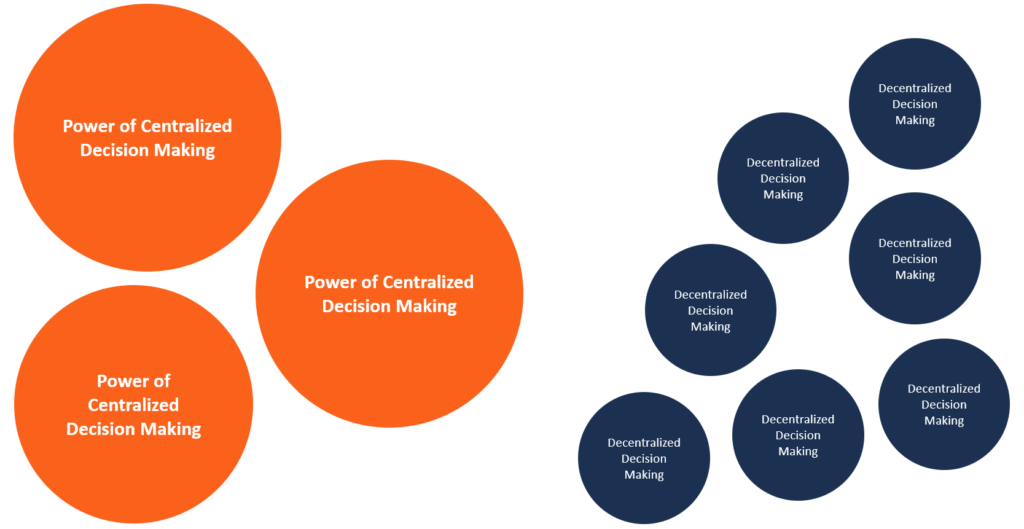
Similarly, in a centralized government structure, the decision-making authority is concentrated at the top, and all other lower levels follow the directions coming from the top of the organization structure.
Advantages of Centralization
An effective centralization offers the following advantages:
1. A clear chain of command
A centralized organization benefits from a clear chain of command because every person within the organization knows who to report to. Junior employees know who to approach whenever they have concerns about the organization. On the other hand, senior executives follow a clear plan of delegating authority to employees who excel in specific functions. The executives also gain the confidence that when they delegate responsibilities to mid-level managers and other employees, there will be no overlap. A clear chain of command is beneficial when the organization needs to execute decisions quickly and in a unified manner.
2. Focused vision
When an organization follows a centralized management structure, it can focus on the fulfillment of its vision with ease. There are clear lines of communication and the senior executive can communicate the organization’s vision to employees and guide them toward the achievement of the vision. In the absence of centralized management, there will be inconsistencies in relaying the message to employees because there are no clear lines of authority. Directing the organization’s vision from the top allows for a smooth implementation of its visions and strategies. The organization’s stakeholdersStakeholderIn business, a stakeholder is any individual, group, or party that has an interest in an organization and the outcomes of its actions. Common examples such as customers, suppliers, and communities also receive a uniform message.
3. Reduced costs
A centralized organization adheres to standard procedures and methods that guide the organization, which helps reduce office and administrative costsSG&ASG&A includes all non-production expenses incurred by a company in any given period. It includes expenses such as rent, advertising, marketing. The main decision-makers are housed at the company’s head office or headquarters, and therefore, there is no need for deploying more departments and equipment to other branches. Also, the organization does not need to incur extra costs to hire specialists for its branches since critical decisions are made at the head office and then communicated to the branches. The clear chain of command reduces duplication of responsibilities that may result in additional costs to the organization.
4. Quick implementation of decisions
In a centralized organization, decisions are made by a small group of people and then communicated to the lower-level managers. The involvement of only a few people makes the decision-making process more efficient since they can discuss the details of each decision in one meeting. The decisions are then communicated to the lower levels of the organization for implementation. If lower-level managers are involved in the decision-making process, the process will take longer and conflicts will arise. That will make the implementation process lengthy and complicated because some managers may object to the decisions if their input is ignored.
5. Improved quality of work
The standardized procedures and better supervision in a centralized organization result in improved quality of work. There are supervisors in each department who ensure that the outputs are uniform and of high quality. The use of advanced equipment reduces potential wastage from manual work and also helps guarantee high-quality work. Standardization of work also reduces the replication of tasks that may result in high labor costs.
Disadvantages of Centralization
The following are the disadvantages of centralization:
1. Bureaucratic leadership
Centralized management resembles a dictatorial form of leadership where employees are only expected to deliver results according to what the top executives assign them. Employees are unable to contribute to the decision-making process of the organization, and they are merely implementers of decisions made at a higher level. When the employees face difficulties in implementing some of the decisions, the executives will not understand because they are only decision-makers and not implementers of the decisions. The result of such actions is a decline in performance because the employees lack the motivation to implement decisions taken by top-level managers without the input of lower-level employees.
2. Remote control
The organization’s executives are under tremendous pressure to formulate decisions for the organization, and they lack control over the implementation process. The failure of executives to decentralize the decision-making process adds a lot of work to their desks. The executives suffer from a lack of time to supervise the implementation of the decisions. This leads to reluctance on the part of employees. Therefore, the executives may end up making too many decisions that are either poorly implemented or ignored by the employees.
3. Delays in work
Centralization results in delays in work as records are sent to and from the head office. Employees rely on the information communicated to them from the top, and there will be a loss in man-hours if there are delays in relaying the records. This means that the employees will be less productive if they need to wait long periods to get guidance on their next projects.
4. Lack of employee loyalty
Employees become loyal to an organization when they are allowed personal initiatives in the work they do. They can introduce their creativity and suggest ways of performing certain tasks. However, in centralization, there is no initiative in work because employees perform tasks conceptualized by top executives. This limits their creativity and loyalty to the organization due to the rigidity of the work.
Summary
Centralization refers to a setup in which the decision-making powers are concentrated in a few leaders at the top of the organizational structure. Decisions are made at the top and communicated to lower-level managers for implementation.
Other resources
CFI is a leading provider of training and career advancement for finance professionals, including the Financial Modeling & Valuation Analyst (FMVA)™Become a Certified Financial Modeling & Valuation Analyst (FMVA)®CFI's Financial Modeling and Valuation Analyst (FMVA)® certification will help you gain the confidence you need in your finance career. Enroll today! certification program. To keep learning and advancing your career, the following CFI resources will be helpful:
- Corporate StrategyCorporate StrategyCorporate Strategy focuses on how to manage resources, risk and return across a firm, as opposed to looking at competitive advantages in business strategy
- GroupthinkGroupthinkGroupthink is a term developed by social psychologist Irving Janis in 1972 to describe faulty decisions made by a group due to group pressures. Groupthink is a phenomenon in which the ways of approaching problems or matters are dealt by the consensus of a group rather than by individuals acting independently.
- Corporate DevelopmentCorporate DevelopmentCorporate development is the group at a corporation responsible for strategic decisions to grow and restructure its business, establish strategic partnerships, engage in mergers & acquisitions (M&A), and/or achieve organizational excellence. Corp Dev also pursues opportunities that leverage the value of the company’s business platform.
- Leading by ExampleLeading by ExampleLeadership is a process in which an individual influences the behavior and attitudes of other people. Leading by example helps other people see what lies
-
![Guerrilla Marketing: Definition, Tactics & Examples | [Your Brand/Site Name]](https://www.etffin.com/article/uploadfiles/202110/2021100815412062_S.jpeg)
Guerrilla Marketing: Definition, Tactics & Examples | [Your Brand/Site Name]
Guerrilla marketing refers to an advertising strategyAIDA ModelThe AIDA model, which stands for Attention, Interest, Desire, and Action model, is an advertising effect model that identifies the stages
-

Holacracy: A Decentralized Management Approach Explained
Holacracy is an organizational structure that embodies decentralized management where an organization comprises units or teams that work autonomously to achieve company-wide goals.Holacracy aims to di
Business strategy
- Affiliate Marketing: A Comprehensive Guide for Beginners
- Assemble-to-Order (ATO): Definition, Benefits & Implementation
- Bootstrapping: How to Build a Business with Minimal Funding
- Brownfield Investment: Definition, Benefits & Examples
- Centralization vs. Decentralization: Understanding Organizational Structure
- Understanding Non-Profit Organizations (NPOs): Definition & Purpose
- Organizational Analysis: Understanding & Improving Business Performance
- Systems Thinking: A Comprehensive Overview & Applications
- Centralized Cryptocurrency Exchanges: A Comprehensive Guide
-
 Franchise Explained: What is a Franchisee and How it Works
A franchisee is a business that operates under an existing business’s trademarks. They purchase the right to use a parent company’s brands, material, and other knowledge to sell the same g...
-
 Greenfield Investment: Definition, Advantages & Examples
In economics, a greenfield investment (GI) refers to a type of foreign direct investment (FDI)Foreign Direct Investment (FDI)Foreign direct investment (FDI) is an investment from a party in one countr...