
Exit Strategies: Planning Your Business's Future
Exit strategies are plans executed by business owners, investors, traders, or venture capitalistsVenture CapitalVenture capital is a form of financing that provides funds to early stage, emerging companies with high growth potential, in exchange for equity or an ownership stake. Venture capitalists take the risk of investing in startup companies, with the hope that they will earn significant returns when the companies become a success. to liquidate their position in a financial assetFinancial AssetsFinancial assets refer to assets that arise from contractual agreements on future cash flows or from owning equity instruments of another entity. A key upon meeting certain criteria. An exit plan is how an investor plans to get out of an investment.

When Are Exit Strategies Used?
An exit plan may be used to:
- Close down a non-profitable business
- Execute an investment or business ventureReal Estate Joint VentureA Real Estate Joint Venture (JV) plays a crucial role in the development and financing of most large real estate projects. when profit objectives are met
- Close down a business in the event of a significant change in market conditions
- Sell an investment or a company
- Sell an unsuccessful company to limit losses
- Reduce ownership in a company or give up control
Examples of Exit Plans
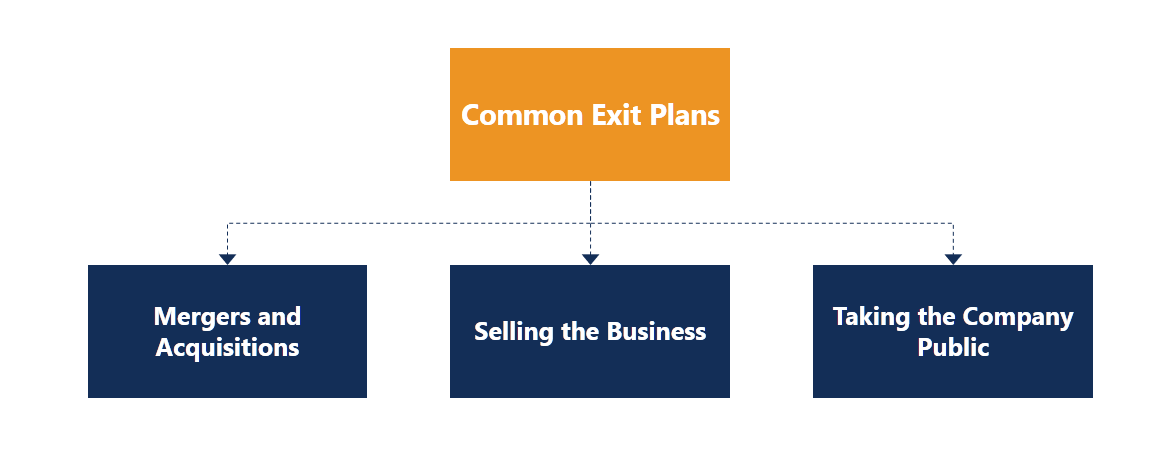
Examples of some of the most common exit strategies for investors or owners of various types of investments include:
- In the years before exiting your company, increase your personal salary and pay bonuses to yourself. However, make sure you are able to meet obligations. This is the easiest business exit plan to execute.
- Upon retiring, sell all your shares to existing partners. You will get money from the sale of shares and be able to leave the company.
- Liquidate all your assets at market value. Use the revenue to pay off obligations and keep the rest.
- Go through an initial public offering (IPO)Initial Public Offering (IPO)An Initial Public Offering (IPO) is the first sale of stocks issued by a company to the public. Prior to an IPO, a company is considered a private company, usually with a small number of investors (founders, friends, family, and business investors such as venture capitalists or angel investors). Learn what an IPO is.
- Merge with another business or be acquired.
- Sell the company outright.
- Pass on the business to a family member.
Exit Strategies for Start-ups
Exit plans are commonly used by entrepreneurs to sell the company that he or she founded. Entrepreneurs will typically develop an exit strategy before going into business because the choice of exit plan has a significant influence on business development choices.
For example, if your plan is to get listed on the stock market (an IPO), it is important that your company follow certain accounting regulations. In addition, most entrepreneurs are not interested in a big-company role and are only interested in starting up companies. A well-defined exit plan helps entrepreneurs swiftly move onto their next big project.
Common types of exit strategies:
- Initial public offering (IPO)
- Strategic acquisitions
- Management buyouts
The exit plan chosen by the entrepreneur depends on the role he/she wants in the future of the company. For example, a strategic acquisition will relieve the entrepreneur of all roles and responsibilities in his or her founding company as they give up control of it.
Exits in Financial Modeling and Valuation
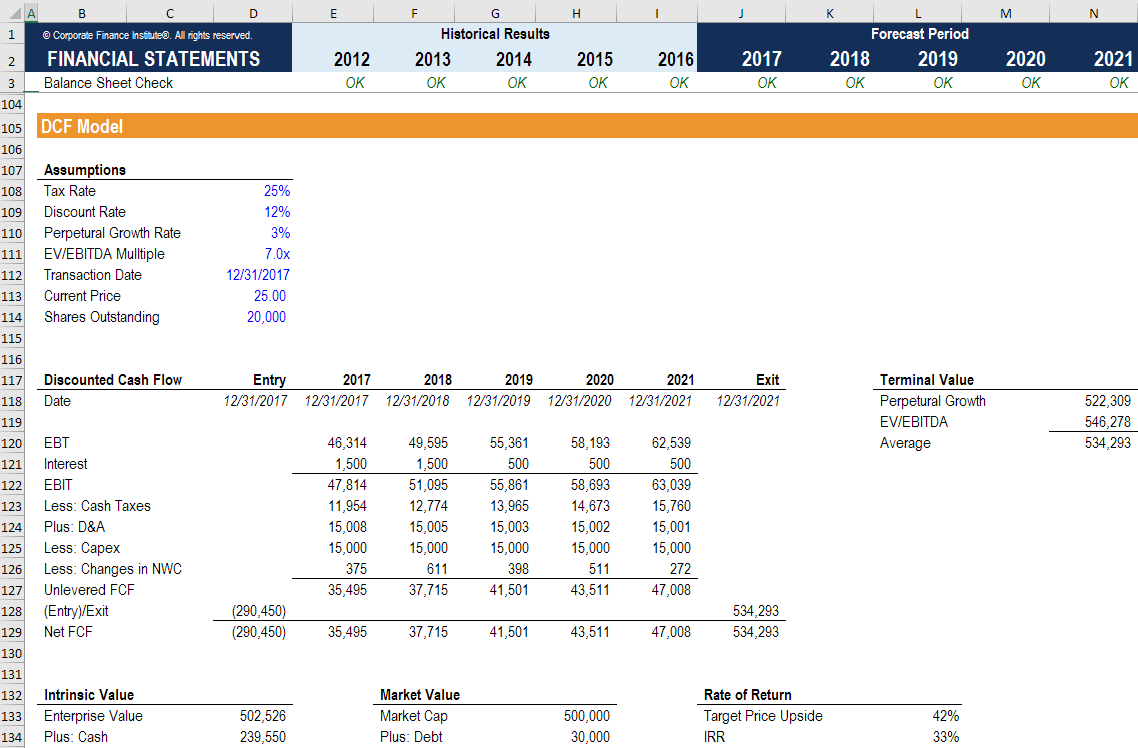
In financial modelingWhat is Financial ModelingFinancial modeling is performed in Excel to forecast a company's financial performance. Overview of what is financial modeling, how & why to build a model., it’s necessary to have a terminal value when building a DCF modelDCF Model Training Free GuideA DCF model is a specific type of financial model used to value a business. The model is simply a forecast of a company’s unlevered free cash flow. The terminal value can be calculated in two different ways – using a perpetual growth rate and using an exit multiple. The latter method is more common among industry practitioners and assumes that the business is sold for a “multiple” of some metric, like EBITDAEBITDAEBITDA or Earnings Before Interest, Tax, Depreciation, Amortization is a company's profits before any of these net deductions are made. EBITDA focuses on the operating decisions of a business because it looks at the business’ profitability from core operations before the impact of capital structure. Formula, examples.
In the example of a DCF model below you can see the terminal valueTerminal ValueTerminal Value (TV) is the estimated present value of a business beyond the explicit forecast period. TV is used in various financial tools section, which assumes the company is sold for 7.0x EBITDA.
Learn more in CFI’s DCF modeling courses online now!
Importance of an Exit Plan
It may seem counter-intuitive for a business owner to develop exit strategies. For example, if you are an e-commerce business owner with increasing revenue, why would you want to exit your company?
In fact, it is important to consider an exit plan even if you do not intend to sell your company immediately. For example:
- Personal health issues or a family crisis: You may be affected by personal health issues or experience a family crisis. These issues can take away your focus on effectively running the company. An exit plan would help ensure the company will be run smoothly.
- An economic recession: Economic recessions can have a significant effect on your company and you may want your company to avoid assuming the impact of a recession.
- Unexpected offers: Large players may look to acquire your company. Even if you do not have any intentions of immediately selling the company, you would be able to have an insightful conversation if you have thought of an exit plan.
- A clearly defined goal: By having a well-defined exit plan, you will also have a clear goal. An exit plan has a significant influence on your strategic decisions.
Additional Resources
Thank you for reading CFI’s guide to developing an exit strategy. To keep learning and advancing your career as a financial analyst, these CFI resources will be a big help:
- Corporate VenturingCorporate VenturingCorporate venturing (also known as corporate venture capital) is the practice of directly investing corporate funds into external startup companies. This is usually done by large companies who wish to invest small but innovative startup firms. They do so through joint venture agreements and acquisition of equity stakes.
- Angel InvestorsAngel InvestorAn angel investor is a person or company that provides capital for start-up businesses in exchange for ownership equity or convertible debt. They may provide a one-time investment or an ongoing capital injection to help the business move through the difficult early stages.
- Liquidation ValueLiquidation ValueLiquidation value is an estimation of the final value which will be received by the holder of financial instruments when an asset is sold or liquidated.
- Valuation MethodsValuation MethodsWhen valuing a company as a going concern there are three main valuation methods used: DCF analysis, comparable companies, and precedent transactions
-

Understanding Operating Expenses (OpEx): A Comprehensive Guide
What Are Operating Expenses? Operating expenses are expenditures directly related to d
-

Understanding Material Participation Tests: IRS Requirements
Material participation tests are a set of criteria that the Internal Revenue Service (IRS) uses to determine if an individual actively participated in a business, trade, or other income-producing acti
Business strategy
- Understanding Business Metrics: Key Performance Indicators & KPIs
- Hedge Fund Strategies: A Comprehensive Guide for Investors
- Non-Operating Assets: Definition, Examples & Financial Impact
- Understanding Fixed Charges: A Comprehensive Guide
- Understanding Business Overheads: Costs & Examples
- Retail Assortment Strategies: A Comprehensive Guide
- Business Operations: Definition, Activities & Optimization
- Company Recovery Strategies: Preventing Business Shutdowns
- Turnaround Recovery Strategies: A Comprehensive Guide
-
 Understanding Options Trading Privileges: A Comprehensive Guide
Options are derivative contracts that have values based on individual stocks, exchange-traded funds or stock market indexes. Options are short-term contracts with a wide range of different contracts t...
-
Essential Business Metrics: 35 KPIs to Drive Growth & Profitability
Companies can improve their profitability in three ways: generate more revenue for a given cost, generate the same revenue for a lower cost or both. All methods require measuring and tracking operatio...