
Non-Operating Assets: Definition, Examples & Financial Impact
Non-operating assets are assets that are not required in the normal operations of a business but that can generate income nonetheless. The assets are recorded in the balance sheetBalance SheetThe balance sheet is one of the three fundamental financial statements. The financial statements are key to both financial modeling and accounting. and may be listed separately or as part of operating assets. Non-operating assets do not help in the day-to-day operations of the business, but they may be investments or assets that can be disposed of to generate income to finance the operations of the business.
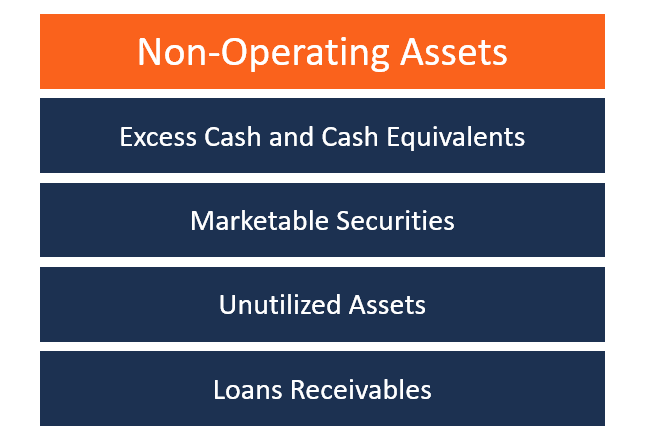
Identifying non-operating assets is an important step when determining the current value of a company since such assets are often left out when calculating the net worth of a business based on its earnings potential.
Examples of Non-Operating Assets
The following are the most common non-operating assets:
1. Underutilized cash
Any excess cash and cash equivalentsCash EquivalentsCash and cash equivalents are the most liquid of all assets on the balance sheet. Cash equivalents include money market securities, banker's acceptances that are not immediately required in financing the day-to-day operations of the company are recognized as non-operating assets. The underutilized cash is the amount that exceeds the operating cash requirements of the business, and they should be added to the value of the operating assets when conducting an appraisal.
The excess cash can be used to purchase short-term investments such as commercial paper or government securities10-Year US Treasury NoteThe 10-year US Treasury Note is a debt obligation that is issued by the US Treasury Department and comes with a maturity of 10 years., which can be quickly converted into cash. The securities are known as near-cash investments because they can be sold to get quick cash to finance operations.
2. Marketable securities
Marketable securitiesMarketable SecuritiesMarketable securities are unrestricted short-term financial instruments that are issued either for equity securities or for debt securities of a publicly listed company. The issuing company creates these instruments for the express purpose of raising funds to further finance business activities and expansion. are financial instruments that can be bought and sold on public exchanges or elsewhere in the secondary market. Examples of marketable securities include treasury bills, common stock, banker’s acceptances, and corporate bonds. They have maturities of less than one year and have low returns due to their high liquidity and low-risk nature.
Rather than letting cash sit idly, businesses purchase marketable securities to earn returns from them. If the business has an urgent need for cash, the securities can be quickly liquidated at a reasonable price.
3. Unutilized assets
A business may also hold assets that are no longer required in the day-to-day operations, and that do not currently generate cash flows for the business. An example of an unutilized asset is a plot of land owned, but not currently used, by the business.
Although the land may have accumulated substantial market value, it does not bring in any cash flows yet and may be excluded when estimating the value of the company on the basis of the potential cash flows.
Another example of an unutilized asset is an occupied building that was used to manufacture a specific line of products that has since been discontinued. Since the building is not used in the daily operations of the business, it is recognized as a non-operating asset.
4. Loans receivable
Loans receivables represent funds that have been lent out to borrowers that are yet to be collected. If the company is in the business of selling products and services to customers, the loans receivable is recognized as a non-operating asset since it is not part of the ordinary operations of the company.
If the company is in the business of lending out money to borrowers, the loans receivables will be a significant proportion of the company’s cash flow and will, therefore, be recorded as operating assets.
Treatment of Non-Operating Assets in Business Valuations
When conducting business valuations, non-operating assets are valued at the net realizable value. This is the value obtained from the sale of the asset after deducting any associated costs such as income taxes and disposition costs. The net realizable value is the value that counts when calculating the total net worth of the company.
For example, if the non-operating asset is a real estate property, the business can obtain an appraisal of the property by deducting the interest expense, taxes, and other expenses from the market value before adding the net realizable value to the enterprise value of the company.
Additional Resources
CFI is the official provider of the global Financial Modeling & Valuation Analyst (FMVA)™Current AssetsCurrent assets are all assets that a company expects to convert to cash within one year. They are commonly used to measure the liquidity of a certification program, designed to help anyone become a world-class financial analyst. To keep advancing your career, the additional CFI resources below will be useful:
- Asset ValuationAsset ValuationAsset valuation simply pertains to the process to determine the value of a specific property, including stocks, options, bonds, buildings, machinery, or land
- Projecting Balance Sheet ItemsProjecting Balance Sheet Line ItemsProjecting balance sheet line items involves analyzing working capital, PP&E, debt share capital and net income. This guide breaks down how to calculate
- Treasury Bills (T-Bills)Treasury Bills (T-Bills)Treasury Bills (or T-Bills for short) are a short-term financial instrument issued by the US Treasury with maturity periods from a few days up to 52 weeks.
- Types of AssetsTypes of AssetsCommon types of assets include current, non-current, physical, intangible, operating, and non-operating. Correctly identifying and
-

Understanding Material Participation Tests: IRS Requirements
Material participation tests are a set of criteria that the Internal Revenue Service (IRS) uses to determine if an individual actively participated in a business, trade, or other income-producing acti
-

Understanding Net Foreign Assets (NFA): A Comprehensive Guide
Net Foreign Assets (NFA) refer to the net amount of foreign assets that a country owns or the total value of a country’s foreign assets minus the total value of assets within a country that are
finance
- Investable Assets: A Comprehensive Guide for Investors
- Understanding Household Assets: A Comprehensive Guide
- Fixed Assets: Definition, Examples & Importance for Businesses
- Monetary Assets: Definition, Examples & Key Characteristics
- Understanding Non-Monetary Assets: Definition & Examples
- Understanding Quick Assets: Definition & Examples
- Understanding Hard Assets: Definition, Examples & Investment
- Trading Assets: Definition, Types & How They Work
- Understanding Liquid Assets: A Comprehensive Guide
-
 Understanding Operating Expenses (OpEx): A Comprehensive Guide
What Are Operating Expenses? Operating expenses are expenditures directly related to d...
-
 Understanding Unrestricted Net Assets for Nonprofits
Unrestricted net assets are the asset (current and/or fixed) donations made to not-for-profit organizations (NPOs)Not-for-Profit OrganizationsA not-for-profit organization focuses on a particular soci...