
Understanding External Economies of Scale: Industry-Wide Cost Advantages
External economies of scale refer to factors that are beyond the control of an individual firm, but occur within the industry, and lead to such a cost benefit. For example, if the government imposes higher tariffsTariffA tariff is a form of tax imposed on imported goods or services. Tariffs are a common element in international trading. The primary goals of imposing on the import of a certain good, then it is beneficial for all domestic firms producing that good since it reduces their competition.

As firms increase their output levels, their average cost (AC) of production falls. The cost benefits that come with higher production levels are known as economies of scale.
Summary
- External economies of scale refer to factors that are beyond the control of an individual firm, but occur within the industry, and lead to a cost benefit.
- The prospect of external economies of scale often induce firms in the same industry to cluster together.
- External economies of scale and cluster industries often lead to the formation of economies of agglomeration. It is a situation when mutually beneficial firms from different industries are set up close to one another.
Internal vs. External Economies of Scale
Internal economies of scale are different from external ones since the former include factors that are unique to an individual firm. If a particular firm formulates a technique of production that saves time and cost, then the benefit is internal to the firm and will not impact other firms in the industry.
The prospect of external economies of scale often induce firms in the same industry to cluster together. When one firm is well established in a particular region, it can access a developed transportation network, connections with suppliersDisintermediationDisintermediation is the removal of different elements within the middle of a supply chain. The intermediaries in product development – or, and a ready workforce. New firms emerging within the industry would like to take advantage of the existing infrastructure and settle close to the older firm.
External economies of scale and cluster industries often lead to the formation of economies of agglomeration. It is a situation when mutually beneficial firms from different industries are set up close to one another.
In such a setup, all firms can enjoy external economies of scale across industries. For example, food processing industries are often located close to agricultural fields so that both industries can reduce their transportation costs.
Sources of External Economies of Scale
External economies of scale arise due to one or more of the following factors:
1. Economies of concentration
When firms within the same industry cluster together, they can take advantage of the existing infrastructure and supply networks. Moreover, skilled workersLabor MarketThe labor market is the place where the supply and the demand for jobs meet, with the workers or labor providing the services that employers demand. tend to shift close to such clusters for work, thereby giving firms easy availability to labor.
2. Economies of information
When several firms are located close to each other, they can access perfect information on the prices of inputs. Since all firms purchase inputs from the same suppliers, the latter cannot charge different prices from different firms. The elimination of discriminatory pricing ensures that no firm pays a higher amount for inputs, and it reduces the overall average cost.
3. Economies of innovation
Many firms prefer to set up their premises close to centers engaged in research and development of efficient production methods. Firms can then quickly adapt to all innovations developed by these centers in order to achieve greater efficiency in production and, therefore, lower their costs.
4. Tax breaks
When the government of a country offers tax concessions on the production of a certain product or subsidies on the purchase of certain raw materials, it reduces the cost of production of all firms in that particular industry. It is another source of external economies of scale.
Consider a new firm, X, which faces the option of setting up premises in isolation or in a cluster. Its cost of production includes the following components: raw materials, labor, machinery, and transportation.
The cost of each of the inputs is lower in the cluster region since facilities for the same are already available there. In order to produce 1,000 units, the cost breakup is as follows (all figures are denominated in dollars):
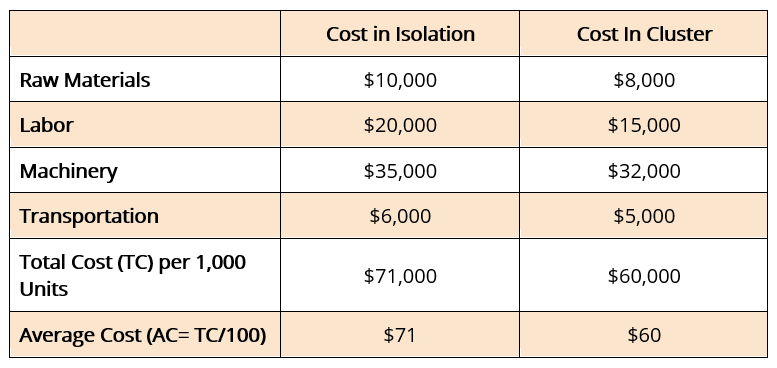
Firm X can reduce its average cost of production by $11 if it sets up its premises near the cluster.
Advantages and Disadvantages of External Economies of Scale
External economies of scale are sometimes referred to as positive externalities because they provide the following advantages for firms:
1. Equitable benefits
All firms in a particular industry receive equal access to the benefits of external economies of scale.
2. Growth of supporting industries
External economies of scale boost output levels of all firms in a particular industry, and consequently, encourage the growth of supporting industries, that is, industries that provide raw materials, equipment, and transportation services.
However, there are certain drawbacks of external economies of scale, which are as follows:
1. Beyond control
Factors that contribute to such advantages are outside the control of firms. Therefore, no firm gets a competitive advantageCompetitive AdvantageA competitive advantage is an attribute that enables a company to outperform its competitors. It allows a company to achieve superior margins over others since the benefits are available equally to all firms.
2. Location restrictions
Often, cluster industries and external economies of scale foster a strong inter-relationship. It can restrict firms from moving to a location away from the cluster.
Additional Resources
CFI offers the Commercial Banking & Credit Analyst (CBCA)™Program Page - CBCAGet CFI's CBCA™ certification and become a Commercial Banking & Credit Analyst. Enroll and advance your career with our certification programs and courses. certification program for those looking to take their careers to the next level. To keep learning and advancing your career, the following resources will be helpful:
- Asymmetric InformationAsymmetric InformationAsymmetric information is, just as the term suggests, unequal, disproportionate, or lopsided information. It is typically used in reference to some type of business deal or financial arrangement where one party possesses more, or more detailed, information than the other.
- Cost StructureCost StructureCost structure refers to the types of expenses that a business incurs, and is typically composed of fixed and variable costs. Fixed costs remain unchanged
- Negative ExternalitiesNegative ExternalitiesNegative externalities occur when the product and/or consumption of a good or service exerts a negative effect on a third party independent
- Cost of Goods Manufactured (COGM)Cost of Goods Manufactured (COGM)Cost of Goods Manufactured (COGM) is a term used in managerial accounting that refers to a schedule or statement that shows the total
-

Investable Assets: A Comprehensive Guide for Investors
Stock market ticker wall in yellow, showing some stocks going up or down. You can calculate your net worth by deducting your total liabilities from your assets. However, assets come in many v
-

Understanding Tiger Bonds: A Guide to Zero-Coupon Treasury Securities
Tiger bonds are zero-coupon bonds based on U.S. Treasury bonds. Treasury investors growth receipts (TIGR), better known as "Tiger" bonds, are a type of zero-coupon bond originally i
Business strategy
- Understanding Affiliated Companies: Definition & Key Differences
- Retail Assortment Strategies: A Comprehensive Guide
- Business Operations: Definition, Activities & Optimization
- Company Recovery Strategies: Preventing Business Shutdowns
- External Analysis: Understanding Your Industry & Market
- Understanding External Economies of Scale: Industry-Wide Cost Advantages
- Understanding Not-for-Profit Organizations: Mission, Funding & Operations
- Understanding Switching Costs: Barriers to Customer Loyalty
- Financial Investment Strategies: Maximizing Returns & Minimizing Risk
-
 Understanding Duplicate Checks: Security & Convenience
What Are Duplicate Checks? Duplicate checks are special checks that can be ordered from banks or other retailers of personal checks. They have the advantage of leaving you with an exact and i...
-
 Mutual Funds: A Beginner's Guide to Diversified Investing
Many conservative-minded investors don't want to take high risks when they invest their money. Instead of diving into the deep-end of the investment pool alone, which can be a scary plunge, they p...