
Understanding Not-for-Profit Organizations: Mission, Funding & Operations
A not-for-profit organization is an organization that focuses on a particular social cause, and all the money earned or donated is used in pursuing its objectives and meeting operational costsFixed and Variable CostsCost is something that can be classified in several ways depending on its nature. One of the most popular methods is classification according. Unlike for-profit corporations, not-for-profit organizations do not distribute their surplus revenues to their owners. Instead, they use the funds to pursue a specific social cause or advocate for a shared point of view.

Not-for-profit organizations operate as charitable organizations, and they are exempted from paying taxes on the money they earn or are donated to them by well-wishers. Most not-for-profit organizations are dedicated to social causes in the areas of religion, science, research, and education.
Summary
- A not-for-profit organization is a type of organization that uses its revenues and donations to pursue a specific social cause.
- Unlike for-profit organizations, the revenues generated by a not-for-profit organization are not distributed to the members.
- Not-for-profit organizations are tax-exempt.
Types of Not-for-Profit Organizations
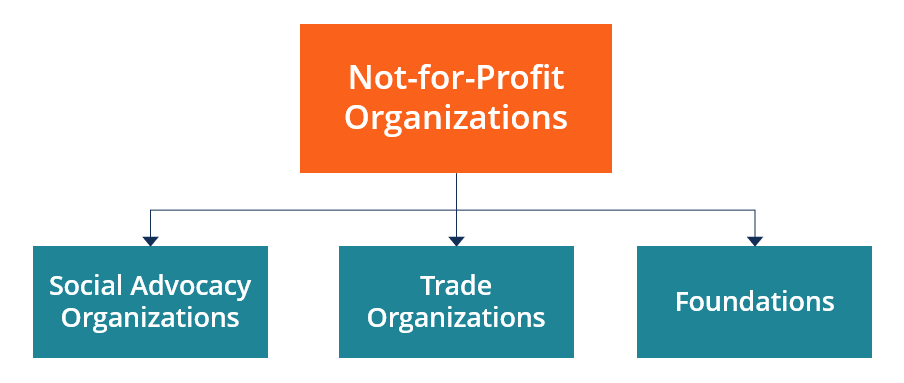
The following are the main types of not-for-profit organizations:
1. Social advocacy organizations
Social advocacy organizations are formed with the goal of promoting or lobbying a specific social cause or political effort. They can organize fundraising and other efforts to inform the public about the cause they are promoting and encourage the public to support their cause.
Such organizations raise funds through membership dues and donations from the members of the public and corporate organizations that support their cause. They are classified under 501 (c)(4) of the US Internal Revenue Service for tax purposes.
2. Trade organizations
Trade organizations are formed with the goal of improving the business conditions of their members. Such organizations get funds through membership dues, as well as charging a fee to members who enroll in their education programs. Some common types of trade organizations include chambers of commerce, real estate boards, and health workers organizations.
3. Foundations
Foundations are usually established by wealthy individuals or corporates with the goal of funding non-profits and events that support a specific social cause. They are required to donate a specific portion of their income in order to retain their status. In the United States, foundations are restricted from supporting political activities, even though they can make donations to organizations involved in political lobbying.
Foundations are classified into either private or public foundations. A private foundation is established by an individual, family, or corporationCorporationA corporation is a legal entity created by individuals, stockholders, or shareholders, with the purpose of operating for profit. Corporations are allowed to enter into contracts, sue and be sued, own assets, remit federal and state taxes, and borrow money from financial institutions.. The foundations are required to meet a payout requirement, and they must list all grants paid out every year.
On the other hand, public foundations are charity organizations that receive money from different sources such as individuals, corporations, or other foundations. They engage in some kind of direct initiatives, such as homeless shelters, and they use the solicited funds to support their own activities.
How to Start a Not-for-Profit Organization?
There is no restriction on who can start a not-for-profit organization. Anybody who sees a need in the community in the areas of religion, science, or education can start a not-for-profit organization. Once you identify a need in the community, research the problem in detail to get more information on the issue and how it can be solved. Then, create a business plan, outlining the problem, objectives, and possible ways that you will use to attain the objectives.
After solidifying the idea, create a board of directors and volunteers who will be in charge of running the day-to-day operations of the business. The next step is to determine the feasibility of the idea and develop a detailed business plan that includes a mission statementMission StatementA mission statement defines what line of business a company is in, and why it exists or what purpose it serves., organizational plan, budgetary estimates, as well as financial resources development.
Begin the incorporation process at your state of residence by completing the state registration forms for not-for-profit organizations. You should also file the 501(c)(4) tax-exempt status with the IRS, as well as seek tax-exempt recognition at the state and local levels.
For-Profit vs. Not-for-Profit Organizations
For-profit and not-for-profit organizations differ in how they handle profits generated by the organization. For-profit organizations can participate in a variety of business activities that generate profits, and the profits earned are distributed to shareholders according to their percentage of ownership. Also, since for-profit organizations are engaged in profitable commercial activities, they generate enough revenues to pay salaries to full-time employees, managers, and directors.
Not-for-profit organizations are required to operate exclusively as charity organizations dedicated to a particular social cause in religious, scientific, educational, or public safety settings. All the revenues earned or donated to not-for-profit organizations are not distributed to the members but instead used to advance the social cause. Also, most not-for-profit organizations rely on volunteers to achieve their goals since they lack enough funds to employ full-time staff.
Not-for-Profit vs. Non-Profit Organizations
Not-for-profit and non-profit are terms that are commonly used interchangeably, but they do not mean the same thing. While both types of organizations do not distribute their profits to members, they differ in how they use their funds, size, and purpose.
Non-profit organizations focus on larger, more organized activities in the social, political, environmental, or economic spectrum. The organizations may also be formed to promote religious, cultural, or educational objectives. Examples of such organizations include UNICEF and the American Red Cross.
On the other hand, not-for-profit organizations focus on smaller group activities within the society or community, and they focus on areas such as religion, education, science, and public safety. Such organizations may include clubs, trade organizations, religious groups, welfare societies, etc.
Additional Resources
CFI offers the Commercial Banking & Credit Analyst (CBCA)™Program Page - CBCAGet CFI's CBCA™ certification and become a Commercial Banking & Credit Analyst. Enroll and advance your career with our certification programs and courses. certification program for those looking to take their careers to the next level. To keep learning and advancing your career, the following CFI resources will be helpful:
- Corporate Social Responsibility (CSR)Corporate Social Responsibility (CSR)Corporate social responsibility (CSR) refers to strategies that companies put into action as part of corporate governance that are designed to
- Non-Profit Business PlanNon-Profit Business PlanA non-profit business plan is simply a roadmap of the non-profit organization that outlines its goals and objectives, how it can achieve its stated purpose
- Profit ModelProfit ModelA profit model refers to a company’s plan that aims to make the business profitable and viable. It lays out what the company plans to manufacture, how
- Types of BusinessesTypes of BusinessesThere are four main types of businesses to choose when forming a company: sole proprietorships, partnerships, limited liability companies, and corporations.
-

Understanding Excess Reserves: What Banks Hold & Why It Matters
Excess reserves refer to the cash held by a bank or other financial institution above the reserve requirement that an authority sets. The amount of excess reserves is equal to the total reserves reduc
-

Fidelity Bonds: Protection Against Employee Dishonesty & Fraud
Fidelity bonds are designed to protect their policyholders from any loss that occurs as a result of harmful or deceitful actions by specifically indicated parties. In most cases, fidelity bonds are us
Business strategy
- Understanding Financial Barriers: How Costs Impact Your Lifestyle
- Loans Receivable: Understanding and Analyzing Your Balance Sheet
- Understanding Royalty Checks: A Comprehensive Guide
- Understanding Duplicate Checks: Security & Convenience
- Mutual Funds: A Beginner's Guide to Diversified Investing
- Investable Assets: A Comprehensive Guide for Investors
- Understanding Tiger Bonds: A Guide to Zero-Coupon Treasury Securities
- Understanding Industry Trends: Impact & Significance
- Understanding Switching Costs: Barriers to Customer Loyalty
-
 Understanding Earnings: A Guide to Financial Profitability
Earnings refer to the income that an individual or organization gains during a certain period. They can be found on a company’s income statement and are used to measure the profitability of that...
-
 Understanding Efficiency Ratios: A Key to Business Performance
Efficiency ratios are metrics that are used in analyzing a company’s ability to effectively employ its resources, such as capital and assets, to produce income. The ratios serve as a comparison ...