
Horizontal Integration: Definition, Strategy & Benefits
Horizontal integration is a competitive strategy where business entities operating at the value chainValue ChainA value chain is all the activities and processes within a company that help add value to the final product. In today’s business landscape, companies across level and within the same industry merge to increase the production of goods and services. The overall gain from a horizontal integration is an increase in the market power and minimal loss for being non-integrated.
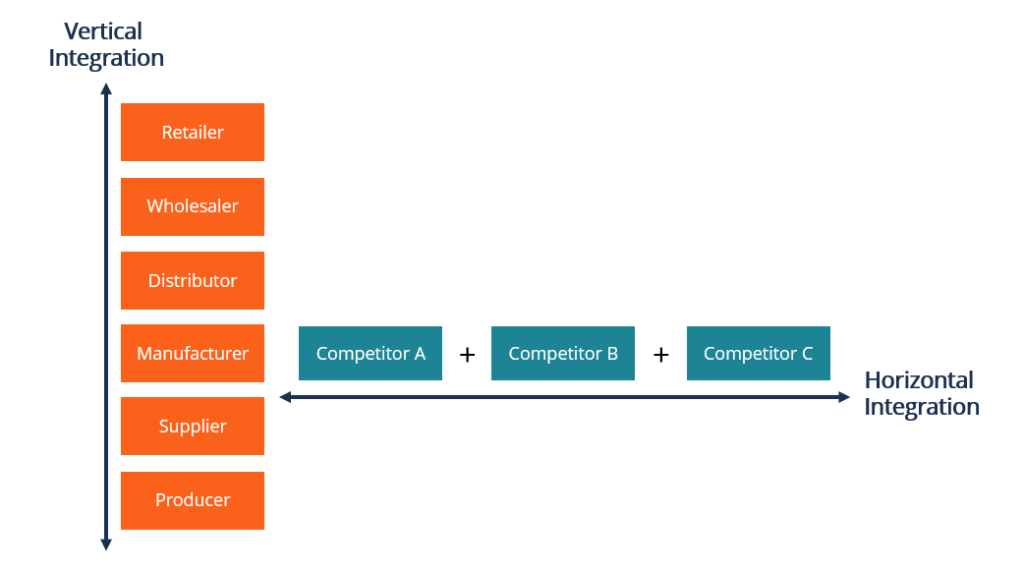
Horizontal integration can be contrasted with vertical integration, where a company takes control of its supply chain and value by owning its suppliers, distributors, or retail locations.
Summary
- Horizontal integration happens when one firm acquires another firm operating in the same industry or producing the same line of products.
- Companies that engage in horizontal integration may realize economies of scale, reduced production costs, synergy in marketing, increased revenue, among others.
- As with any other business strategy, horizontal integration does not always lead to increased value and profitability as expected. Instead, it can be the precursor to dismal performance, devaluation, inefficiency, stunted economic growth, and reduced competitiveness.
Understanding Horizontal Integration
Horizontal integration is a competitive strategy that can result in economies of scaleEconomies of ScaleEconomies of scale refer to the cost advantage experienced by a firm when it increases its level of output.The advantage arises due to the, competitive edge, increased market share, and business expansion. Businesses in strategic alliances target outcomes that provide more resources, market, competence, and efficiency. The two amalgamated entities should be better positioned to realize more revenue than they would have when operating independently.
Horizontal integration may also involve the optimization of activities or the consolidation of strategic business activities within the firm’s scope of processes and activities. It may arise from expansion to new market segments, economies of scale, economies of scope and experience, and the price difference in the factors of production.
However, these business combinations may create a monopoly power in an industry, which may be a disadvantage to the consumer. The reduced competition may induce collusive behavior, leading to increased prices for products.
Aspects of Horizontal Integration
There are several aspects that characterize a horizontal integration versus other business combinations. They include:
- The direction of horizontal integration
- Profitability of integration
- Target of integration
- Forms and intensity of integration
Horizontal integration can be distinguished from conglomerate integration by taking into account the direction. It is usually a preserve for companies with financial surpluses. Horizontal mergers of related companies occur within the same industry or line of products so that the entities involved can exploit their competencies.
Companies merge and expand their activities as a unit in sectors related to associated products or services to utilize their skills and resources. Businesses that aim to increase their profitability can adopt horizontal integration within the same product lines.
On the other end of the spectrum, conglomerateConglomerateA conglomerate is one very large corporation or company, composed of several combined companies, that is formed by either takeovers or mergers. In most cases, a conglomerate supplies a variety of goods and services that are not necessarily related to one another. diversification is for companies that strive for growth. Notwithstanding this rule, some companies may use only the selected competencies of horizontal integration.
Horizontal Integration vs. Vertical Integration
Horizontal integration and vertical integration are strategic alliances by companies in the same sector. The horizontal integration of companies within the same industry attracts businesses that target to reach a broader market or offer more products/services. It can lead to product diversification, increased company size, narrow competition, and economies of scale.
A successful horizontal integration equips companies with the ability to cut down on costs by using the same research and development, technologies, marketing and advertising, production, and distribution. The need to acquire a new customer segment can also be a reason for horizontal integration.
In a vertical integration, a business entity acquires another business operating in the production process of the same industry. They are combinations with companies that are upstream or downstream of the same product supply chain.
Companies may choose to undergo vertical integration to increase profitability, reduce production costs, and strengthen their supply chain. Integrating vertically requires one company that is higher or below in the supply chain process. They can draw several benefits from vertical integration, including increased profits from the new business operations, efficiency in the production process, and enhanced distribution and delivery.
Benefits of Horizontal Integration
1. Larger market share
Successful mergers create a large market share for the integrated company or business units. Horizontally integrated firms improve market share by the expansion of business activities, cost synergies in marketing, combined product base, and shared technology, among others.
2. Large customer base
When two companies come together, they also bring different consumer bases. As a result, the new firm has access to a large customer segment.
3. Higher revenue
By increasing its market share and consumer base, the new company has the ability to increase its revenue two-fold or more.
Drawbacks of Horizontal Integration
Despite the increased potential profitability of horizontal integration from the increased value and synergies, the strategy has some potential drawbacks:
1. Threatens competition
Mergers and acquisitions of large corporations usually lead to monopolies to the detriment of consumers. Market dominance may fuel unethical practices, such as indefinite hiking of market prices or narrowing of products and services. For this reason, monopolies are subject to antitrust laws, not to mention the scrutiny of regulatory bodies.
2. Reduces flexibility
Horizontal integration may impede the flexibility of the acquired firm since it must conform to the operations of the bigger company.
More Resources
CFI is the official provider of the global Commercial Banking & Credit Analyst (CBCA)™Program Page - CBCAGet CFI's CBCA™ certification and become a Commercial Banking & Credit Analyst. Enroll and advance your career with our certification programs and courses. certification program, designed to help anyone become a world-class financial analyst. To keep advancing your career, the additional CFI resources below will be useful:
- Competitive AdvantageCompetitive AdvantageA competitive advantage is an attribute that enables a company to outperform its competitors. It allows a company to achieve superior margins
- Vertical IntegrationVertical IntegrationA vertical integration is when a firm extends its operations within its supply chain. It means that a vertically integrated company will bring in previously
- Operations ManagementOperations ManagementOperations management is a field of business concerned with the administration of business practices to maximize efficiency within the organization. It
- Products and ServicesProducts and ServicesA product is a tangible item that is put on the market for acquisition, attention, or consumption while a service is an intangible item, which arises from
-

Understanding Regulation Z: Your Rights as a Borrower
Regulation Z is a consumer-protection regulation that compels lenders to disclose the cost of credit in a clear way for consumers. Whether you’re applying for a mortgage or dealing
-

DeFi Explained: A Beginner's Guide to Decentralized Finance
The Beginner’s Guide to Decentralized FinanceIf you’re diving deep into the world of cryptocurrency, you have probably heard the term “DeFi” used to describe a variety of new protocols and assets. Fi
Business strategy
- Horizontal Analysis: Understanding Financial Trends & Growth
- Understanding Horizontal Equity in Taxation
- Understanding Horizontal Channels in Trading: A Comprehensive Guide
- Understanding Horizontal Lines in Technical Analysis & Geometry
- Understanding Horizontal Spreads in Options Trading
- Forward Integration: Definition, Benefits & Examples
- Horizontal Acquisition: Definition, Strategy & Examples
- Horizontal Mergers: Definition, Benefits & Examples | [Your Company Name]
- Vertical Integration: Definition, Types & Benefits | [Your Company Name]
-
Understanding Cryptocurrency: A Beginner's Guide to Digital Currency
Cryptocurrency is a kind of digital currency that is intended to act as a medium of exchange. Cryptocurrency has become popular in the last decade, in particular, with Bitcoin becoming the most widel...
-
DB(k) Plans: A Hybrid Retirement Solution for Employers & Employees
The DB(k) plan is a type of retirement plan that is available for employers. This type of retirement plan combines features from the 401(k) plan with features from a defined benefit pension plan...