
Industry Analysis: A Comprehensive Guide for Business Insights
Industry analysis is a market assessment tool used by businesses and analysts to understand the competitive dynamics of an industry. It helps them get a sense of what is happening in an industry, e.g., demand-supply statisticsLaw of SupplyThe law of supply is a basic principle in economics that asserts that, assuming all else being constant, an increase in the price of goods, degree of competition within the industry, state of competitionNatural MonopolyA natural monopoly is a market where a single seller can provide the output because of its size. A natural monopolist can produce the entire output for the market at a cost lower than what it would be if there were multiple firms operating in the market. A natural monopoly occurs when a firm enjoys extensive economies of scale in its production process. of the industry with other emerging industries, future prospects of the industry taking into account technological changes, credit system within the industry, and the influence of external factorsSystemic RiskSystemic risk can be defined as the risk associated with the collapse or failure of a company, industry, financial institution or an entire economy. It is the risk of a major failure of a financial system, whereby a crisis occurs when providers of capital lose trust in the users of capital on the industry.
Industry analysis, for an entrepreneur or a company, is a method that helps to understand a company’s position relative to other participants in the industry. It helps them to identify both the opportunities and threats coming their way and gives them a strong idea of the present and future scenario of the industry. The key to surviving in this ever-changing business environment is to understand the differences between yourself and your competitors in the industry and use it to your full advantage.

Learn more in CFI’s Corporate & Business Strategy Course.
Types of industry analysis
There are three commonly used and important methods of performing industry analysis. The three methods are:
- Competitive Forces Model (Porter’s 5 Forces)Competitive Forces ModelThe competitive forces model is an important tool used in strategic analysis to analyze the competitiveness in an industry. This model is more commonly
- Broad Factors Analysis (PEST Analysis)Broad Factors AnalysisA Broad Factors Analysis assesses and summarizes four macro-environmental factors: political, economic, socio-demographic, and technological.
- SWOT AnalysisSWOT AnalysisA SWOT analysis is used to study the internal and external environments of a company and is part of a company’s strategic planning process. In addition, a
#1 Competitive Forces Model (Porter’s 5 Forces)
One of the most famous models ever developed for industry analysis, famously known as Porter’s 5 ForcesCompetitive Forces ModelThe competitive forces model is an important tool used in strategic analysis to analyze the competitiveness in an industry. This model is more commonly, was introduced by Michael Porter in his 1980 book “Competitive Strategy: Techniques for Analyzing Industries and Competitors.”
According to Porter, analysis of the five forces gives an accurate impression of the industry and makes analysis easier. In our Corporate & Business Strategy course, we cover these five forces and an additional force — power of complementary good/service providers.
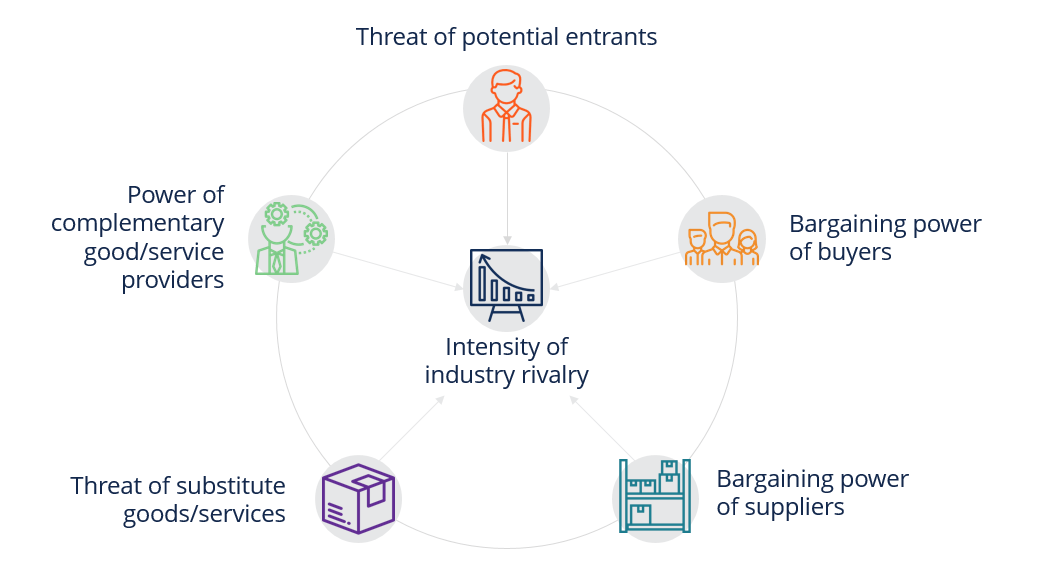
The above image comes from a section of CFI’s Corporate & Business Strategy Course.
1. Intensity of industry rivalry
The number of participants in the industry and their respective market shares are a direct representation of the competitiveness of the industry. These are directly affected by all the factors mentioned above. Lack of differentiation in products tends to add to the intensity of competition. High exit costs such as high fixed assets, government restrictions, labor unions, etc. also make the competitors fight the battle a little harder.
2. Threat of potential entrants
This indicates the ease with which new firms can enter the market of a particular industry. If it is easy to enter an industry, companies face the constant risk of new competitors. If the entry is difficult, whichever company enjoys little competitive advantageCompetitive AdvantageA competitive advantage is an attribute that enables a company to outperform its competitors. It allows a company to achieve superior margins reaps the benefits for a longer period. Also, under difficult entry circumstances, companies face a constant set of competitors.
3. Bargaining power of suppliers
This refers to the bargaining power of suppliersBargaining Power of SuppliersThe Bargaining Power of Suppliers, one of the forces in Porter’s Five Forces Industry Analysis Framework, is the mirror image of the bargaining power. If the industry relies on a small number of suppliers, they enjoy a considerable amount of bargaining power. This can particularly affect small businesses because it directly influences the quality and the price of the final product.
4. Bargaining power of buyers
The complete opposite happens when the bargaining power lies with the customers. If consumers/buyers enjoy market power, they are in a position to negotiate lower prices, better quality, or additional services and discounts. This is the case in an industry with more competitors but with a single buyer constituting a large share of the industry’s sales.
5. Threat of substitute goods/services
The industry is always competing with another industry producing a similar substitute product. Hence, all firms in an industry have potential competitors from other industries. This takes a toll on their profitability because they are unable to charge exorbitant prices. Substitutes can take two forms – products with the same function/quality but lesser price, or products of the same price but of better quality or providing more utility.
#2 Broad Factors Analysis (PEST Analysis)
Broad Factors AnalysisBroad Factors AnalysisA Broad Factors Analysis assesses and summarizes four macro-environmental factors: political, economic, socio-demographic, and technological., also commonly called the PEST Analysis stands for Political, Economic, Social and Technological. PEST analysis is a useful framework for analyzing the external environment.
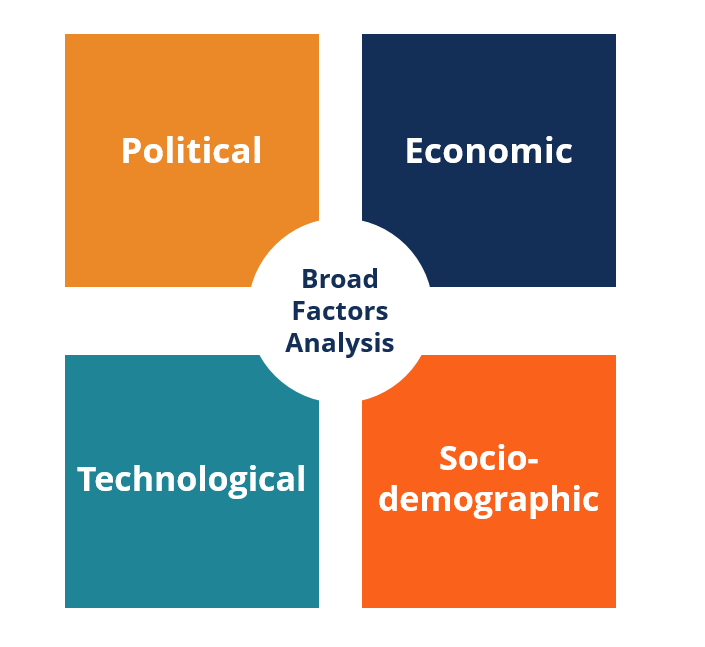
The above image comes from a section of CFI’s Corporate & Business Strategy Course.
To use PEST as a form of industry analysis, an analyst will analyze each of the 4 components of the model. These components include:
1. Political
Political factors that impact an industry include specific policies and regulations related to things like taxes, environmental regulation, tariffs, trade policies, labor laws, ease of doing business, and overall political stability.
2. Economic
The economic forces that have an impact include inflation, exchange rates (FX), interest rates, GDP growth rates, conditions in the capital markets (ability to access capital), etc.
3. Social
The social impact on an industry refers to trends among people and includes things such as population growth, demographics (age, gender, etc.), and trends in behavior such as health, fashion, and social movements.
4. Technological
The technological aspect of PEST analysis incorporates factors such as advancements and developments that change the way a business operates and the ways in which people live their lives (e.g., the advent of the internet).
#3 SWOT Analysis
SWOT AnalysisSWOT AnalysisA SWOT analysis is used to study the internal and external environments of a company and is part of a company’s strategic planning process. In addition, a stands for Strengths, Weaknesses, Opportunities, and Threats. It can be a great way of summarizing various industry forces and determining their implications for the business in question.
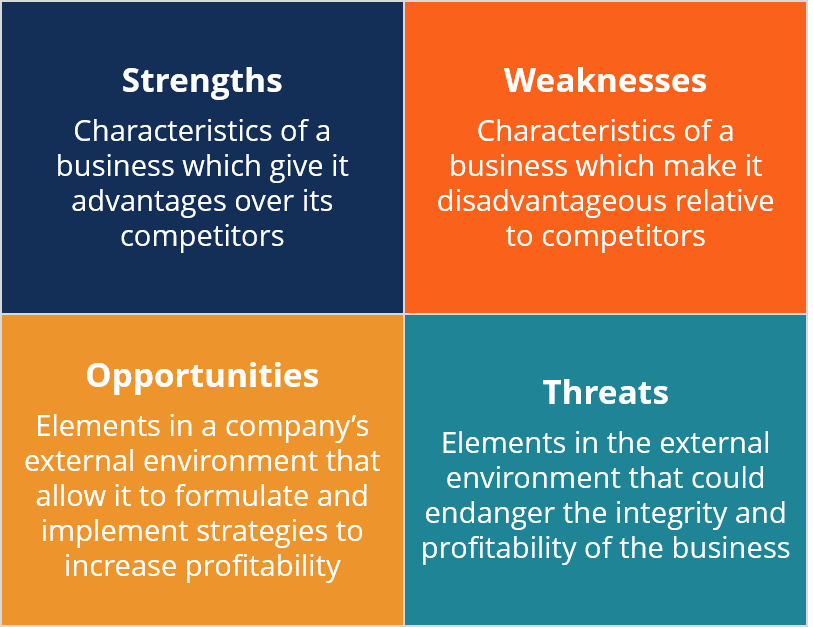
The above image comes from a section of CFI’s Corporate & Business Strategy Course. Check it out to learn more about performing SWOT analysis.
1. Internal
Internal factors that already exist and have contributed to the current position and may continue to exist.
2. External
External factors are usually contingent events. Assess their importance based on the likelihood of them happening and their potential impact on the company. Also, consider whether management has the intention and ability to take advantage of the opportunity/avoid the threat.
Importance of Industry Analysis
Industry analysis, as a form of market assessment, is crucial because it helps a business understand market conditions. It helps them forecast demand and supply and, consequently, financial returns from the business. It indicates the competitiveness of the industry and costs associated with entering and exiting the industry. It is very important when planning a small business. Analysis helps to identify which stage an industry is currently in; whether it is still growing and there is scope to reap benefits, or has it reached its saturation point.
With a very detailed study of the industry, entrepreneurs can get a stronghold on the operations of the industry and may discover untapped opportunities. It is also important to understand that industry analysis is somewhat subjective and does not always guarantee success. It may happen that incorrect interpretation of data leads entrepreneurs to a wrong path or into making wrong decisions. Hence, it becomes important to collect data carefully.
Additional Resources
Thank you for reading the CFI guide to industry analysis, a very important part of all business valuation. To continue advancing your skills as a financial analyst, these additional CFI resources will be of value:
- Top Valuation MethodsValuation MethodsWhen valuing a company as a going concern there are three main valuation methods used: DCF analysis, comparable companies, and precedent transactions
- Business LifecycleBusiness CycleA business cycle is a cycle of fluctuations in the Gross Domestic Product (GDP) around its long-term natural growth rate. It explains the
- DCF Modeling GuideDCF Model Training Free GuideA DCF model is a specific type of financial model used to value a business. The model is simply a forecast of a company’s unlevered free cash flow
- Strategic Analysis GuidesStrategyCorporate and business strategy guides. Read all CFI articles and resources on business and corporate strategy, important concepts for financial analysts to incorporate in their financial modeling and analysis. First mover advantage, Porter's 5 Forces, SWOT, competitive advantage, bargaining power of suppliers
-

Horizontal Analysis: Understanding Financial Trends & Growth
Horizontal analysis is an approach used to analyze financial statements by comparing specific financial information for a certain accounting period with information from other periods. Analysts use su
-

Incremental Analysis: A Comprehensive Guide for Business Decisions
Incremental analysis (also referred to as the relevant cost approach, marginal analysis, or differential analysis) is a decision-making tool used to assess financial information and derive a decision
Business strategy
- Contribution Analysis: Understanding Profitability & Cost Management
- Credit Analysis: A Comprehensive Guide to Assessing Credit Risk
- Understanding Industry Knowledge: Benefits & Importance
- Quantitative Analysis: Definition, Methods & Applications
- Financial Analysis: A Comprehensive Guide for Professionals
- 5C Analysis: A Comprehensive Framework for Business Strategy
- Understanding Industry Maturity: A Comprehensive Guide
- Pareto Analysis: The 80/20 Rule Explained | [Your Brand/Website Name]
- Top-Down Analysis: A Comprehensive Guide for Investors
-
 Understanding Industry Trends: Impact & Significance
What Are Industry Trends? A trend is a direction, a general course following a tendency or a style. There are trends in business, fashion, lifestyles, languages and education. Industry trends...
-
 DuPont Analysis: A Comprehensive Guide to Profitability Assessment
In the 1920s, the management at DuPont Corporation developed a model called DuPont Analysis for a detailed assessment of the company’s profitability. DuPont Analysis is a tool that may help us t...