
Understanding Excess Reserves: What Banks Hold & Why It Matters
Excess reserves refer to the cash held by a bank or other financial institution above the reserve requirement that an authority sets. The amount of excess reserves is equal to the total reserves reduced by the required reserves. Holding excess reserves leads to the opportunity costOpportunity CostOpportunity cost is one of the key concepts in the study of economics and is prevalent throughout various decision-making processes. The of investing the cash for higher returns.

Summary
- Excess reserves refer to the cash and deposits held by a financial institution (e.g., a commercial bank) exceeding the reserve requirement that an authority (e.g., the central bank) sets.
- Excess reserves protect the banking system by providing additional liquidity buffers.
- The Federal Reserve implements Interest on Excess Reserves (IOER) to adjust the banks’ holding of excess reserves and influence the monetary supply.
Understanding Excess Reserves
Financial institutions are required to hold a minimum amount of reserves to ensure sufficient liquidity when clients want to withdraw cash under normal circumstances. The central bank sets the reserve requirement for commercial banks as a percentage of the deposit liabilities that a commercial bank holds. A bank’s reserves consist of its cash holdings and deposit balance with the central bank.
Banks are required to meet the reserves requirement by holding a minimum amount of cash and deposits. However, prudent banks often hold an additional amount as a margin of safety to cover unexpected events, such as a sudden large loan loss or cash withdrawal. This additional amount of reserves is known as excess reserves.
Excess reserves provide extra liquidity and safety for the banking system. A financial institution can earn a higher credit rating by increasing its level of excess reserves. However, higher excess reserves also lead to higher opportunity costs since the cash or deposit held is not invested to generate higher returns, especially in the long run.
Interest on Excess Reserves (IOER)
There are several interest rates related to excess reserves. Before 2008, banks in the U.S. were not paid with interests for holding excess reserves. The 2008 Global Financial Crisis accelerated the decision that the Federal ReserveFederal Reserve (The Fed)The Federal Reserve is the central bank of the United States and is the financial authority behind the world’s largest free market economy. is authorized to pay a rate of interest to banks on their holding of excess reserves. This is known as Interest on Excess Reserves (IOER), which gives banks an incentive to increase their liquidity buffer.
The central bank can also use the IOER rate as a tool of monetary policy. By raising the IOER rate, the central bank gives commercial banks more incentives to hold excess reserves, which reduces the money supply. To conduct an expansionary monetary policy, the central bank can lower the IOER rate. This will lead to commercial banks reducing their excess reserves.
Excess Reserves and Interbank Rate
Interbank rate is an interest rate on short-term borrowing and lending between banks. The Federal Fund rate is set by the Federal Open Market Committee (FOMC) as a target rate for the borrowing and lending of excess reserves between commercial banks on an overnight basis. If a commercial bank sees its cash and deposit holdings falling below the minimum requirement at the end of a day, the bank can borrow from another who has excess reserves overnight to meet the reserves requirement.
The Federal Reserve can impact the interbank rate by adjusting the money supply. Increasing the money supply reduces the demand for overnight borrowing between banks, leading to a lower rate. Conversely, contracting the money supply can lead to a higher interbank rate.
London Interbank Offered Rate (LIBOR) is a widely-accepted benchmark rate for international interbank short-term loans between major global banks. The Intercontinental Exchange (ICE) queries the major banks for their interest charges on lending to other banks. Unlike the Federal Funds Rate, which only covers the borrowing in the U.S. dollar, LIBOR includes a currency basis of the U.S. dollar and Japanese yen, euro, British pound, and Swiss franc.
Excess Reserves vs. Free Reserves
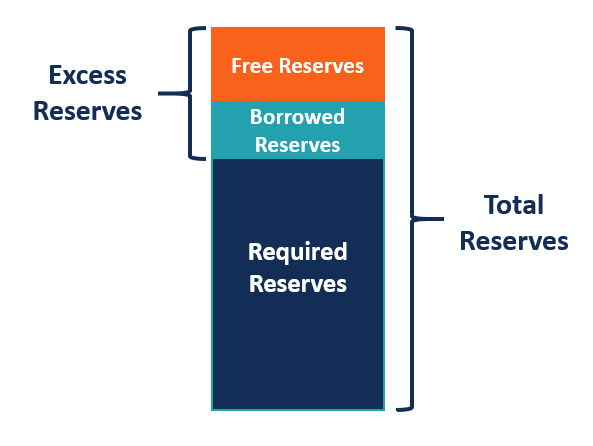
Free reserves are the part of excess reserves, excluding the reserves borrowed from the central bank. A higher level of excess reserves does not necessarily mean a higher level of free reserves. A commercial bank’s free reserve is the amount that the bank can lend out. If commercial banks have more free reserves, greater amounts of credits are available to businesses and individuals. It means a lower cost of financing and may lead to inflation.
The mechanisms of excess reserves and free reserves as tools of monetary policyMonetary PolicyMonetary policy is an economic policy that manages the size and growth rate of the money supply in an economy. It is a powerful tool to are similar. During economic downturns, the central bank can implement a lower IOER rate and Federal Funds rate to promote commercial banks to lower their free reserves and free up more money supply in the economy.
Related Readings
CFI offers the Commercial Banking & Credit Analyst (CBCA)™Program Page - CBCAGet CFI's CBCA™ certification and become a Commercial Banking & Credit Analyst. Enroll and advance your career with our certification programs and courses. certification program for those looking to take their careers to the next level. To keep learning and advancing your career, the following resources will be helpful:
- 2008 Global Financial Crisis 2008-2009 Global Financial CrisisThe Global Financial Crisis of 2008-2009 refers to the massive financial crisis the world faced from 2008 to 2009. The financial crisis took its toll on individuals and institutions around the globe, with millions of American being deeply impacted. Financial institutions started to sink, many were absorbed by larger entities, and the US Government was forced to offer bailouts
- Federal Funds RateFederal Funds RateIn the United States, the federal funds rate is the interest rate that depository institutions (such as banks and credit unions) charge other depository institutions.
- Reserve RatioReserve RatioThe reserve ratio – also known as bank reserve ratio, bank reserve requirement, or cash reserve ratio – is the percentage of deposits a financial institution must hold in reserve as cash. The central bank is the institution that determines the required amount of reserve ratio.
- Foreign Exchange ReservesForeign Exchange ReservesForeign exchange reserves refer to foreign assets held by the central bank of a country. Foreign assets comprise assets that are not denominated in the domestic currency of the country. For example, US government bonds held by the Bank of Japan are foreign assets for Japan.
-

Monetary Assets: Definition, Examples & Key Characteristics
Monetary assets are assets that carry a fixed value in terms of currency units (e.g., dollars, euros, yen). They are stated as a fixed value in dollar terms even when macroeconomic factors, such as in
-

Understanding Non-Monetary Assets: Definition & Examples
Non-monetary assets are assets whose value frequently changes in response to changes in economic and market conditions. The assets appear on the balance sheet under intangible and non-current assetsNo
finance
- Excess Reserves: Definition, Purpose & Banking Implications
- Understanding Agency Costs: Protecting Shareholder Interests
- Understanding Bank Reserves: A Comprehensive Guide
- Cash Reserves: Definition, Benefits & Short-Term Needs
- CCPPO Shares Explained: Understanding Cumulative, Convertible, & Participating Preferred Stock
- Understanding Company Bylaws: A Comprehensive Guide
- Corporate Bonds: A Comprehensive Guide to Investing
- Foreign Exchange Reserves: Definition & Importance
- Understanding Excess Returns (Alpha): A Comprehensive Guide
-
 Industrial REITs: Investing in the Future of Logistics & Warehousing
Industrial REITs are companies that own and manage real estate properties that are used for manufacturing, production, storage, and distribution of goods. The structure under which industrial REITs op...
-
 Understanding Dividends: A Guide for Investors
There are advantages and disadvantages relative to investing in stocks with dividends vs stocks without dividends. Dividends are periodic payments made by companies to owners of its stock. They are a ...