
Strategic Analysis: A Comprehensive Guide for Business Success
Strategic analysis refers to the process of conducting research on a company and its operating environment to formulate a strategy. The definition of strategic analysis may differ from an academic or business perspective, but the process involves several common factors:
- Identifying and evaluating data relevant to the company’s strategyCorporate StrategyCorporate Strategy focuses on how to manage resources, risk and return across a firm, as opposed to looking at competitive advantages in business strategy
- Defining the internal and external environments to be analyzed
- Using several analytic methods such as Porter’s five forces analysis, SWOT analysisSWOT AnalysisA SWOT analysis is used to study the internal and external environments of a company and is part of a company’s strategic planning process. In addition, a, and value chain analysis

What is Strategy?
A strategy is a plan of actions taken by managers to achieve the company’s overall goal and other subsidiary goals. It often determines the success of a company. In strategy, a company is essentially asking itself, “Where do you want to play and how are you going to win?” The following guide gives a high-level overview of business strategy, its implementation, and the processes that lead to business success.
Vision, Mission, and Values
To develop a business strategy, a company needs a very well-defined understanding of what it is and what it represents. Strategists need to look at the following:
- Vision – What it wants to achieve in the future (5-10 years)
- Mission Statement – What business a company is in and how it rallies people
- Values – The fundamental beliefs of an organization reflecting its commitments and ethics
After gaining a deep understanding of the company’s vision, mission, and values, strategists can help the business undergo a strategic analysis. The purpose of a strategic analysis is to analyze an organization’s external and internal environment, assess current strategies, and generate and evaluate the most successful strategic alternatives.
Strategic Analysis Process
The following infographic demonstrates the strategic analysis process:
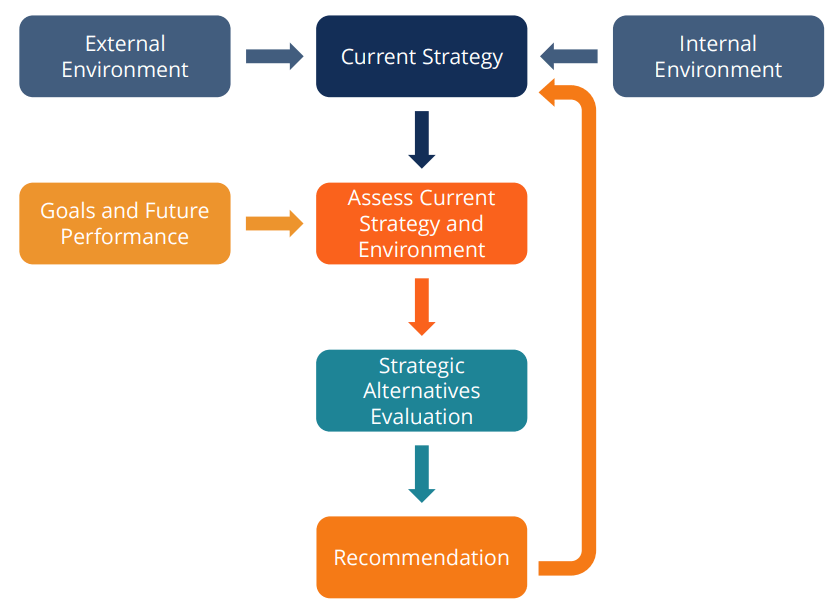
1. Perform an environmental analysis of current strategies
Starting from the beginning, a company needs to complete an environmental analysis of its current strategies. Internal environment considerations include issues such as operational inefficiencies, employee morale, and constraints from financial issues. External environment considerations include political trends, economic shifts, and changes in consumer tastes.
2. Determine the effectiveness of existing strategies
A key purpose of a strategic analysis is to determine the effectiveness of the current strategy amid the prevailing business environment. Strategists must ask themselves questions such as: Is our strategy failing or succeeding? Will we meet our stated goals? Does our strategy align with our vision, mission, and values?
3. Formulate plans
If the answer to the questions posed in the assessment stage is “No” or “Unsure,” we undergo a planning stage where the company proposes strategic alternatives. Strategists may propose ways to keep costs low and operations leaner. Potential strategic alternatives include changes in capital structure, changes in supply chain management, or any other alternative to a business process.
4. Recommend and implement the most viable strategy
Lastly, after assessing strategies and proposing alternatives, we reach a recommendation. After assessing all possible strategic alternatives, we choose to implement the most viable and quantitatively profitable strategy. After producing a recommendation, we iteratively repeat the entire process. Strategies must be implemented, assessed, and re-assessed. They must change because business environments are not static.
Levels of Strategy
Strategic plans involve three levels in terms of scope:
1. Corporate-level (Portfolio)
At the highest level, corporate strategyCorporate StrategyCorporate Strategy focuses on how to manage resources, risk and return across a firm, as opposed to looking at competitive advantages in business strategy involves high-level strategic decisions that will help a company sustain a competitive advantage and remain profitable in the foreseeable future. Corporate-level decisions are all-encompassing of a company.
2. Business-level
At the median level of strategy are business-level decisions. The business-level strategy focuses on market position to help the company gain a competitive advantage in its own industry or other industries.
3. Functional-level
At the lowest level are functional-level decisions. They focus on activities within and between different functions, aimed at improving the efficiency of the overall business. These strategies are focused on particular functions and groups.
Related Readings
CFI offers the Financial Modeling & Valuation Analyst (FMVA)™Become a Certified Financial Modeling & Valuation Analyst (FMVA)®CFI's Financial Modeling and Valuation Analyst (FMVA)® certification will help you gain the confidence you need in your finance career. Enroll today! certification program for those looking to take their careers to the next level. To keep learning and advancing your career, the following CFI resources will be helpful:
- Business Life CycleBusiness CycleA business cycle is a cycle of fluctuations in the Gross Domestic Product (GDP) around its long-term natural growth rate. It explains the
- Competitive AdvantageCompetitive AdvantageA competitive advantage is an attribute that enables a company to outperform its competitors. It allows a company to achieve superior margins
- Industry AnalysisIndustry AnalysisIndustry analysis is a market assessment tool used by businesses and analysts to understand the complexity of an industry. There are three commonly used and
- Types of Financial AnalysisTypes of Financial AnalysisFinancial analysis involves using financial data to assess a company’s performance and make recommendations about how it can improve going forward. Financial Analysts primarily carry out their work in Excel, using a spreadsheet to analyze historical data and make projections Types of Financial Analysis
-

Strategic Analysis: A Comprehensive Guide for Business Success
Strategic analysis refers to the process of conducting research on a company and its operating environment to formulate a strategy. The definition of strategic analysis may differ from an academi
-

Strategic Financial Management: A Comprehensive Guide
Strategic financial management is a term used to describe the process of managing the finances of a company to meet its strategic goals. It is a management approach that uses different techniques and
Business strategy
- Contribution Analysis: Understanding Profitability & Cost Management
- Credit Analysis: A Comprehensive Guide to Assessing Credit Risk
- Quantitative Analysis: Definition, Methods & Applications
- Assemble-to-Order (ATO): Definition, Benefits & Implementation
- Industry Analysis: A Comprehensive Guide for Business Insights
- Pareto Analysis: The 80/20 Rule Explained | [Your Brand/Website Name]
- Strategic Buyers: Definition, Types & Acquisition Strategies
- Strategic Planning: A Comprehensive Guide to Long-Term Success
- Top-Down Analysis: A Comprehensive Guide for Investors
-
 External Analysis: Understanding Your Industry & Market
External analysis means examining the industry environmentIndustry AnalysisIndustry analysis is a market assessment tool used by businesses and analysts to understand the complexity of an industry. Th...
-
 Organizational Analysis: Understanding & Improving Business Performance
Organizational analysis is the process of appraising the growth, personnel, operations, and work environment of an entity. Undertaking an organizational analysis is beneficial, as it enables managemen...