
Strategic Management: Definition, Objectives & Implementation
Strategic management is the formulation and implementation of major objectives and projects, by an organization’s management on behalf of its shareholders (or owners).ShareholderA shareholder can be a person, company, or organization that holds stock(s) in a given company. A shareholder must own a minimum of one share in a company’s stock or mutual fund to make them a partial owner. Typically, the formulation process starts with an assessment of available resources, an industry analysis to assess the competitive environment in which the company operates, and an internal operations assessment. From this overall assessment, a strategy is then created to achieve the desired goals. Implementation of the formulated strategyStrategyCorporate and business strategy guides. Read all CFI articles and resources on business and corporate strategy, important concepts for financial analysts to incorporate in their financial modeling and analysis. First mover advantage, Porter's 5 Forces, SWOT, competitive advantage, bargaining power of suppliers seeks to steer and align the company with its main objectives.

Components of Strategic Management
#1 Formulation
Formulation includes an assessment of the environment in which the organization operates and then creating a strategy on how the organization will operate and compete. This is similar to the first step of the budgetingBudgetingBudgeting is the tactical implementation of a business plan. To achieve the goals in a business’s strategic plan, we need some type of budget that finances the business plan and sets measures and indicators of performance. process.
#2 Implementation
Implementation includes the deployment of an organization’s resources to meet the desired objectives.
Frameworks for Strategic Management
#1. Competitive Advantage
An organization may achieve either lower cost of production or product differentiation as an advantage against its rivals. It is important to look at the market positioningMarket PositioningMarket Positioning refers to the ability to influence consumer perception regarding a brand or product relative to competitors. The objective of market of the brand and company and also to pinpoint all the competitive advantagesCompetitive AdvantageA competitive advantage is an attribute that enables a company to outperform its competitors. It allows a company to achieve superior margins the company has over its competitors.
#2. Corporate Strategy and Portfolio Theory
The Modern Portfolio Theory provides a framework for allocating assets so that, for a given level of risk, the expected returnExpected ReturnThe expected return on an investment is the expected value of the probability distribution of possible returns it can provide to investors. The return on the investment is an unknown variable that has different values associated with different probabilities. is maximized. Portfolio Theory allows corporations to perform a cost-benefit analysis on the deployment of resources and view the merit of individual resource placement to the company in its totality.
The Growth-Share Matrix, developed by the Boston Consulting Group, helps corporations analyze the value of their individual business units by plotting the business on an axis. The two parameters of judgment are market share – a measure of a business unit’s competitive position in regards to its peers – and industry growth rate – a measure of the prospects of the particular industry in which the unit operates.
#3. Core Competence
Businesses should seek to develop expertise in areas of relative excellence and eliminate or outsource the remainder of its business activities. By being able to do this, an organization can provide a unique and unparalleled product, service, or perspective to the market and consumers.
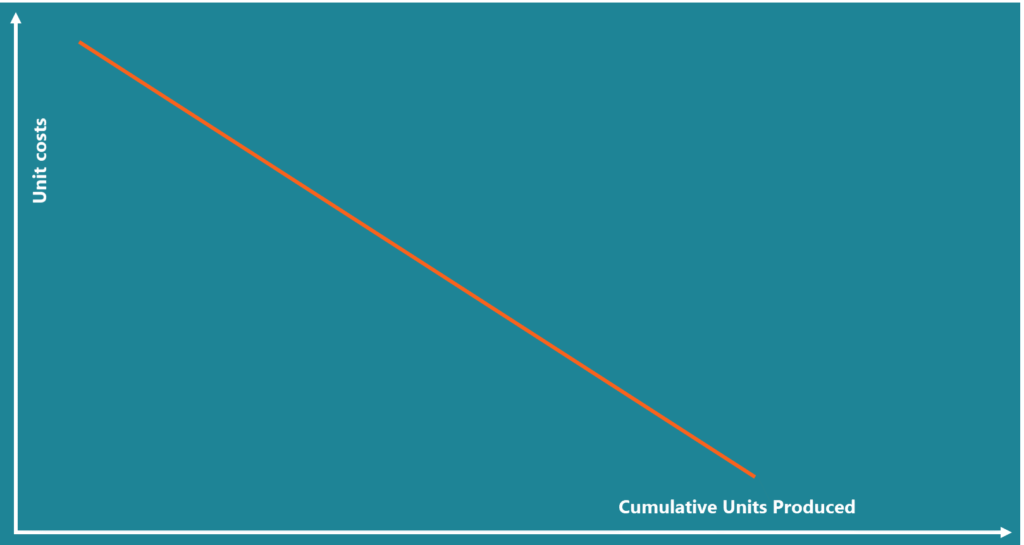
#4. Experience Curve
The experience curve expresses the proposition that whenever the output produced doubles, the value-addedValue AddedValue Added is the extra value created over and above the original value of something. It can apply to products, services, companies, management, and costs decline by a consistent percentage.
Generic Competitive Strategies
Companies should concentrate their strategy on either cost leadership, focus, or differentiation. According to famed business strategist Michael Porter, if a company does not place focus on a singular factor, it risks wasting its resources. Such a strategy places emphasis on either specializing in a product or service by creating a unique selling proposition or creating economies of scaleEconomies of ScaleEconomies of scale refer to the cost advantage experienced by a firm when it increases its level of output.The advantage arises due to the to achieve low costs of production.
Industry Structure and Profitability
The Competitive Forces Model (Porters 5 Forces) Competitive Forces ModelThe competitive forces model is an important tool used in strategic analysis to analyze the competitiveness in an industry. This model is more commonlyis a framework used to assess the competitiveness of the industry.
#1. Threat of new entrants
In a competitive industry, the threat of new entrants will be high. Assuming an industry or sector is highly profitable, it will be considered as an attractive business prospect by many. Some deterrents to ease of entry into a market include patents, high capital requirements, customer loyalty to established brands, and existing economies of scale.
#2. Threat of substitutes
If a product or experience can be easily duplicated with a similar alternative, the demand for that product is said to be diluted. If consumers can find similar alternative products, the industry or sector is deemed to be competitive.
#3. Bargaining power of customers
Customers will enjoy high bargaining power in a competitive market. Sellers will not be able to exert pricing pressure that will favor their profitability.
#4. Bargaining power of suppliers
When several suppliers are present to source raw or intermediary materials, they are not able to influence the final price in an unjustifiable way.
#5. Competitive rivalries
Competitive industries enjoy a high degree of innovation and evolved competitive and marketing strategies.
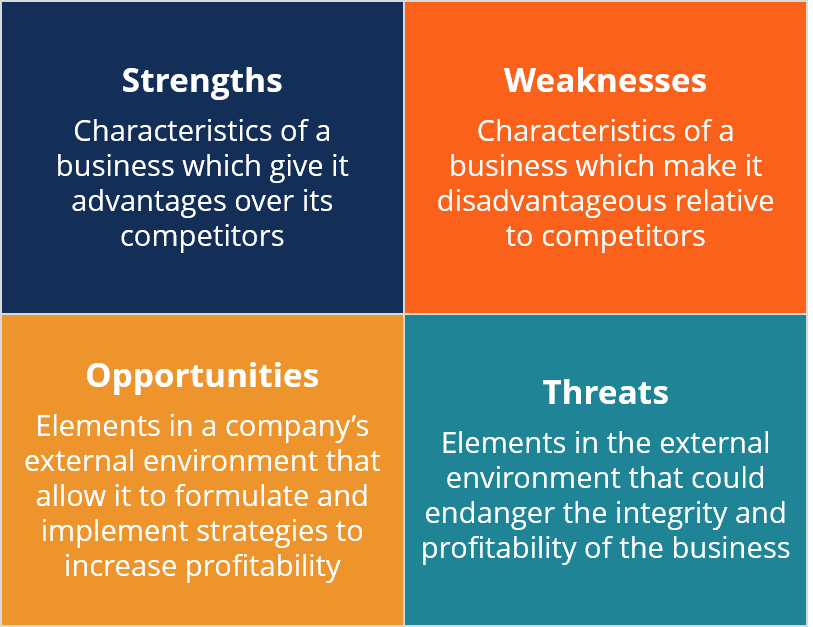
SWOT Analysis
SWOTSWOT AnalysisA SWOT analysis is used to study the internal and external environments of a company and is part of a company’s strategic planning process. In addition, a is an acronym for Strengths, Weaknesses, Opportunities, Threats. This framework is employed to assess internal strengths and weaknesses, to explore the external scope of opportunities available for the business to exploit, and to confront threats presented by opponents or policies.
Value Chain
The value chain consists of a list of processes or activities that a company performs to bring a product or service into the market. The activities are divided into two functions:
#1. Primary activities
These include functions that go directly into creating a good or service. They consist of functions such as inbound and outbound logistics, operations, marketing and sales, and servicing the product.
#2. Support activities
These include functions that facilitate the production of the good or service. They consist of functions such as human resources, technology, procurement, and infrastructure.
According to Porter, aligning activities can improve the operational efficiency of an organization and ultimately create a competitive advantage for it.
Related Readings
CFI is the official provider of the Financial Modeling and Valuation Analyst (FMVA)™Become a Certified Financial Modeling & Valuation Analyst (FMVA)®CFI's Financial Modeling and Valuation Analyst (FMVA)® certification will help you gain the confidence you need in your finance career. Enroll today! certification program, designed to transform anyone into a world-class financial analyst.
To keep learning and developing your knowledge of financial analysis, we highly recommend the additional CFI resources below:
- Corporate StrategyCorporate StrategyCorporate Strategy focuses on how to manage resources, risk and return across a firm, as opposed to looking at competitive advantages in business strategy
- CVP AnalysisCVP Analysis GuideCost Volume Profit Analysis (CVP analysis), also commonly referred to as Break Even Analysis, is a way for companies to determine how changes
- Management TheoriesManagement TheoriesManagement theories are concepts surrounding recommended management strategies, which may include tools such as frameworks and guidelines that can be implemented in modern organizations. Generally, professionals will not rely solely on one management theory alone
- Organizational AnalysisOrganizational AnalysisOrganizational analysis is the process of appraising the growth, personnel, operations, and work environment of an entity.
-

Streamlining Processes: Definition, Benefits & Techniques
Streamlining refers to the improvement of the efficiency of a certain process within an organization. It can be done by automationExcel vs Automation in Financial ModelingBefore we discuss Excel vs au
-

Understanding Business Structures: A Comprehensive Guide
There are different types of businesses to choose from when forming a company, each with its own legal structure and rules. Typically, there are four main types of businesses: Sole ProprietorshipsSole
Business strategy
- Divestiture Explained: Definition, Types & Examples
- Working Capital Management: A Comprehensive Guide
- Asset Management Companies (AMCs): A Comprehensive Guide
- Bootstrapping: How to Build a Business with Minimal Funding
- Business Operations: Definition, Activities & Optimization
- Understanding Limited Liability Companies (LLCs): A Comprehensive Guide
- Risk Management: A Comprehensive Guide for Business Success
- Strategic Alliances: Definition, Benefits & Examples | [Your Brand/Website Name]
- Strategic Financial Management: A Comprehensive Guide
-
 Ramp-Up: Definition, Benefits & How to Achieve It
In business, ramp-up is a term that describes a significant increase in the output of a company’s products or services. Essentially, ramp-up implies bringing the company’s capacity utiliza...
-
 Strategic Buyers: Definition, Types & Acquisition Strategies
A strategic buyer is a buyer who is already operating in the same industry as the company he’s trying to acquire. Often, strategic buyers are competitors, suppliers, or clients of the acquisitio...