
Understanding Variable Interest Entities (VIEs): Definition & Examples
A variable interest entity (VIE) may be any type of legal business structure. It can be, for instance, a trust, a partnership, a corporation, or joint ventureJoint Venture (JV)A joint venture (JV) is a commercial enterprise in which two or more organizations combine their resources to gain a tactical and strategic edge in the market. Companies often enter into a joint venture to pursue specific projects. The JV may be a new project or new core business. It is created such that even if an investor does not hold a majority of the voting rights, they are able to exercise a controlling interest in it.
A VIE is almost always created to protect a business from legal action by its creditors. It may also be an accounting structure wherein the equity investors are unable to finance the working capital needs or operating costs of the business.
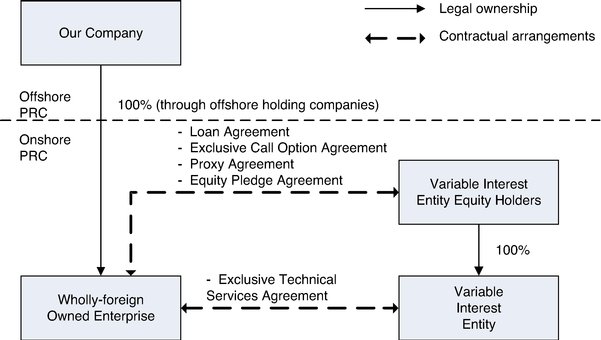
An accounting entity is an established economic unit to isolate the accounting of a certain type of transactions from other divisions of a business entity. Such an accounting entity may either be a corporation, a subsidiary within a corporation, or sole proprietorshipSole ProprietorshipA sole proprietorship (also known as individual entrepreneurship, sole trader, or proprietorship) is a type of an unincorporated entity that is owned only. The accounting entity is required to have a separate set of books that differentiates the assets and liabilities from those of the owner company or entity.
Summary
- A variable interest entity (VIE) may be any type of legal business structure created to protect the business from legal action by its creditors.
- A VIE may also be an accounting structure wherein the equity investors are unable to finance the working capital needs or operating costs of the business.
- Public companies are required to disclose their relationships with VIEs according to the accounting rules to be followed by corporations with respect to VIEs, as per the FASB.
Variable Interest Entity – Formation
A VIE is usually formed with a limited scope and purpose. For instance, a VIE may be established to finance a project – purchasing a large asset to lease it back to another entity without putting the entire business at risk. It is done by establishing special purpose vehicles that enable the company to hold financial assetsFinancial AssetsFinancial assets refer to assets that arise from contractual agreements on future cash flows or from owning equity instruments of another entity. A key passively or to conduct research and development activities actively.
Creating a VIE – Advantages
If done properly, a VIE can create a completely new risk category for the business. A less risky entity can bargain for credit at a lower rate of interest, drastically decreasing the cost of capital for new investments. A high-risk entity, on the other hand, can shield the company from higher liability.
Creating a VIE – Disadvantages
There exists a propensity to misuse structures such as VIE, for instance, to keep securitized assets off the balance sheets of corporates. Regulatory reforms that followed the 2008 global financial crisis sought to curtail the excessive use of asset-backed securities in the financial industry. However, due to lobbying efforts by banks, the Financial Accounting Standards Board (FASB) rules for VIEs were relaxed, which enabled banks to continue pouring debt in off-balance-sheet entities.
Variable Interest Entity – Disclosure Requirements
Public companiesPublic CompaniesPublic companies are entities that trade their stocks on the public exchange market. Investors can become shareholders in a public company by purchasing shares of the company's stock. The company is considered public since any interested investor can purchase shares of the company in the public exchange to become equity owners. are required to disclose their relationships with VIE according to the accounting rules to be followed by corporations with respect to VIEs, as per the FASB. In a situation where the company owns a majority interest in a VIE, the holdings are to be disclosed in the consolidated balance sheet of the company. The consolidation is not mandatory in situations where the company is not the primary beneficiary of such an entity.
Companies are also mandated to disclose information regarding VIEs wherein they hold a significant interest. It may include information on how the entity operates, the sources and quantum of financial support it receives, and the kind of financial support received, among other contractual commitments. An estimation of the potential losses that could be incurred by the VIE may also be included.
Related Readings
CFI is the official provider of the global Commercial Banking & Credit Analyst (CBCA)™Program Page - CBCAGet CFI's CBCA™ certification and become a Commercial Banking & Credit Analyst. Enroll and advance your career with our certification programs and courses. certification program, designed to help anyone become a world-class financial analyst. To keep learning and advancing your career, the additional CFI resources below will be useful:
- CorporationCorporationA corporation is a legal entity created by individuals, stockholders, or shareholders, with the purpose of operating for profit. Corporations are allowed to enter into contracts, sue and be sued, own assets, remit federal and state taxes, and borrow money from financial institutions.
- EntityEntityAn entity is an organization created by one or more people to carry out the functions of a business, and that maintains a separate legal existence for tax
- PartnershipPartnershipA partnership is a type of business where two or more people establish and run a business together. There are three main types of partnerships: GP, LP, LLP
- Special Purpose Vehicle (SPV)Special Purpose Vehicle (SPV)A Special Purpose Vehicle/Entity (SPV/SPE) is a separate entity created for a specific and narrow objective, and that is held off-balance sheet. SPV is a
-

Mortgage Interest Credit: Tax Benefits & Eligibility
A mortgage interest credit is a tax deduction that can be filed on your federal income tax returns. According to the IRS (and Form 8223 that is filed for mortgage interest credit), you have to possess
-
Accrued vs. Regular Interest: Understanding the Difference
When investing in stocks and bonds, investors are paid either an accrued interest vs regular interest at an agreed period. The interest payments are not paid immediately, and security issuers will owe
Business strategy
- Understanding Add-On Interest: How It Works & Loan Payments
- Entity Theory: Separating Business & Personal Finances - Definition & Benefits
- Understanding Interest: Costs & Rewards of Borrowing and Lending
- Understanding Interest Income: A Comprehensive Guide
- Understanding Interest Rates: A Comprehensive Guide
- Mortgages Explained: Your Guide to Home Loans & Financing
- Understanding Vested Interest: Definition & Implications
- Understanding Business Entities: Types & Legal Structures
- Variable Interest Entities (VIEs): Definition, Requirements & Implications
-
 Understanding Debt Holders: A Guide to Creditors and Debt Markets
Credit markets help investors grow wealth above inflation. Investors explore debt markets to grow wealth above inflation. Debt markets serve as investment mediums to match businesses seeking ...
-
 Interest Alignment: Understanding Shared Benefits & Relationships
Image of stock prices and percentages. Interest alignment -- or more commonly, "alignment of interests" -- describes an arrangement or relationship in which all parties stand to ben...