
Value-Based Pricing: A Comprehensive Guide to Maximizing Revenue
Value-based pricing is a strategy for pricing goods or services that adjusts the price based on its perceived value rather than on its historical price. The value-based pricing strategy is used to increase revenueSales RevenueSales revenue is the income received by a company from its sales of goods or the provision of services. In accounting, the terms "sales" and by increasing prices without a significant effect on volume.
Summary
- Value-based pricing is a strategy for pricing goods or services that adjusts the price based on its perceived value rather than its historical price.
- The strategy is used when the purchasing decision is emotionally-driven or when scarcity is involved.
- Value pricing is going to price items at a higher level than cost-plus pricing by increasing the perceived value of the good or service.
When is Value-Based Pricing Used
Value-based pricing is used when the perceived value of the product is high. The strategy tends to involve products that possess a certain level of prestige in ownership or are completely unique.
Designer apparel companies are well-known for using value-based pricing. While a designer shirt may cost nominally more than a non-designer shirt to produce, the status carried by the designer brand increases the perceived value of the shirt. Many companies capitalize on such perception, increasing their margins greatly, while minimally reducing sales volume.
A similar strategy may also be used when the purchasing decision is emotionally driven. For example, while a famous painting may sell for millions of dollars at an auction, the cost of creating that painting is meaningless relative to the sale price. The value and price are being derived from the prestige of the artist, as well as other emotional aspects that the buyer may connect with.
Value-based pricing is also often used when scarcityScarcityScarcity, also known as paucity, is an economics term used to refer to a gap between availability of limited resources and the theoretical is involved. For example, at a concert, bottled water may be on sale for $6. However, you can buy the same bottle from a vending machine outside of the concert area for $1 only. The difference in pricing is reflected in the scarcity of water at the concert, and the need for concertgoers to drink water.
Cost-Plus Pricing vs. Value-Based Pricing
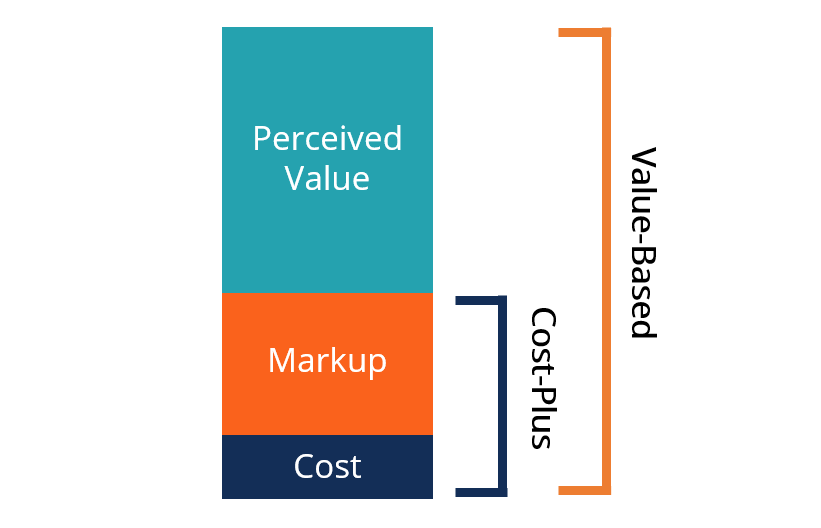
To better understand value-based pricing, you need to understand how it differs from cost-plus pricing. In cost-plus pricing, the seller simply takes the cost of producing the good or service and adds a premium. In this sense, the main determiner of price in a cost-plus pricing strategy is the cost of producing that item. In value-based pricing strategies, prices are always equal to or higher than in cost-plus pricing strategiesVariable Cost-Plus PricingVariable cost-plus pricing is a type of pricing method wherein the selling price of a given product is determined by adding a markup over the total variable.
The above diagram shows that a cost-plus pricing strategy adds a certain markup, making the price of the item dependent on its cost. The value-based pricing strategy is used on items that demonstrate a level of perceived value much greater than the cost.
Issues with Value-Based Pricing
Value-based pricing may not always be the best pricing strategy for a company, and implementing it can come with several obstacles. It can be very difficult to evaluate the perceived value of a product or serviceProducts and ServicesA product is a tangible item that is put on the market for acquisition, attention, or consumption while a service is an intangible item, which arises from. With cost-plus pricing or competition-based pricing, a price can be decided relatively easily by evaluating costs or the competitor’s prices. The value-based pricing strategy involves guesswork and is more qualitative in nature.
Execution of Value-Based Pricing Strategy
The way that a product is marketed and perceived by consumers is especially important in a value-based pricing strategy. As the price level is going to be higher than a cost-plus strategy, the perceived value needs to be strong. This can cause implementation costs to be more with value-based pricing, as extensive research must be done to arrive at a pricing decision. Also, differentiating the product from similar competing products may require a substantial investment.
Example
Assume an individual works for a film production company and is tasked with pricing merchandise for an upcoming Spiderman film. The production company owns all rights over Spiderman-branded merchandise, meaning it won’t need to compete with other companies on price. Additionally, the new Spiderman stars Tobey Maguire, a fan favorite.
The merchandise would be the perfect candidate for a value-based pricing strategy. First, as other companies can’t legally produce the merchandise, you won’t need to worry about lowering the price to remain competitive. Additionally, the fact that Tobey Maguire is starring in the film means that the fans are willing to pay more for the same item. Therefore, the perceived value of the product increases.
More Resources
CFI is the official provider of the Commercial Banking & Credit Analyst (CBCA)™Program Page - CBCAGet CFI's CBCA™ certification and become a Commercial Banking & Credit Analyst. Enroll and advance your career with our certification programs and courses. certification program, designed to transform anyone into a world-class financial analyst.
In order to help you become a world-class financial analyst and advance your career to your fullest potential, these additional CFI resources will be very helpful:
- 4 P’s of Marketing4 P’s of MarketingThe “4 P’s of Marketing” refer to the four key elements comprising the process of marketing a product or service. They involve a marketing
- Brand EquityBrand EquityIn marketing, brand equity refers to the value of a brand and is determined by the consumer’s perception of the brand. Brand equity can be positive or
- Market PositioningMarket PositioningMarket Positioning refers to the ability to influence consumer perception regarding a brand or product relative to competitors. The objective of market
- Opportunity CostOpportunity CostOpportunity cost is one of the key concepts in the study of economics and is prevalent throughout various decision-making processes. The
-

0x: A Comprehensive Guide to Decentralized Ethereum Trading
What Is 0x? 0x is a decentralized exchange for trading ERC 20 tokens. (See also: What Is ERC 20 And What Does It Mean For Ethereum?). It is among the most high-profile examples of decentra
-
Annuities Explained: A Simple Guide to Retirement Income
So you're wondering what is an annuity? There are dozens of different flavours of annuities that perform different functions and pay their holders out in different ways, but for our purposes let’
Business strategy
- Arbitrage Pricing Theory (APT): A Comprehensive Overview
- Understanding Bond Pricing: Key Factors & Valuation
- Understanding Historic Pricing and Net Asset Value (NAV)
- Matrix Pricing: Estimating Value for Illiquid Securities
- High-Low Pricing Strategy: Definition & How It Works
- Loss Leader Pricing: Strategy, Benefits & Examples
- Penetration Pricing: A Comprehensive Guide to Gaining Market Share
- Predatory Pricing: Definition, Tactics & Legal Implications
- Forward Pricing in Mutual Funds: A Clear Explanation
-
 Understanding Regulation Z: Your Rights as a Borrower
Regulation Z is a consumer-protection regulation that compels lenders to disclose the cost of credit in a clear way for consumers. Whether you’re applying for a mortgage or dealing...
-
DeFi Explained: A Beginner's Guide to Decentralized Finance
The Beginner’s Guide to Decentralized FinanceIf you’re diving deep into the world of cryptocurrency, you have probably heard the term “DeFi” used to describe a variety of new protocols and assets. Fi...