
Facebook Libra Project: A Deep Dive into the Cryptocurrency Initiative
- Libra token, designed broadly similar to other cryptocurrencies, but differed fundamentally to operate as a more stable (and less speculative asset), and
- Blockchain network that would be the technical foundation of the token and the tool for verifying transactions and confirming token ownership.
The Libra Association:
Facebook’s New Crypto Oligarchy
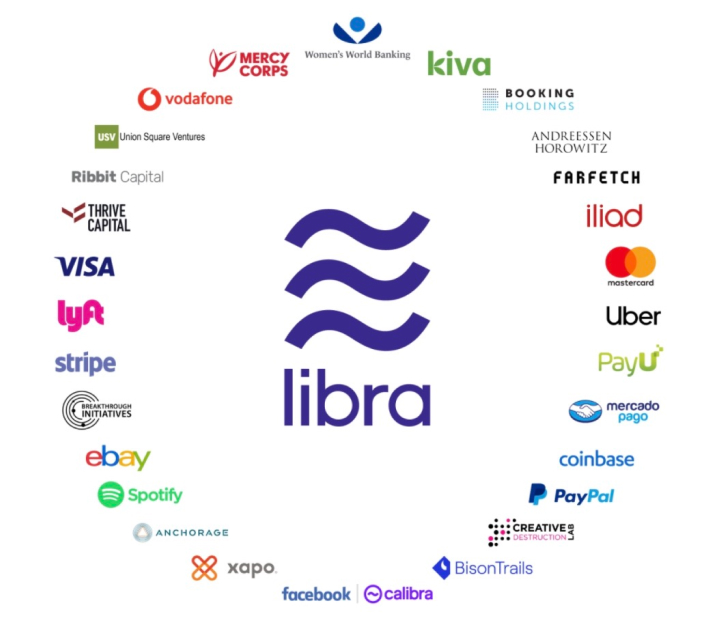
Anticipating scrutiny towards the project, which did in fact come in waves, Facebook created a nonprofit, called the Libra Association, based in Geneva, Switzerland.
The Libra Association serves two main functions:
- To validate transactions on the Libra blockchain, and
- To manage the reserve Libra is tied to and allocates funds to social causes.
Membership
Within the Libra Association is a governing body called the Libra Association Council, comprised of a representative of each member of the association. These representatives will then vote on policy and operating decisions.
Each founding member to the Libra Association paid a minimum of $10 million to join and optionally become a validator node operator, gain one vote in the Council and be entitled to a share (proportionate to their investment) of the dividends from interest earned on the Libra reserve into which users pay fiat currency to receive Libra.
At launch, the Libra Association’s founding members included 27 companies:
Payment Providers- Mastercard
- PayPal
- PayU (Naspers’ fintech arm)
- Stripe
- Visa (via Letter of Intent)
- Booking Holdings
- eBay
- Facebook/Calibra
- Farfetch
- Lyft
- Mercado Pago
- Spotify AB
- Uber Technologies, Inc.
- Iliad
- Vodafone Group
- Coinbase
- Anchorage
- Bison Trails
- Xapo Holdings Limited
- Andreessen Horowitz
- Breakthrough Initiatives
- Ribbit Capital
- Thrive Capital
- Union Square Ventures
- Creative Destruction Lab
- Kiva
- Mercy Corps
- Women’s World Banking
Facebook/Calibra’s membership in the Libra Association allows Facebook (along with each member) to get up to only one vote or 1% of the total vote, whichever is larger, in the Libra Association council.
Exit of Libra Co-Founder Morgan Beller
However, Facebook’s initial June 18, 2019 announcement that it would be shifting course into the world of finance, creating a global financial system didn’t last long.
Upon its announcement, it immediately attracted an outcry of privacy concerns by lawmakers and regulators due to the ongoing concerns surrounding Facebook’s platform and advertising policies--something that its CEO is still answering for before Congress in 2020.
Within minutes, France’s Minister of the Economy and Finance, Bruno le Maire, who happened to be in the middle of a live interview when Facebook first published its announcement, responded within minutes, criticizing Libra, and stating that Libra should not be developed in the EU. Other politicians and government officials quickly followed suit.
On July 15, 2019, Facebook announced that its currency would not be launching until all regulatory concerns have been met and Libra has the “appropriate approvals”.
In September 2019, Morgan Beller, 27, left her role as Novi’s head of strategy to become a partner at NFX, a venture capital firm focused on seed investments with offices in San Francisco and Herzliya, Israel.
Beller rose to prominence in 2019 as one of the founders behind Libra, developing the idea for the Facebook-backed digital currency alongside David Marcus, a former PayPal president and Facebook vice president. She has been credited by those throughout the blockchain community as the original driving force behind Facebook’s decision to enter the cryptocurrency sector.
October 2019: Mass-Wide Exits
One month after Beller left Libra, seven companies, including PayPal, Mastercard, Visa, Mercado Page, eBay, Stripe, and Booking Holdings pulled out of the Libra Association in fear of regulatory and privacy concerns.
Facebook claims it will keep financial data from transactions on Libra separate from user ad profiles. The blockchain is “pseudonymous”, the company said and, like many crypto networks, will allow users to hold one or more addresses not linked to their real-life identities. They also keep the integration into Facebook Messenger and WhatsApp separate from Facebook user data.
Vodafone Exits
During that same period, British telecom conglomerate Vodafone, became the eighth company to pull out of the Libra Association, but first one to exit the company since it was formally organized. Instead, Vodafone said it would be leaving specifically to focus on its own related, successful digital payments service, M-Pesa, and that the exit was unrelated to the regulatory concerns.
-

Understanding HOA Estoppel Letters: A Comprehensive Guide
You likely need an estoppel letter when buying or selling a condominium unit or house that's subject to a homeowners association, commonly known as an HOA. A buyer and mortgage lender want to know
-

Libra Cryptocurrency: A Comprehensive Overview for Consumers
Cryptocurrencies have become a global phenomenon in the past few years. Now Facebook is launching it’s own cryptocurrency, in association with Visa, MasterCard,
Fund information
- Understanding Baselines: Performance Measurement & Project Management
- Libra Cryptocurrency: A Comprehensive Overview
- Project Budget: Definition, Template & Cost Estimation
- Project Sequencing: Strategic Investment & Capital Budgeting
- Real Estate Project Finance: A Comprehensive Guide
- Social Impact Bonds: Investing in Social Good & Outcomes
- Expansion Projects: Definition, Types & Strategic Growth
- Libra Cryptocurrency: What You Need to Know About Facebook's Digital Currency
- CrypToadz NFTs: Understanding the Viral Collection & How to Buy
-
Social Impact Bonds: Investing for Social Good | [Your Company Name]
More and more of us are concerned about investing in companies that practice ethical and environmentally-conscious business by engaging in socially responsible investing (SRI) and ESG investing. But t...
-
Facebook's Libra: Crypto Leaders React to Social Media Giant's Cryptocurrency
After over a decade of peaceful co-existence, the two most significant technology innovations to hit the market this century are finally joining forces. The merging of cryptocurrency ...