
Social Impact Bonds: Investing in Social Good & Outcomes
A social impact bond (also known as a social benefit good or social bond) is a type of financial securityFixed Income SecuritiesFixed income securities are a type of debt instrument that provides returns in the form of regular, or fixed, interest payments and repayments of the that provides capital to the public sector to fund projects that will create better social outcomes and lead to savings. These bonds are a new development in finance. UK-based Social Finance Ltd introduced the first social impact bond in 2010.
Purpose of Social Impact Bonds
The purpose of social impact bonds goes beyond its financial component. The securities are intended to help align the interests of different entities – including governments, investors, social enterprises, and the general public – to develop effective solutions for public-sector problems.
Although the security is called a bond, they lack most of the features of conventional bonds. They feature a fixed term, but they do not offer a fixed rate of returnRate of ReturnThe Rate of Return (ROR) is the gain or loss of an investment over a period of time copmared to the initial cost of the investment expressed as a percentage. This guide teaches the most common formulas to investors. Instead, the repayment of the bonds primarily depends on the success of the project that has been subsidized using the bonds.
If a project is successful, the investors are repaid by the government using the savings that have been created by the project. However, if the project fails, the investors do not receive anything. Therefore, social impact bonds come with high risks for investors.
How Does a Social Impact Bond Work?
Social impact bonds are often differentiated from other fixed securities by the number of key players involved in the capital-raising processCapital Raising ProcessThis article is intended to provide readers with a deeper understanding of how the capital raising process works and happens in the industry today. For more information on capital raising and different types of commitments made by the underwriter, please see our underwriting overview.. The steps involved in the process include:
1. Identifying the problem and possible solutions
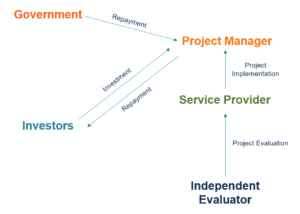
Generally, the process starts when the government identifies a challenge or problem in the public sector. Some of the problems include public safety, health, and family support services. Then, the government determines possible solutions to the identified problem, which can include a proven strategy or program that can be reproduced.
2. Raising funds for the project from private investors
After the potential solution has been identified, the government works to attract private investors to the project. The parties determine the quantifiable metrics that will indicate the project’s success.
Interested investors provide the required capital to support the operations and execution of the solution. Note that the investors do not receive any interest payments for the duration of the project.
3. Implementing the project
The project managerProject ManagementProject management is designed to produce an end product that will make an impact on an organization. It is where knowledge, skills, experience, and uses the obtained funds to finance the project’s operations, and the service provider begins the implementation of the program.
4. Assessing the project’s success and paying the project manager and investors
At the end of the fixed term, an independent evaluator completes the assessment of the project’s success based on the predetermined metrics. If the project meets the criteria, the government pays the project manager, who then transfers the funds to the investors in the social impact bonds.
More Resources
Thank you for reading CFI’s explanation of social impact bonds. CFI is the official provider of the Financial Modeling and Valuation Analyst (FMVA)™Become a Certified Financial Modeling & Valuation Analyst (FMVA)®CFI's Financial Modeling and Valuation Analyst (FMVA)® certification will help you gain the confidence you need in your finance career. Enroll today! certification program, designed to transform anyone into a world-class financial analyst.
To keep learning and developing your knowledge of financial analysis, we highly recommend the additional resources below:
- Equity CrowdfundingEquity CrowdfundingEquity crowdfunding (also known as crowd-investing or investment crowdfunding) is a method of raising capital used by startups and early-stage companies. Essentially, equity crowdfunding offers the company’s securities to a number of potential investors in exchange for financing.
- Junk BondsJunk BondsJunk Bonds, also known as high-yield bonds, are bonds that are rated below investment grade by the big three rating agencies (see image below). Junk bonds carry a higher risk of default than other bonds, but they pay higher returns to make them attractive to investors.
- Private Equity FundsPrivate Equity FundsPrivate equity funds are pools of capital to be invested in companies that represent an opportunity for a high rate of return. They come with a fixed
- Revenue-based FinancingRevenue-Based FinancingRevenue-based financing, also known as royalty-based financing, is a type of capital-raising method in which investors agree to provide capital to a company in exchange for a certain percentage of the company’s ongoing total gross revenues.
-

Asset Swap Explained: Definition, OTC Trading & Key Concepts
An asset swap is a derivative contract between two parties that swap fixed and floating assets. The transactions are done over-the-counterOver-the-Counter (OTC)Over-the-counter (OTC) is the trading of
-

Understanding Bond Pricing: Key Factors & Valuation
Bond pricing is an empirical matter in the field of financial instrumentsPublic SecuritiesPublic securities, or marketable securities, are investments that are openly or easily traded in a market. The
invest
- Coupon Bonds: Understanding Fixed Income & Interest Payments
- Development Impact Bonds: Investing in Social Change
- Discount Bonds: Understanding Pricing & Secondary Markets
- Impact Investing: Generate Returns & Positive Change
- Understanding Noncallable Securities: A Comprehensive Guide
- Samurai Bonds: A Guide to Understanding Yen-Denominated Corporate Debt
- Treasury Bonds: A Comprehensive Guide to U.S. Government Debt
- Zero-Coupon Bonds: Definition, How They Work & Examples
- Social Impact Bonds: Investing for Social Good | [Your Company Name]
-
 Amortized Bonds: Understanding Principal Repayment
An amortized bond is a bond with the principal amount – otherwise known as face value –regularly paid down over the life of the bond. The bond’s principal is divided up according to ...
-
 ASCOT Options: Understanding Asset-Swapped Convertible Options
The term ASCOT is short for Asset Swapped Convertible Option Transaction. It is an American style call option to buy back a convertible bond. It falls under the category of financial products called s...