
Understanding Canadian Income Tax Brackets: A Comprehensive Guide
This article will outline how Canadian tax brackets function. The income taxationAccounting For Income TaxesIncome taxes and their accounting is a key area of corporate finance. There are several objectives in accounting for income taxes and optimizing a company's valuation. system in Canada is a progressive system, meaning that individuals who earn more are generally taxed more. By contrast, in a flat taxation system, everyone pays the same percentage of their incomes in income taxes. Canadians are required to pay a combination of both federal and provincial income taxes.

Federal Income Tax Brackets (2018)
As of 2018, Canadian tax brackets at the federal level are as follows:
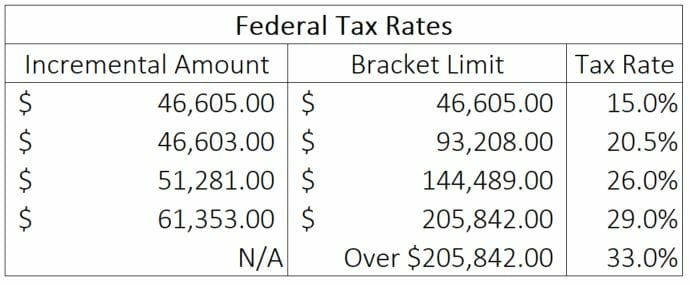
- “Incremental Amount” here refers to the maximum additional income that can be taxed at the next bracket’s tax rate before being taxed overall at a higher rate.
- “Bracket Limit” refers to the maximum total income that can fall into each of the tax brackets.
- “Tax Rate” refers to the applicable rate of taxation for the given income bracket.
Taking a quick look at the rate differences between the lowest and highest tax brackets, we can see that individuals who earn in excess of $205,842 are taxed twice as much as individuals making less than $46,605.
Provincial Income Tax Brackets (2018)
For a complete list of Canadian provincial tax brackets, please visit the Government of Canada’s tax website.
Within Canada, each province imposes its own income tax rates that are set by the provincial governments. Provincial taxes go to fund small-to-medium scale public service and infrastructure projects within the provinces.
Example of Canadian Tax Brackets
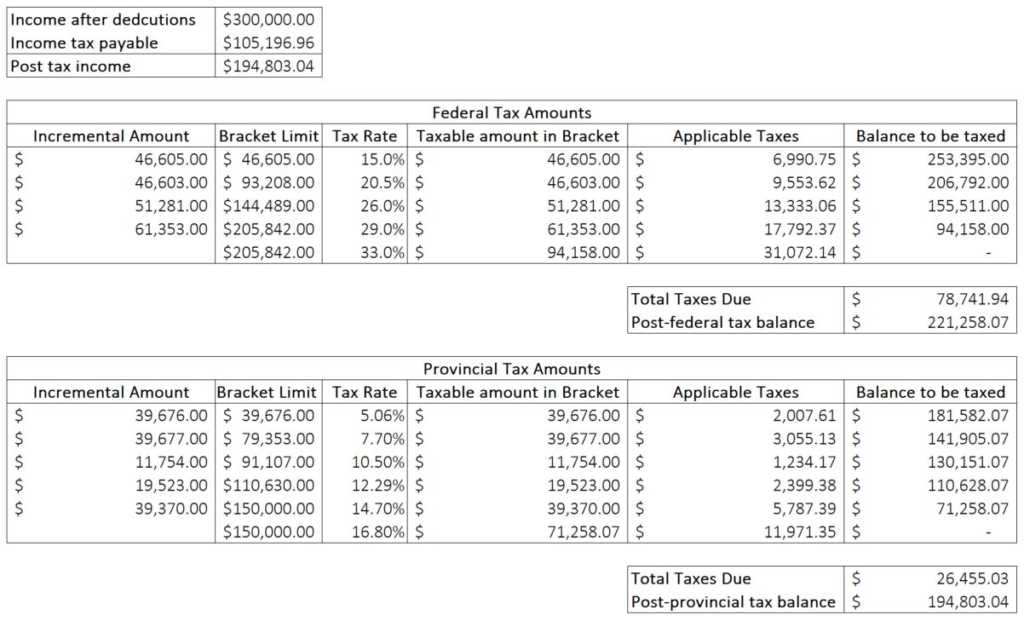
Below is a detailed breakdown of how income taxes would be applied to a $300,000 income. The example assumes that the income taxes are being filed in British Columbia and, thus, are subject to B.C. provincial taxes.
More about the Progressive Tax System
Progressive tax systemsProgressive TaxA progressive tax is a tax rate that increases as the taxable value goes up. It is usually segmented into tax brackets that progress to enable governments to capitalize on the concept of decreasing marginal utility. The idea is that once individuals reach a certain amount of income, each additional dollar generated above that threshold holds less and less utility. This is because after meeting the threshold, individuals begin to view other resources, such as time, as more valuable. Assessing the threshold is quite difficult, as every person follows a different utility curve.
Most tax experts agree that a progressive tax system is most conducive to combatting income inequality.
Additional Resources
Thank you for reading CFI’s guide to Canadian tax brackets. To learn more about related tax topics, check out the following CFI articles:
- Ad Valorem TaxAd Valorem TaxThe term “ad valorem” is Latin for “according to value,” which means that it is flexible and depends on the assessed value of an asset, product or service.
- Permanent/Temporary Differences in Tax AccountingPermanent/Temporary Differences in Tax AccountingPermanent differences are created when there's a discrepancy between pre-tax book income and taxable income under tax returns and tax
- Tax HavenTax HavenA tax haven or offshore financial center is any country or jurisdiction that offers minimal tax liability to foreign individuals and businesses.
- Tax ShieldTax ShieldA Tax Shield is an allowable deduction from taxable income that results in a reduction of taxes owed. The value of these shields depends on the effective tax rate for the corporation or individual. Common expenses that are deductible include depreciation, amortization, mortgage payments and interest expense
-

Voluntary Tax Compliance: Understanding the U.S. Tax System
Voluntary compliance is an assumption under which the U.S. tax system operates. It is the principle for which all the taxpayers will cooperate with the tax system, filing an honest and accurate annual
-

Understanding Canadian Income Tax: A Comprehensive Guide
Benjamin Franklin’s infamous quote certainly holds true in Canada.“In this world nothing can be said to be certain, except death and taxes,”Canada’s taxes are as abundant as our lakes. First there are
finance
- Corporate vs. Personal Income Tax: Key Differences Explained
- Understanding Federal Income Tax: A Comprehensive Guide
- Understanding Foreign Tax Credits: A Comprehensive Guide
- Understanding Income Tax: A Comprehensive Guide for Individuals & Businesses
- Understanding Income Tax Payable: A Guide for Businesses
- Interest Tax Shields: Understanding Tax Deductions on Interest Expense
- Understanding Net of Tax: Definition & Calculation
- 2020 Federal Income Tax Brackets: Rates & Ranges | Credit Karma Tax
- 2019 State Income Tax Rates: A Comprehensive Overview
-
 Hybrid Securities: A Comprehensive Guide to Balanced Investments
Hybrid securities are investment instruments that combine the features of pure equities and pure bonds. These securities tend to offer a higher return than pure fixed income securitiesFixed Income Sec...
-
 Understanding Deferred Income Tax: A Comprehensive Guide
Deferred income tax is a liability that can be found on a balance sheet. It results from differences in income tax recognition between tax laws (IRS) and accounting methods (GAAPGAAPGAAP, Generally Ac...