
Canadian Dollar (CAD): Your Complete Guide to the Canadian Currency
The Canadian Dollar refers to Canada’s domestic currency and is abbreviated as CAD. A Canadian dollar consists of 100 cents and is also described as C$ to differentiate it from other dollar-denominated national currencies, such as the US dollarUnited States Dollar (USD)The United States Dollar refers to the national currency of the U.S and is represented by the ISO code USD and is often abbreviated as US$.. The Canadian dollar is considered a benchmark currency, implying that this currency is held as a reserve currency by various global central banks.
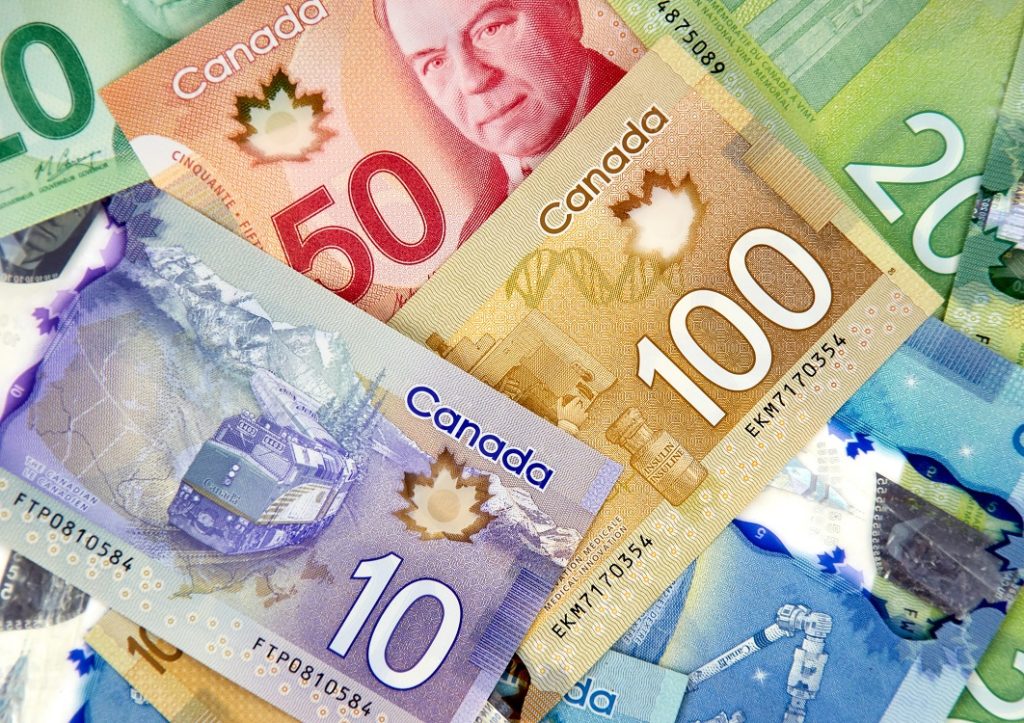
The Canadian dollar is regarded as a hard currencyHard CurrencyA hard currency refers to a currency that is generally issued by developed countries, globally traded, and seen as politically and, which means that the currency appears to be relatively stable (over shorter periods) because it comes from a nation that is economically and politically stable. The CAD’s also become more common as a reserve currency kept by international central banks since the financial crisis of the late 2000s.
Summary
- The Canadian Dollar represents Canada’s official currency and is abbreviated as CAD.
- CAD is regarded as a hard currency, which means that the currency appears to be relatively stable.
- Natural resources serve as an essential part of the economy of Canada; hence, its currency appears to vary according to the price of commodities around the world.
History of the Canadian Dollar
The Canadian government introduced Canadian coins in 1858. The Canadian dollar replaced the Canadian pound and continues to be in use. In 1871, the federal government enacted the Uniform Currency Act, which substituted the multiple currencies used by various provinces with one Canadian dollar. The CAD’s changed throughout its history between being pegged to the U.S. dollar or gold and being permitted to move freely.
The Canadian dollar was first licensed to change according to the forex market in 1950. It was pegged again from 1962-1970, as part of the fixed exchange rate scheme of the Bretton Woods Agreement. As the Bretton Woods regime started to break down in 1970, CAD was allowed to change according to the forex market, and it has floated since then along with all key currencies around the world.
The Bank of Canada (BoC) is in charge of the production and distribution of banknotes to different banks across Canada. On one side, all Canadian coins include the image of the ruling British monarch and different designs on the other side. Canada stopped issuing $1 bills in 1989, two years after the loonie was introduced, which shows a typical loon on the front side. Similarly, with the introduction of the “toonie,” the country’s $2 coin, the production of the $2 bill ceased in 1996.
In 2012, Canada stopped making the penny and discontinued it completely in 2013. Nevertheless, the coin still exists as a legal tender. Retailers round up cash purchases to the nearest five cents since the penny is no longer in circulation. The non-cash transactions are also conducted to the penny.
Currently, banknotes are officially issued in denominations of 5 CAD, 10 CAD, 20 CAD, 50 CAD, and 100 CAD. Six denominations of currency circulate as coins – 5 cents, 10 cents, 25 cents, 50 cents, 1 CAD, and 2 CAD – in Canada.
Frontier Series Canadian Dollar and Monetary Policy
In an attempt to combat forging, the BoC issued a new series of banknotes, and paper notes are no longer printed. The series – called the Frontier Series – is the seventh one in Canada and is made entirely of polymer, a synthetic material that offers security features applied to the currency. The frontier series was presented for the first time in June 2011, and in the same year, the first bill of 100 CAD was put into use. Over the next two years, the remaining bills of $50, $20, $10, and $5 were released.
Canada keeps an autonomous monetary policyMonetary PolicyMonetary policy is an economic policy that manages the size and growth rate of the money supply in an economy. It is a powerful tool to. The BoC is responsible for monitoring the execution of the policies in ways that it believes are better tailored to the economic conditions and inflation goals of Canada. Established in 1935, the BoC is based in Ottawa. It is governed by the Board of Governors, the bank’s policy-making body.
The value of the Canadian dollar and monetary policies are heavily affected by commodity prices around the globe. Natural resources are an essential part of the economy of Canada; hence, its currency appears to vary according to the price of commodities around the world. The US dollar is the commonly used benchmark for the Canadian dollar in the foreign exchange market and USD/CAD is one of the most traded currency pairs.
Additional Resources
CFI is the official provider of the Commercial Banking & Credit Analyst (CBCA)™Program Page - CBCAGet CFI's CBCA™ certification and become a Commercial Banking & Credit Analyst. Enroll and advance your career with our certification programs and courses. certification program, designed to transform anyone into a world-class financial analyst.
To keep learning and developing your knowledge of financial analysis, we highly recommend the additional resources below:
- Currency PairCurrency PairA currency pair is a quotation of two different currencies, where one is quoted against the other. The first listed currency within a currency
- Kuwaiti Dinar (KWD)Kuwaiti Dinar (KWD)Kuwaiti Dinar is the legal tender of the State of Kuwait, an oil-rich nation in the Middle East that is surrounded by Iraq and Saudi Arabia.
- USD/CAD Currency CrossUSD/CAD Currency CrossThe USD/CAD currency pair represents the quoted rate for exchanging US to CAD, or, how many Canadian dollars one receives per US dollar. For example, a USD/CAD rate of 1.25 means 1 US dollar is equivalent to 1.25 Canadian dollars. The USD/CAD exchange rate is affected by economic and political forces on both
- Top Banks in CanadaTop Banks in CanadaBanks in Canada include 29 domestic banks, 24 foreign bank subsidiaries, 27 full-service foreign bank branches, & 3 foreign bank lending branches.
-

CAD/USD Exchange Rate: Understanding the Value of the Canadian Dollar
The value of dollars in Canada depends on the exchange rate. Canada and the United States both call their unit of currency the dollar. Despite the name, these are two different currencies and
-

Dollar Pegged Currencies: A Comprehensive List & Explanation
Close-up of an exchange rate board of foreign currencies Countries have two ways to establish the value of their currency on the international market. Many choose to use a fixed rate backed u
finance
- Afghan Afghani (AFN): Currency Information & Overview
- Australian Dollar (AUD): Currency Overview & Key Facts
- Danish Krone (DKK): Currency Overview, Value & Facts
- Hong Kong Dollar (HKD): Currency Overview & Key Facts
- Indian Rupee (INR): History, Value & Key Facts
- Interbank Market: A Comprehensive Overview of Foreign Exchange Trading
- Jamaican Dollar (JMD): Currency Overview & Information
- Singapore Dollar (SGD): A Comprehensive Guide to the Currency
- USD/CAD Currency Pair: Understanding the US Dollar to Canadian Dollar Exchange
-
 Cayman Islands Dollar (KYD): Understanding the Currency of the Cayman Islands
The Cayman Islands Dollar (KYD) is the national currency in the Cayman Islands. Located just south of Cuba, the Caribbean country is composed of three major islands – Grand Cayman, Little Cayman...
-
 Philippine Peso (PHP): Your Comprehensive Guide
The Philippine Peso refers to the Philippines’s official currency and is represented by ISO code PHP. The Bangko Sentral ng Pilipinas (BSP), the Philippines’ central bank, mints and prints...