
Hybrid Securities: A Comprehensive Guide to Balanced Investments
Hybrid securities are investment instruments that combine the features of pure equities and pure bonds. These securities tend to offer a higher return than pure fixed income securitiesFixed Income SecuritiesFixed income securities are a type of debt instrument that provides returns in the form of regular, or fixed, interest payments and repayments of the such as bonds but a lower return than pure variable income securities such as equities. They are considered less riskier than pure variable income securities such as equities but more risky than pure fixed income securities.
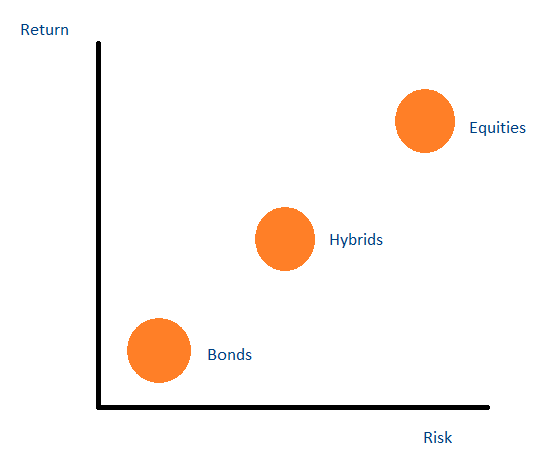
Returns from Hybrid Securities
The return generated by a hybrid security can be divided into two components: The fixed income component (the bond part) and the variable income component (the equity part).
1. Fixed income component
Similar to most fixed income instruments, hybrid securities typically pay a certain proportion of the face valuePar ValuePar Value is the nominal or face value of a bond, or stock, or coupon as indicated on a bond or stock certificate. It is a static value of the security as a return in each time period (usually annually) until the security matures.
2. Variable income component
At maturity, the value of hybrid securities usually depends on the price of some other underlying security or set of securities. Unlike bonds, which return their full face value at maturity, hybrid securities usually return an amount different from their initial face value. This is why hybrid securities are considered riskier than pure fixed income securities.
Examples of Hybrid Securities
1. Preferred stocks
Holders of preferred stocksPreferred SharesPreferred shares (preferred stock, preference shares) are the class of stock ownership in a corporation that has a priority claim on the company’s assets over common stock shares. The shares are more senior than common stock but are more junior relative to debt, such as bonds. receive dividends before the holders of common stocks. Also, the dividend received by the holders of preferred stocks is usually different from the dividend received by the holders of common stocks. Preferred stocks are considered safer than common stocks but less safe than bonds.
In case the business faces solvency issues, the holders of preferred stocks are paid before the holders of common stocks. In addition, preferred stocks can sometimes be converted to common stocks at a premium (1 preferred stock for 2 common stocks).
2. In-kind toggle notes
In-kind toggle notes are a form of hybrid security that allows cash-strapped companies to raise additional capital to meet short-term liquidity needs. An in-kind toggle note allows a company to pay interest in the form of additional debt. The company issuing the in-kind toggle note gives the holder of the note more debt in place of interest payment. In-kind toggle notes can be seen as an instrument to delay the payment of interest to debtholders.
3. Convertible bonds
Convertible bonds are fixed income instruments with a call optionCall OptionA call option, commonly referred to as a "call," is a form of a derivatives contract that gives the call option buyer the right, but not the obligation, to buy a stock or other financial instrument at a specific price - the strike price of the option - within a specified time frame. on some equity. The convertible bonds issued by a company can be converted into a fixed number of stock shares of that company. In some special cases, a convertible bond issued by a company comes with a call option on the stocks of some other company. These special convertible bonds are known as exchangeable bonds.
The interest rates on convertible bonds are usually lower than the interest rates on standard fixed income bonds. The interest rate differential is the “premium” convertible bondholders pay for the equity call option.
More Resources
Thank you for reading CFI’s explanation of hybrid securities. CFI is the official provider of the global Financial Modeling & Valuation Analyst (FMVA)™Become a Certified Financial Modeling & Valuation Analyst (FMVA)®CFI's Financial Modeling and Valuation Analyst (FMVA)® certification will help you gain the confidence you need in your finance career. Enroll today! certification program, designed to help anyone become a world-class financial analyst. To keep advancing your career, the additional resources below will be useful:
- Equity Capital MarketEquity Capital Market (ECM)The equity capital market is a subset of the capital market, where financial institutions and companies interact to trade financial instruments
- Objective vs. Subjective TradingObjective vs Subjective TradingObjective vs subjective trading: Most traders follow either an essentially objective or subjective trading style. Objective traders follow a set of rules to guide their trading decisions. They prefer to have buy and sell decisions essentially pre-planned. In contrast, subjective traders disavow using a strict set of rules
- Pessimist vs. Optimist InvestorsPessimist vs. Optimist InvestorsDifferentiating between pessimist vs. optimist investors is best done by using the phrase “a pessimist is an optimist with experience.” An optimist is hopeful and confident that things will turn out for the better. On the other hand, a pessimist always keeps in mind the possibility of the worst outcome.
- Stock Investing: A Guide to Growth InvestingStock Investing: A Guide to Growth InvestingInvestors can take advantage of new growth investing strategies in order to more precisely hone in on stocks or other investments offering above-average growth potential.
-

Credit Card ABS: Understanding Asset-Backed Securities
Credit card asset-backed securities (ABS) are fixed incomeFixed Income SecuritiesFixed income securities are a type of debt instrument that provides returns in the form of regular, or fixed, interest
-

Understanding Equity Issuance Fees: Costs of Raising Capital
“Equity issuance fees” is the accounting term used to reference the costs a company incurs when they introduce securities Marketable SecuritiesMarketable securities are unrestricted short-
invest
- Marketable Securities: Definition & Types | [Your Brand/Company Name]
- Capital Markets Explained: Investing in Equity & Debt
- Commodity-Linked Securities: Explained | Investment Guide
- Understanding Distressed Securities: Risks & Opportunities
- Understanding Fixed Income Securities: A Comprehensive Guide
- Income Stocks: A Guide to Dividend Investing
- Non-Marginable Securities: Definition & Investing Implications
- Trading Securities: Definition, Types & Short-Term Investment Strategies
- Securities Explained: A Beginner's Guide to Stocks, Bonds & More
-
 Understanding Canadian Income Tax Brackets: A Comprehensive Guide
This article will outline how Canadian tax brackets function. The income taxationAccounting For Income TaxesIncome taxes and their accounting is a key area of corporate finance. There are several obje...
-
 Understanding Security Types: A Comprehensive Guide
There are four main types of security: debt securities, equity securities, derivative securities, and hybrid securities, which are a combination of debt and equity. Fig. 1. Types of Securities&nb...