
Cash Earnings Per Share (Cash EPS): A Comprehensive Guide
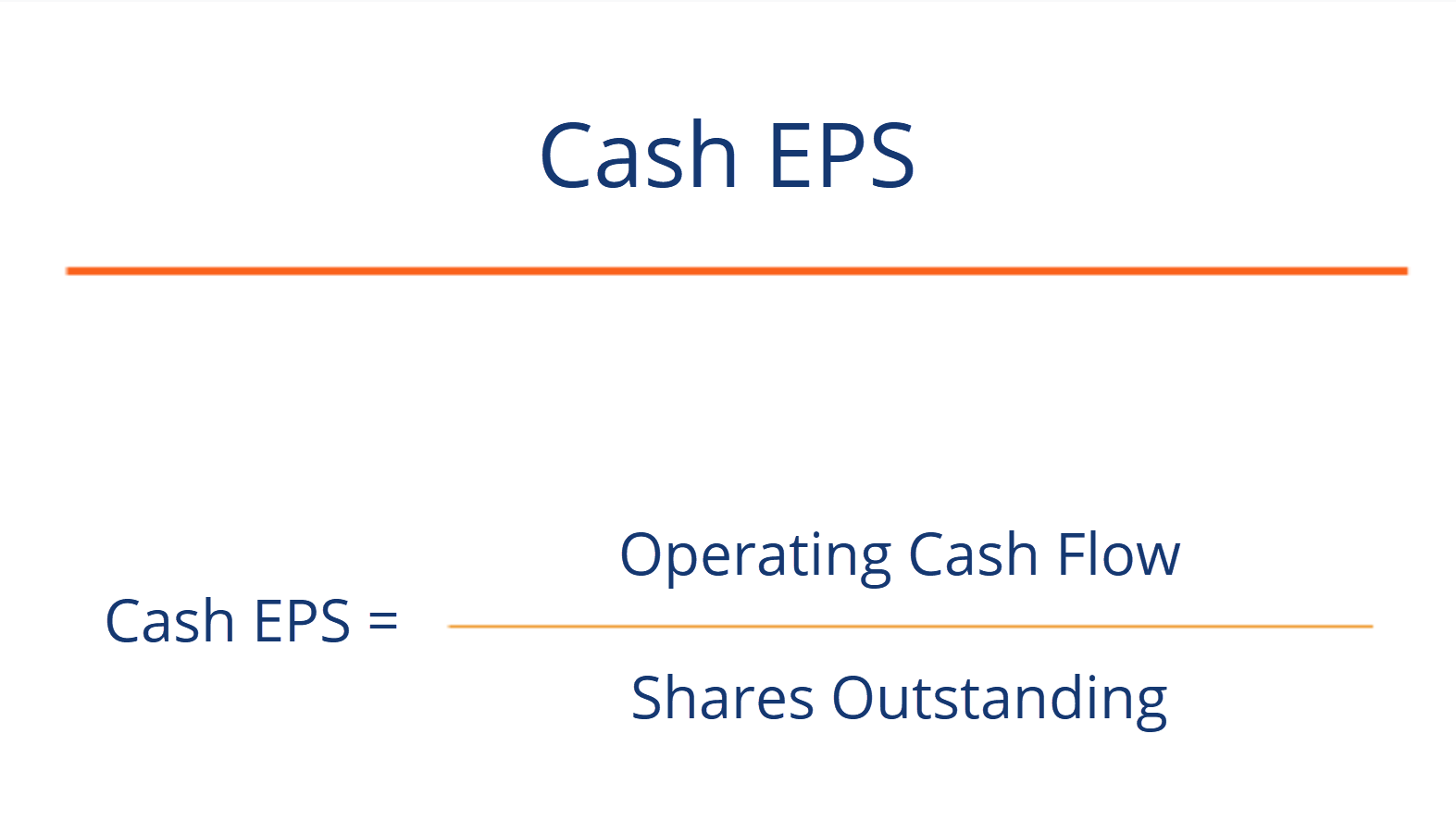
Cash earnings per share (cash EPS) is the operating cash flowCash Flow StatementA cash flow Statement contains information on how much cash a company generated and used during a given period. generated by a company divided by the number of shares outstanding. Cash earnings per share (Cash EPS) is different from traditional earnings per share (EPS), which takes the company’s net income and divides it by the number of shares outstanding. In other words, EPS measures how much of the company’s profit can be allocated to each share of stock, while Cash EPS measures how much cash flow can be allocated to each share of stock.
A company with higher cash earnings per share is considered to show better financial performance and have a better ability to generate cash flow. Cash EPS can be used to compare the company against its peers or against its own past results.
Calculating Cash Earnings Per Share
We calculate Cash EPS by adding non-cash transactions – e.g., amortization, depreciation, and deferred tax – back into Net Income to find operating cash flowValuationFree valuation guides to learn the most important concepts at your own pace. These articles will teach you business valuation best practices and how to value a company using comparable company analysis, discounted cash flow (DCF) modeling, and precedent transactions, as used in investment banking, equity research,. This is then divided by the number of shares.
Cash EPS = Operating Cash Flow / Diluted Shares Outstanding
A non-cash transaction is one that is captured in the company’s income statement but that does not involve actual cash flow during the period recorded. For example, depreciation expense is deducted from net income but does not actually involve any outflow of cash. Thus, this must be added back to net income to remove the accounting impact.
Note: Cash EPS is different from Diluted EPS. Diluted EPS refers to net income divided by the number of fully diluted shares outstanding (a metric used to measure the earnings per share of a company if all its convertible securities are exercised). Convertible securities refer to a company’s outstanding warrants, stock options, convertible debentures, and convertible preferred shares. The company’s diluted EPS will always be lower than the Cash EPS.
Download the Free Template
Enter your name and email in the form below and download the free template now!
Interpreting Cash Earnings Per Share
Cash earnings per share shows the ability of the company to generate cash flowValuationFree valuation guides to learn the most important concepts at your own pace. These articles will teach you business valuation best practices and how to value a company using comparable company analysis, discounted cash flow (DCF) modeling, and precedent transactions, as used in investment banking, equity research, that can be used for many things, including servicing its debts, paying shareholders’ dividends, and undertaking other transactions. A company with higher cash earnings per share is considered to be worth more per share than a company with a lower cash EPS (all else being equal).
As a general rule with investors, high earnings per share growth leads to a rise in the company’s share price.
In order to compare the value of two different companies, the price-earnings ratioPrice Earnings RatioThe Price Earnings Ratio (P/E Ratio is the relationship between a company’s stock price and earnings per share. It provides a better sense of the value of a company. can be a helpful starting point.
Learn More
We hope you have enjoyed reading CFI’s guide to Cash EPS – to learn more about profitability ratios, we recommend the following CFI resources:
- PE RatioPrice Earnings RatioThe Price Earnings Ratio (P/E Ratio is the relationship between a company’s stock price and earnings per share. It provides a better sense of the value of a company.
- Cash flow guideValuationFree valuation guides to learn the most important concepts at your own pace. These articles will teach you business valuation best practices and how to value a company using comparable company analysis, discounted cash flow (DCF) modeling, and precedent transactions, as used in investment banking, equity research,
- EV/EBITDAEV/EBITDAEV/EBITDA is used in valuation to compare the value of similar businesses by evaluating their Enterprise Value (EV) to EBITDA multiple relative to an average. In this guide, we will break down the EV/EBTIDA multiple into its various components, and walk you through how to calculate it step by step
- Valuation methodsValuation MethodsWhen valuing a company as a going concern there are three main valuation methods used: DCF analysis, comparable companies, and precedent transactions
-

Shareholder Yield: A Comprehensive Guide to Returns for Investors
Shareholder yield refers to how much money shareholders receive from a company that is in the form of cash dividendsDividendA dividend is a share of profits and retained earnings that a company pays o
-

EPS vs. DPS: Understanding Earnings Per Share and Dividends Per Share
Earnings Per Share (EPS) vs. Dividends Per Share (DPS): An Overview Earnings per share (EPS) and dividends per share (DPS) are both reflections of a companys profitability, but thats where any
finance
- Understanding Dividend Per Share (DPS): A Comprehensive Guide
- Understanding Earnings: A Guide to Financial Profitability
- Earnings Per Share (EPS): A Comprehensive Guide
- Understanding Earnings Per Share (EPS): Formula & Calculation
- Earnings Per Share (EPS): A Comprehensive Guide for Investors
- Understanding Earnings Per Share (EPS): Types & Significance
- Understanding Earnings Per Share (EPS): Different Calculations & What They Mean
- Understanding Earnings Per Share (EPS): A Key Investment Metric
- Understanding Earnings Per Share (EPS): A Comprehensive Guide
-
 Revenue Per Employee: Definition, Calculation & Importance
Revenue per employee is an efficiency ratio used to determine the revenue generated per individual working at a company. The revenue per employee ratio is important for determining the efficiency and ...
-
 Share Repurchase: Definition, Benefits & How It Works
A share repurchase refers to the management of a public companyPrivate vs Public CompanyThe main difference between a private vs public company is that the shares of a public company are traded on a s...