
Understanding Dividend Per Share (DPS): A Comprehensive Guide
Dividend Per Share (DPS) is the total amount of dividendsDividendA dividend is a share of profits and retained earnings that a company pays out to its shareholders. When a company generates a profit and accumulates retained earnings, those earnings can be either reinvested in the business or paid out to shareholders as a dividend. attributed to each individual share outstandingWeighted Average Shares OutstandingWeighted average shares outstanding refers to the number of shares of a company calculated after adjusting for changes in the share capital over a reporting period. The number of weighted average shares outstanding is used in calculating metrics such as Earnings per Share (EPS) on a company's financial statements of a company. Calculating the dividend per share allows an investor to determine how much income from the company he or she will receive on a per-share basis. Dividends are usually a cash payment paid to the investors in a company, although there are other types of payment that can be received (discussed below).
Dividend Per Share Formula
The formula for calculating dividend per share has two variations:
Dividend Per Share = Total Dividends Paid / Shares Outstanding
or
Dividend Per Share = Earnings Per Share x Dividend Payout Ratio
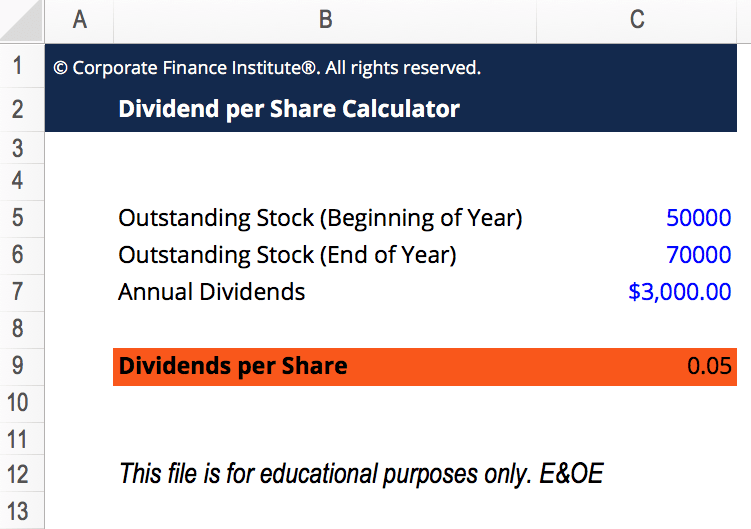
Download the Free Template
Enter your name and email in the form below and download the free template now!
Types of Dividends
Although dividends are usually a cash payment paid to investors, that is not always the case. There are several types of dividends, such as:
1. Cash dividends
This is the most common form of dividend per share an investor will receive. It is simply a cash payment and the value can be calculated by either of the above two formulas.
2. Property dividends
The company issues a dividend in the form of an asset such as property, plant, and equipment (PP&E)PP&E (Property, Plant and Equipment)PP&E (Property, Plant, and Equipment) is one of the core non-current assets found on the balance sheet. PP&E is impacted by Capex,, a vehicle, inventoryInventoryInventory is a current asset account found on the balance sheet, consisting of all raw materials, work-in-progress, and finished goods that a, etc.
3. Stock dividends
The company gives each shareholder a certain number of extra shares based on the current amount of shares that each shareholder owns (on a pro-rataPro-Rata RightA pro-rata right is a legal term that describes the right, but not the obligation, that can be given to an investor to maintain their initial level of percentage ownership in a company during subsequent rounds of financing. basis).
4. Scrip dividends
The company promises payment to shareholders at a later date. Scrip dividends are essentially a promissory notePromissory NoteA promissory note refers to a financial instrument that includes a written promise from the issuer to pay a second party – the payee – to pay shareholders at a future date.
5. Liquidating dividends
The company liquidates all its assets and pays the sum to shareholders as a dividend. Liquidating dividends are usually issued when the company is about to shut down.
Dividend Per Share Example
Company A announced a total dividend of $500,000 paid to shareholders in the upcoming quarter. Currently, there are 1 million shares outstanding.
The dividend per share would simply be the total dividend divided by the shares outstanding. In this case, it is $500,000 / 1,000,000 = $0.50 dividend per share.
Calculating DPS from the Income Statement
If a company follows a consistent dividend payout ratioDividend Payout RatioDividend Payout Ratio is the amount of dividends paid to shareholders in relation to the total amount of net income generated by a company. Formula, example (i.e., the company is known to pay a consistent percentage of its earnings as dividends), a rough estimate of the dividend per share can be calculated through the income statement. To calculate the DPS from the income statement:
1. Figure out the net income of the company
Net income is generally the last item on the income statementIncome StatementThe Income Statement is one of a company's core financial statements that shows their profit and loss over a period of time. The profit or.
2. Determine the number of shares outstanding
The number of shares outstanding can typically be found on the company’s balance sheetBalance SheetThe balance sheet is one of the three fundamental financial statements. The financial statements are key to both financial modeling and accounting.. If there are treasury shares, it is important to subtract those from the number of issued shares to get the number of outstanding shares.
3. Divide net income by the number of shares outstanding
Dividing net income by the number of shares outstanding would give you the earnings per share (EPS)Earnings Per Share Formula (EPS)EPS is a financial ratio, which divides net earnings available to common shareholders by the average outstanding shares over a certain period of time. The EPS formula indicates a company’s ability to produce net profits for common shareholders..
Alternatively:
4. Determine the company’s typical payout ratio
Estimate the typical payout ratio by looking at past historical dividend payouts. For example, if the company historically paid out between 50% and 55% of its net income as dividends, use the midpoint (53%) as the typical payout ratio.
5. Multiply the payout ratio by the net income per share to get the dividend per share
Sample Dividend Per Share Calculation
Company A reported a net income of $10 million. Currently, there are 10 million shares issued with 3 million shares in the treasury. Company A has historically paid out 45% of its earnings as dividends.
To estimate the dividend per share:
- The net income of this company is $10,000,000.
- The number of shares outstanding is 10,000,000 issued – 3,000,000 in the treasury = 7,000,000 shares outstanding.
- $10,000,000 / 7,000,000 = $1.4286 net income per share.
- The company historically paid out 45% of its earnings as dividends.
- 0.45 x $1.4286 = $0.6429 dividend per share.
Example of Dividend per Share
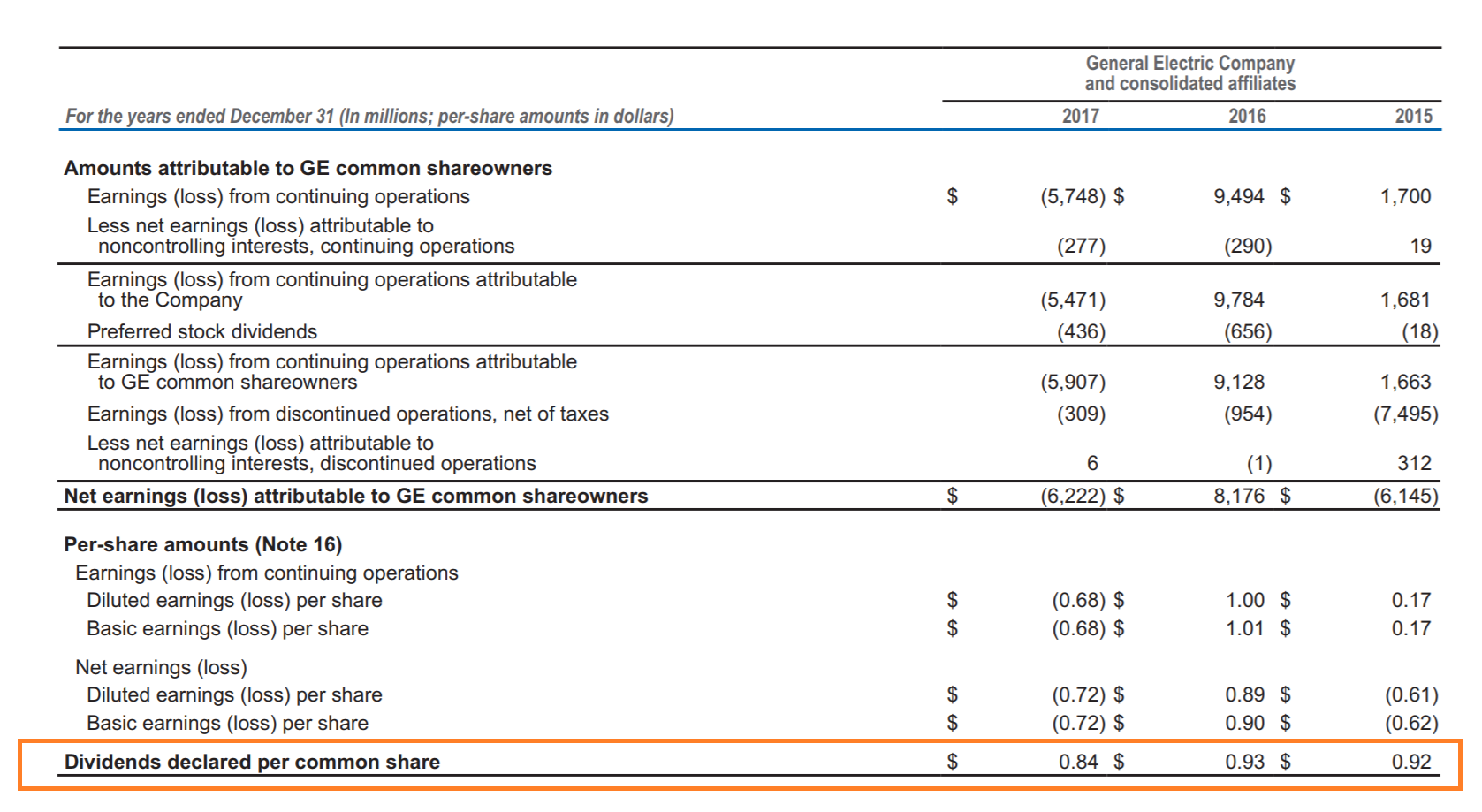
Below is an example from GE’s 2017 annual report. In their financial statements is a section that outlines the dividends declared per common share. For easy reference, you can compare the dividends to the net earnings per share (EPS) in the same period.
The Rationale for Paying a Dividend to Shareholders
Let us consider two key reasons as to why companies choose to issue dividends:
1. To attract investors
Many investors enjoy receiving dividends and view them as a steady income source. Therefore, these investors are more attracted to dividend-paying companies.
2. To signal the company’s strength
Paying a dividend to shareholders may be a signaling method by the company. Dividend payments are typically associated with a strong company with positive expectations about its future earnings. This makes the stock more attractive and may increase the market value of the company’s stock.
The Rationale for Not Paying a Dividend
Although dividends can be used to signal a company’s strength and attract investors, there are also several important reasons as to why companies do not issue dividends:
1. Rapid growth
A company that is growing rapidly most likely won’t pay dividends. The earnings of the company are instead reinvested to help fund further growth.
2. Internal investment opportunities
A mature company may hold onto its earnings and reinvest them. The money may be used to fund a new project, acquire new assets, or pursue mergers and acquisitions (M&A)Mergers Acquisitions M&A ProcessThis guide takes you through all the steps in the M&A process. Learn how mergers and acquisitions and deals are completed. In this guide, we'll outline the acquisition process from start to finish, the various types of acquirers (strategic vs. financial buys), the importance of synergies, and transaction costs.
3. Wrong signaling
If a company originally issues dividends but decides to pull back on its dividend payout, it can create unfavorable signaling for the company. When companies eliminate or reduce their existing dividend policy, this is typically viewed negatively by investors. Therefore, companies may avoid paying dividends at all to avoid this problem.
Additional Resources
Thank you for reading CFI’s guide to dividend per share. CFI is the official global provider of the Financial Modeling and Valuation Analyst (FMVA)® designationBecome a Certified Financial Modeling & Valuation Analyst (FMVA)®CFI's Financial Modeling and Valuation Analyst (FMVA)® certification will help you gain the confidence you need in your finance career. Enroll today!. To help you in your journey of becoming a world-class financial analyst, these additional CFI resources will be helpful:
- Earnings Per ShareEarnings Per Share (EPS)Earnings per share (EPS) is a key metric used to determine the common shareholder's portion of the company’s profit. EPS measures each common share's profit
- Capital StructureCapital StructureCapital structure refers to the amount of debt and/or equity employed by a firm to fund its operations and finance its assets. A firm's capital structure
- Dividend vs Share Buyback/RepurchaseDividend vs Share Buyback/RepurchaseShareholders invest in publicly traded companies for capital appreciation and income. There are two main ways in which a company returns profits to its shareholders – Cash Dividends and Share Buybacks. The reasons behind the strategic decision on dividend vs share buyback differ from company to company
- Financial Modeling Valuation and Analyst GuideBecome a Certified Financial Modeling & Valuation Analyst (FMVA)®CFI's Financial Modeling and Valuation Analyst (FMVA)® certification will help you gain the confidence you need in your finance career. Enroll today!
-
Acquirer Definition: Understanding Corporate Acquisitions
An acquirer is a registered company that purchases a portion of, or all the rights to, another company. The acquiring company takes over the management of another company by obtaining a majority stake
-

Understanding Clawbacks: Protecting Stakeholders from Failed Performance
What happens when a person promises to perform and then fails to deliver on their promises? Or what happens when it is found that a performance reportDue Diligence ReportExample due diligence report o
finance
- Cash Earnings Per Share (Cash EPS): A Comprehensive Guide
- Understanding Dividend Yield: A Key Metric for Investors
- Understanding Forward Dividend Yield: A Key Metric for Investors
- Understanding Liquidating Dividends: A Comprehensive Guide
- Revenue Per Employee: Definition, Calculation & Importance
- Share Repurchase: Definition, Benefits & How It Works
- Shareholder Yield: A Comprehensive Guide to Returns for Investors
- Special Dividends: Understanding One-Time Distributions
- Understanding Dividend Policy: A Comprehensive Guide
-
 Dividends vs. Share Buybacks: Which is Better for Investors?
ShareholdersShareholderA shareholder can be a person, company, or organization that holds stock(s) in a given company. A shareholder must own a minimum of one share in a company’s stock or mutua...
-
 Earnings Per Share (EPS): A Comprehensive Guide
Earnings per share (EPS) is a key metric used to determine the common shareholder’sStockholders EquityStockholders Equity (also known as Shareholders Equity) is an account on a companys balance ...