
Understanding Cash Flow: A Comprehensive Guide
Cash Flow (CF) is the increase or decrease in the amount of money a business, institution, or individual has. In finance, the term is used to describe the amount of cash (currency) that is generated or consumed in a given time period. There are many types of CF, with various important uses for running a business and performing financial analysisAnalysis of Financial StatementsHow to perform Analysis of Financial Statements. This guide will teach you to perform financial statement analysis of the income statement,. This guide will explore all of them in detail.

Types of Cash Flow
There are several types of Cash Flow, so it’s important to have a solid understanding of what each of them is. When someone refers to CF, they could mean any of the types listed below, so be sure to clarify which cash flow term is being used.
Types of cash flow include:
- Cash from Operating Activities – Cash that is generated by a company’s core business activities – does not include CF from investing. This is found on the company’s Statement of Cash FlowsStatement of Cash FlowsThe Statement of Cash Flows (also referred to as the cash flow statement) is one of the three key financial statements that report the cash (the first section).
- Free Cash Flow to Equity (FCFE) – FCFE represents the cash that’s available after reinvestment back into the business (capital expenditures). Read more about FCFEFree Cash Flow to Equity (FCFE)Free cash flow to equity (FCFE) is the amount of cash a business generates that is available to be potentially distributed to shareholders. It is calculated as Cash from Operations less Capital Expenditures. This guide will provide a detailed explanation of why it’s important and how to calculate it and several.
- Free Cash Flow to the Firm (FCFF) – This is a measure that assumes a company has no leverage (debt). It is used in financial modeling and valuation. Read more about FCFFUnlevered Free Cash FlowUnlevered Free Cash Flow is a theoretical cash flow figure for a business, assuming the company is completely debt free with no interest expense..
- Net Change in Cash – The change in the amount of cash flow from one accounting period to the next. This is found at the bottom of the Cash Flow StatementCash Flow StatementA cash flow Statement contains information on how much cash a company generated and used during a given period..
Uses of Cash Flow
Cash Flow has many uses in both operating a business and in performing financial analysis. In fact, it’s one of the most important metrics in all of finance and accounting.
The most common cash metrics and uses of CF are the following:
- Net Present Value – calculating the value of a business by building a DCF ModelDCF Model Training Free GuideA DCF model is a specific type of financial model used to value a business. The model is simply a forecast of a company’s unlevered free cash flow and calculating the net present value (NPVNet Present Value (NPV)Net Present Value (NPV) is the value of all future cash flows (positive and negative) over the entire life of an investment discounted to the present.)
- Internal Rate of Return – determining the IRRInternal Rate of Return (IRR)The Internal Rate of Return (IRR) is the discount rate that makes the net present value (NPV) of a project zero. In other words, it is the expected compound annual rate of return that will be earned on a project or investment. an investor achieves for making an investment
- Liquidity – assessing how well a company can meet its short-term financial obligations
- Cash Flow Yield – measuring how much cash a business generates per share, relative to its share price, expressed as a percentage
- Cash Flow Per Share (CFPS) – cash from operating activities divided by the number of shares outstanding
- P/CF Ratio – the price of a stock divided by the CFPS (see above), sometimes used as an alternative to the Price-Earnings, or P/E, ratioPrice Earnings RatioThe Price Earnings Ratio (P/E Ratio is the relationship between a company’s stock price and earnings per share. It provides a better sense of the value of a company.
- Cash Conversion Ratio – the amount of time between when a business pays for its inventory (cost of goods sold) and receives payment from its customers is the cash conversion ratioCash Conversion RatioThe Cash Conversion Ratio (CCR) is a financial management tool used to determine the ratio between the cash flows of a company to its net profit.
- Funding Gap – a measure of the shortfall a company has to overcome (how much more cash it needs)
- Dividend Payments – CF can be used to fund dividendDividendA dividend is a share of profits and retained earnings that a company pays out to its shareholders. When a company generates a profit and accumulates retained earnings, those earnings can be either reinvested in the business or paid out to shareholders as a dividend. payments to investors
- Capital Expenditures – CF can also be used to fund reinvestment and growthFinancial Modeling Revenue GrowthRevenue growth in a financial model can be forecasted in several ways. The most appropriate method depends on the level of detail required. in the business
Cash Flow vs Income
Investors and business operators care deeply about CF because it’s the lifeblood of a company. You may be wondering, “How is CF different from what’s reported on a company’s income statementIncome StatementThe Income Statement is one of a company's core financial statements that shows their profit and loss over a period of time. The profit or?” Income and profit are based on accrualAccrual AccountingIn financial accounting, accruals refer to the recording of revenues that a company has earned but has yet to receive payment for, and the accounting principles, which smooths-out expendituresExpenditureAn expenditure represents a payment with either cash or credit to purchase goods or services. An expenditure is recorded at a single point in and matches revenues to the timing of when products/services are delivered. Due to revenue recognition policies and the matching principle, a company’s net income, or net earnings, can actually be materially different from its Cash Flow.
Companies pay close attention to their CF and seek to manage it as carefully as possible. Professionals working in finance, accounting, and financial planning & analysis (FP&A)FP&A RoleThe Financial Planning & Analysis (FP&A) role is gaining greater importance today as it helps bring out crucial analysis on business performance. An FP&A role is no longer limited to management reporting but it also requires lots of business insights so that the top management functions at a company spend significant time evaluating the flow of funds in the business and identifying potential problems.
Learn more from Harvard about the difference between Cash Flow and Net Income here.
Cash Flow Generation Strategies
Since CF matters so much, it’s only natural that managers of businesses do everything in their power to increase it. In the section below, let’s explore how operators of businesses can try to increase the flow of cash in a company. Below is an infographic that demonstrates how CF can be increased using different strategies.
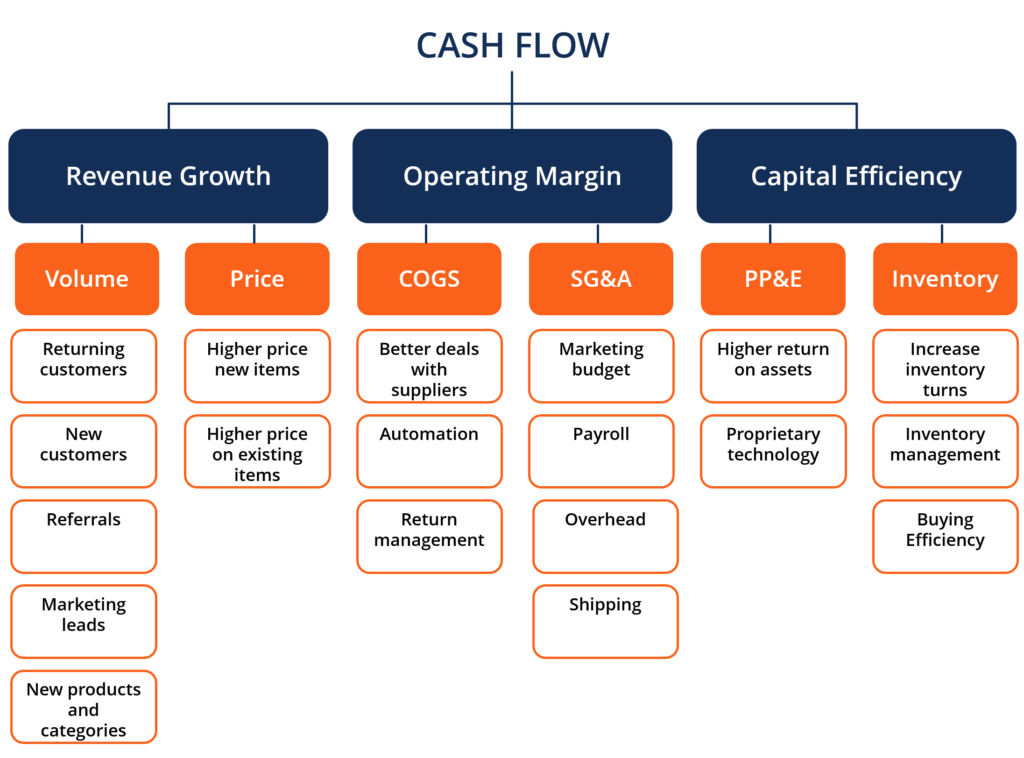
Managers of business can increase CF using any of the levers listed above. The strategies for improving CF fall into one of three categories: revenue growth, operating margins, and capital efficiency. Each of those can then be broken down into higher volume, higher prices, lower cost of goods sold, lower SG&A, more efficient property plant & equipment (PP&E), and more efficient inventory management.
Additional Resources
CFI is the official provider of the Financial Modeling and Valuation Analyst (FMVA)™Become a Certified Financial Modeling & Valuation Analyst (FMVA)®CFI's Financial Modeling and Valuation Analyst (FMVA)® certification will help you gain the confidence you need in your finance career. Enroll today! certification program, designed to transform anyone into a world-class financial analyst. To keep learning and developing your knowledge of financial analysis, we highly recommend the additional CFI resources below:
- What is financial modeling?What is Financial ModelingFinancial modeling is performed in Excel to forecast a company's financial performance. Overview of what is financial modeling, how & why to build a model.
- Types of financial modelsTypes of Financial ModelsThe most common types of financial models include: 3 statement model, DCF model, M&A model, LBO model, budget model. Discover the top 10 types
- Valuation methodsValuation MethodsWhen valuing a company as a going concern there are three main valuation methods used: DCF analysis, comparable companies, and precedent transactions
- Financial statement analysisAnalysis of Financial StatementsHow to perform Analysis of Financial Statements. This guide will teach you to perform financial statement analysis of the income statement,
-

Understanding Money Flow: A Guide for Traders
Money flow is a technical indicator used to assess the future movement of prices based on demand and supplySupply and DemandThe laws of supply and demand are microeconomic concepts that state that in
-

Synthetic Cash: Understanding Simulated Financial Instruments
Synthetic cash is a financial instrument that is created to function like other financial instruments, but certain characteristics of the simulated financial instrument are altered. The simulated inst
finance
- Understanding Cash Consideration in Mergers & Acquisitions
- Cash Flow to Debt Ratio: Understanding and Calculation
- Cash Management: A Comprehensive Guide to Financial Stability
- Understanding Conventional Cash Flow: Definitions and Examples
- Understanding Unconventional Cash Flow: A Comprehensive Guide
- Understanding Incremental Cash Flow: A Business Guide
- Understanding Operating Cash Flow (OCF): A Comprehensive Guide
- Understanding Cash Flow Statements: A Comprehensive Guide
- Cash Flow Loans: Fueling Business Growth & Overcoming Short-Term Needs
-
 Bitcoin Cash (BCH): A Comprehensive Overview - Features, History & Future
Bitcoin Cash (BCH) is a cryptocurrency created from a hard fork of Bitcoin. It is meant to have quicker transactions than Bitcoin. The fork occurred at block 478,559. At that block the Bitcoin bl...
-
 Profit vs. Cash Flow: Understanding the Key Difference
Understanding the difference between profit vs cash is very important in the finance industry. Profit is defined as revenue less all the expenses of a company in a certain period, while cash flow is c...