
Understanding Down Rounds: What They Are and Why They Happen
The term “down round” is used to refer to a scenario where the value of a business at a time of investment is below the value of the same business during a previous period or financing round.
Normally during a down round, investors purchase equity in the business at a lower price, in comparison to previous investors. The same applies to convertible bondsConvertible BondA convertible bond is a type of debt security that provides an investor with a right or an obligation to exchange the bond for a predetermined number of shares in the issuing company at certain times of a bond’s lifetime. A convertible bond is a hybrid security. Down rounds can occur due to various reasons; however, common reasons include increased competition in the market, general economic or stock market declines, or the altered perception of investors on what they believe is the value of the business during the financing round.
During a down round, it is discovered that a business may require more capital than initially projected, and the business realizes that its value is less than it may have been during the previous funding round. Such a realization results in the sale of the business’ capital equity or shares at a lesser price per share.
Summary
- Down round refers to a scenario where the value of a business at a time of investment is below the value of the same business during a previous period or financing round.
- Normally during a down round, investors purchase equity in the business at a lower price, in comparison to previous investors.
- Down rounds are common when the milestones set forth by the business are not met. The milestones can include the product or service development, revenue generation and profitability milestones, production output, hiring of key personnel, etc.
Understanding Down Rounds
A round is used to refer to a funding phase. Common for start-up companies, funds for the business are raised from investors via what is referred to as a series of funding phases. The image below provides an overview of the start-up financing cycle or what is also referred to as investment stages:
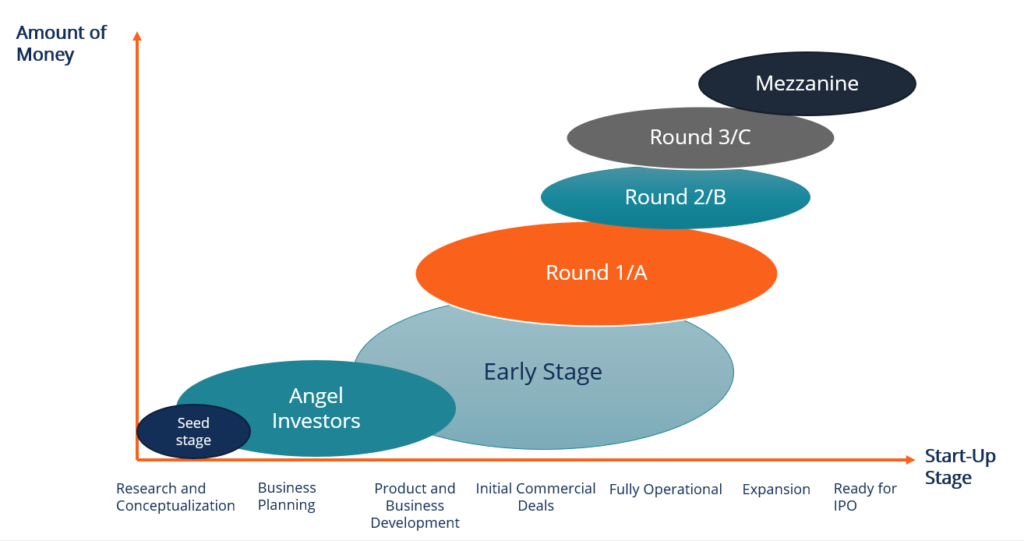
The growth of a business is typically accompanied by an increase in the valuation of the respective company. It allows the company an opportunity to get its stock or share prices increase in conjunction with the higher valuation. In contrast, during a down round, investors tend to value the business at a lower amount. It results in the shares and/or stocks of the business being sold at a lower price, in conjunction with the decrease in the business’ valuation.
During fundraising, companies establish some milestones or benchmarks that are used by investors to evaluate the performance of the company and derive a value for the business. Down rounds are common when the milestones set forth by the business are not met. The milestones can include the product or service development, revenue generation and profitability milestones, production output, hiring of key personnel, etc.
Although it may be more challenging to value a start-upStartup Valuation MethodsSeveral startup valuation methods are available for use by financial analysts. Below, we will discuss some popular methods used for valuing startups, investors are typically able to evaluate the performance of the business during the next round of funding, and they tend to make use of the milestones initially set forth by the business. Should a business fail to meet some of the milestones, investors in preceding rounds can make use of the drawback to lower the share prices and overall business valuation.
New entrants in a market introduce new competitors, and it can, at times, result in a down round. It may be challenging for businesses to convince investors of their value when they face steep competition. In a scenario where there is competition present in the market, investors tend to lower the value of the share prices to accommodate for the risk associated with the investments.
In other words, the lowered share price, and lowered business valuation by investors, serves as a hedging tool for them. In addition, investors tend to study certain elements of the competitors to determine the fair value of the company for upcoming funding rounds.
Furthermore, down rounds can also be attributed to investors lowering the value of a business to accommodate or account for risk managementRisk ManagementRisk management encompasses the identification, analysis, and response to risk factors that form part of the life of a business. It is usually done with, and down rounds often mean that a business or company may need to sell a larger number of shares to meet its capital requirements. Such a scenario can result in the dilution of current shareholders, thereby lowering ownership proportions.
Finally, down rounds may result in the loss of confidence that investors, or the market at large, have in the business. The dilution of ownership, loss of confidence of investors and the market, and decreased company and employee morale resulting from a down round may make the business unattractive to a certain extent. Down rounds are usually viewed as a company’s attempt to stay afloat.
A few alternatives to down rounds are sourcing bridge or short-term financingBridge FinancingBridge financing is a form of temporary financing intended to cover a company’s short-term costs until regular long-term financing is secured., renegotiating terms with existing shareholders, significantly lowering the company’s current burn rate, or shutting the business down.
More Resources
CFI offers the Commercial Banking & Credit Analyst (CBCA)™Program Page - CBCAGet CFI's CBCA™ certification and become a Commercial Banking & Credit Analyst. Enroll and advance your career with our certification programs and courses. certification program for those looking to take their careers to the next level. To keep learning and advancing your career, the following resources will be helpful:
- Angel InvestorsAngel InvestorAn angel investor is a person or company that provides capital for start-up businesses in exchange for ownership equity or convertible debt. They may provide a one-time investment or an ongoing capital injection to help the business move through the difficult early stages.
- Equity Capital Market (ECM)Equity Capital Market (ECM)The equity capital market is a subset of the capital market, where financial institutions and companies interact to trade financial instruments
- Series A FinancingSeries A FinancingSeries A financing (also known as series A round or series A funding) is one of the stages in the capital-raising process by a startup. Essentially, the series A round is the second stage of startup financing and the first stage of venture capital financing.
- Business Valuation Fundamentals Course
-

Understanding Interest-Bearing Debt: Definition & Examples
What Is Interest-Bearing Debt? A business has both income and debts, usually reflected on its balance sheet. Debts, also known as liabilities, can either be interest-bearing, which means they
-

Business Visibility: Forecasting Performance & Driving Success
In business, visibility refers to the extent to which a company can estimate its future performance. While it is a very broad term that applies to both short-term and long-term performance, having vis
finance
- Down Rounds: Understanding Equity Financing & Valuation
- Angel Investors: Definition, Funding & vs. Venture Capital
- Understanding Appraisals: A Comprehensive Guide
- Business Banking: Services, Accounts & Loans Explained
- Understanding Business Risk: Threats & Mitigation
- Divestiture Explained: Definition, Types & Examples
- Understanding Down Payments: A Comprehensive Guide
- Drawing Account Explained: Understanding Owner Withdrawals
- Understanding Insolvency: Definition, Causes & Consequences
-
 Non-Operating Assets: Definition, Examples & Financial Impact
Non-operating assets are assets that are not required in the normal operations of a business but that can generate income nonetheless. The assets are recorded in the balance sheetBalance SheetThe bala...
-
 Understanding Tax Deductions: What Businesses Need to Know
A tax deductible expense is any expense that is considered “ordinary, necessary, and reasonable” and that helps a business to generate incomeTaxable IncomeTaxable income refers to any indi...