
Understanding Liquidity: Factors Affecting Cash Flow
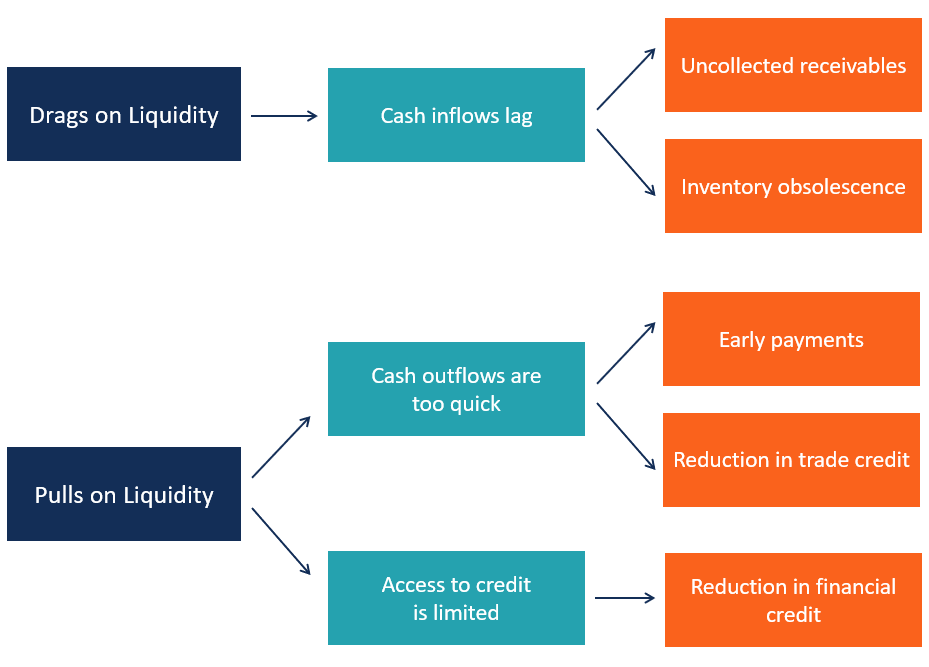
The drags and pulls on liquidity are the factors that negatively affect a company’s cash inflows and outflows by determining a deterioration in its liquidity position.
A drag on liquidity exists when cash inflows lag, for example, because a company is facing trouble with the collection of its commercial credits. A pull on liquidity is generated when cash outflows happen too quickly or when a company’s access to commercial or financial credit is limited.
Drags on Liquidity from Uncollected Receivables
It often happens that a company is willing to sell goods and services while accepting a delayed payment. However, sometimes companies face issues with the collection of their commercial credit, for example, because one or more customers are experiencing deterioration in their business.
For an analyst, the drags are often visible from an analysis of balance sheet trends and ratios. For example, a deterioration in days sales outstanding (DSO)Days Sales Outstanding (DSO)Days Sales Outstanding (DSO) represents the average number of days it takes credit sales to be converted into cash, or how long it takes a is often an indication of negative developments acting as drags on liquidity.
Increasing levels of bad debt expenses are also a useful indicator to identify issues in the collection of receivables.
Drags on Liquidity from Inventory Obsolescence
If a company’s inventoryInventoryInventory is a current asset account found on the balance sheet, consisting of all raw materials, work-in-progress, and finished goods that a is turning obsolete, it will experience a drag on liquidity as the value of such inventory declines, turning into lower cash inflows than planned. Sometimes, such inventory can’t be sold or used at all, while in other cases, the company may need to sell it at significant discounts to the usual price.
Moreover, obsolete inventory may still occupy space, require labor, and generate storage costs that can be avoided. A good indication of increasing inventory obsolescence is often given by slowing inventory turnover ratios.
Drags on Liquidity from Tighter Credit
If access to capital worsens or becomes more expensive, a company’s liquidity may worsen. Credit conditions vary due to the action of several factors, including:
1. Changes in business fundamentals
Deteriorating fundamental trends, such as declining sales, falling margins, or poorer cash flow generation, are factors that would worsen a company’s creditworthinessCreditworthinessCreditworthiness, simply put, is how "worthy" or deserving one is of credit. If a lender is confident that the borrower will honor her debt obligation in a timely fashion, the borrower is deemed creditworthy.. As a result, tighter conditions may negatively affect the company’s liquidity position.
2. Industry trends
Sometimes, whole industries suffer, or are exposed to, unfavorable trends. As a result, credit conditions granted to the companies operating in such industries can worsen, triggering a deterioration in liquidity.
3. Overall macroeconomic conditions
Bad trends in capital markets, rising interest rates, or recessionary environmentsRecessionRecession is a term used to signify a slowdown in general economic activity. In macroeconomics, recessions are officially recognized after two consecutive quarters of negative GDP growth rates. are examples of macroeconomic factors that can negatively impact a company’s access to credit and worsen its liquidity position.
Pulls on Liquidity from Early Payments
Granting commercial credit is common in many industries. It often implies that a customer is allowed to pay 30, 60, or 90 days after a purchase is made.
A company that pays its suppliers, creditors, or employees before the payment is due is creating a pull on liquidity. It is a commonplace among companies to hold payments until the due date without any anticipation of payments.
Pulls on Liquidity from Trade Credit
There are other events related to commercial credit that can act as pulls on a company’s liquidity. Let’s take the case of a company that fails to pay its obligations to its suppliers on a timely basis or one that willingly takes advantage of its suppliers by paying after a long delay. In such cases, suppliers may decide to reduce the amount of trade credit to the customer – impacting its liquidity.
Pulls from Reduced Lines of Credit
As a supplier can reduce the amount of credit to a customer, banks can also reduce the amount of credit available to their customers.
Banks may decide to reduce the lines of credit to a company for many reasons:
- Company-specific reasons, such as deteriorating business trends in the company or in the bank itself. In other cases, it can be a response to a customer’s poor track record of debt repayment.
- The reductions may be mandated by governments or may be due to conditions in the credit markets, such as tighter access to funds from central banks.
Solutions to Drags and Pulls on Liquidity
The drags and pulls on liquidity should be identified and corrected promptly, especially when significant. The measures that are taken obviously depend on the specific type of drag and pull involved.
For example:
- Failure in collecting receivables can make it necessary to involve debt collection agencies and to make changes in the payment terms given to customers. In some cases, companies may stop allowing delayed payments to certain types of customers.
- If obsolescence is becoming a problem, the company should find a way to monetize the obsolete inventory before it becomes a significant drag on liquidity. It may also need to rethink or refine its inventory management system or strategy if it contributes to the issue.
- If a company expects credit-line restrictions in the future, i.e., as a result of worsening market conditions, it may try to open credit lines well above the actual current needs.
More Resources
CFI is the official provider of the global Commercial Banking & Credit Analyst (CBCA)™Program Page - CBCAGet CFI's CBCA™ certification and become a Commercial Banking & Credit Analyst. Enroll and advance your career with our certification programs and courses. certification program, designed to help anyone become a world-class financial analyst. To keep advancing your career, the additional resources below will be useful:
- Bad Debt ExpenseBad Debt ExpenseBad debt expense is the way businesses account for a receivable account that will not be paid. Bad debt arises when a customer either cannot
- Economic IndicatorsEconomic IndicatorsAn economic indicator is a metric used to assess, measure, and evaluate the overall state of health of the macroeconomy. Economic indicators
- Functional ObsolescenceFunctional Obsolescence (Real Estate)In real estate, functional obsolescence refers to the diminishing of the usefulness of an architecture design such that changing it to suit current real
- Sources of LiquiditySources of LiquidityFor a company, its sources of liquidity are all the resources that can be used to generate cash. There are generally two major classes of sources of
-

Child Tax Credit 2021: Eligibility, Amounts & How to Claim
About 39 million American households will soon begin to receive advance monthly payments thanks to changes to the child tax credit for 2021. The $1.9 trillion American Rescue Plan
-

PayPal: A Comprehensive Guide to Features, Benefits & Drawbacks
PayPal is an online payments company that allows people to send money to others. PayPal was one of the original web payments companies and was purchased by eB
finance
- Credit Card Dimensions & Security: Everything You Need to Know
- Understanding the Key Elements of Creditworthiness
- Hope Credit: Understanding Your Post-Secondary Education Tax Credit
- Understanding Retail Bank Types: Commercial Banks, Credit Unions & More
- Understanding the Sales and Collection Cycle: A Comprehensive Guide
- Adoption Tax Credit: Benefits, Eligibility & 2020 Value
- SEP IRA: Employer-Sponsored Retirement Plan Explained & Contribution Limits
- Understanding Credit Scores: History, Average & Importance
- Understanding Different Types of Debt: A Comprehensive Guide
-
 Understanding the Credit Curve: A Guide for Investors
The credit curve is the graphical representation of the relationship between the return offered by a security (credit-generating instrument) and the time to maturity of the security. It measures the i...
-
 Understanding Credit Sales: Definition & Benefits | CFI
Credit sales refer to a sale in which the amount owed will be paid at a later date. In other words, credit sales are purchases made by customers who do not render payment in full, in cash, at the...