
CCPPO Shares Explained: Understanding Cumulative, Convertible, & Participating Preferred Stock
CCPPO (Cumulative, Convertible, Participating, Preferred-dividend Ordinary) shares are a rare type of equity shares issued by a company, which contain multiple features, including cumulative dividendsCumulative DividendA cumulative dividend is a required fixed distribution of earnings made to shareholders. Preferred shares are the most common type of share class that provides the right to receive cumulative dividends. If a company is unable to distribute dividends to shareholders in the period owed, the dividends owed are carried forward until they are paid., participation, convertibility into common shares, and a preferred-dividend feature.
Understanding CCPPO Shares
Essentially, CCPPO shares represent a combination of common and preferred sharesPreferred SharesPreferred shares (preferred stock, preference shares) are the class of stock ownership in a corporation that has a priority claim on the company’s assets over common stock shares. The shares are more senior than common stock but are more junior relative to debt, such as bonds.. In the event of bankruptcy, holders of CCPPO shares can make a priority claim on a company’s assets over common shareholders, but the shares are junior relative to preferred shares. Similarly, CCPPO holders are entitled to a priority claim on the company’s dividends relative to the common shareholders.
CCPPO shares are a relatively rare type of equity securities. The shares are primarily issued by startups that are looking for initial financingFinancingFinancing refers to the methods and types of funding a business uses to sustain and grow its operations. It consists of debt and equity capital, which are used to carry out capital investments, make acquisitions, and generally support the business. or by companies that undergo turbulent times. CCPPO shares are attractive to potential investors since they include the features of preferred shares (preferred and cumulative dividends, convertibility into common shares while carrying voting rights). The combined features provide tighter control over a company (through voting rights) to the holders of CCPPO shares while the investment risk is reduced (due to the preferred claim on dividends).
Private equity firmsTop 10 Private Equity FirmsWho are the top 10 private equity firms in the world? Our list of the top ten largest PE firms, sorted by total capital raised. Common strategies within P.E. include leveraged buyouts (LBO), venture capital, growth capital, distressed investments and mezzanine capital. and venture capitalists are the parties that are typically interested in obtaining CCPPO shares from companies.
Features of CCPPO Shares
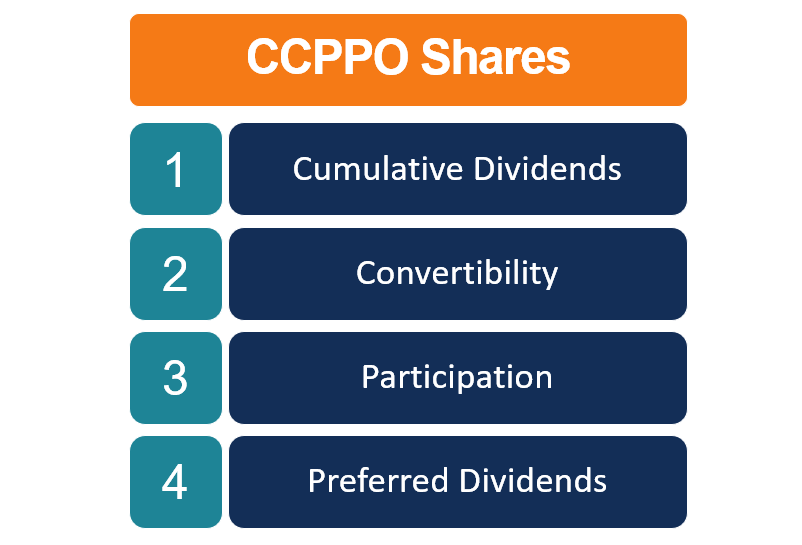
The key distinction of CCPPO shares from other types of equity is that the shares contain a number of different features, including the following:
1. Cumulative dividend feature
If a company misses some of its dividend payments to shareholders due to some reason, the cumulative provision requires a company to settle all missed dividend payments to the shareholders whose shares include the provision. The cumulative dividend feature ensures that the holders of CCPPO shares will receive all the dividend payments that they are entitled to.
2. Convertibility
The convertibility provision provides a right to a shareholder to exchange his/her preferred shares for common shares at a predetermined exchange rate.
3. Participation
The participation feature provides the holders of CCPPO shares an opportunity to receive dividend payments above the normally specified dividend rate. Unlike the holders of non-participating shares who are subject to a restriction on earnings distributed through dividends, the holders of participating shares can potentially receive earnings above their fixed rate.
Participating shares also grant liquidation preferences to their holders over common shareholders in case of a company’s liquidation. Essentially, if a company is liquidated, the participating shareholders are entitled to receive back the purchase price of their shares, as well as any leftover value that would remain after the liquidation of a company as if the shares were common shares.
4. Preferred-dividend feature
Note that CCPPO shares are ordinary, not preferred shares. Since ordinary shares do not offer preferred dividends, such a feature is specified for CCPPO shares. The preferred-dividend provision determines a fixed dividend rate based on the stock’s par value at which dividend payments are paid. Note that the preferred dividends are generally higher than the dividends for the common shares.
More Resources
CFI offers the Financial Modeling & Valuation Analyst (FMVA)™Become a Certified Financial Modeling & Valuation Analyst (FMVA)®CFI's Financial Modeling and Valuation Analyst (FMVA)® certification will help you gain the confidence you need in your finance career. Enroll today! certification program for finance professionals looking to take their careers to the next level. To keep learning and advancing your career, the following CFI resources will be helpful:
- Debt vs Equity FinancingDebt vs Equity FinancingDebt vs Equity Financing - which is best for your business and why? The simple answer is that it depends. The equity versus debt decision relies on a large number of factors such as the current economic climate, the business' existing capital structure, and the business' life cycle stage, to name a few.
- Dividend Per ShareDividend Per Share (DPS)Dividend Per Share (DPS) is the total amount of dividends attributed to each individual share outstanding of a company. Calculating the dividend per share
- Marketable SecuritiesMarketable SecuritiesMarketable securities are unrestricted short-term financial instruments that are issued either for equity securities or for debt securities of a publicly listed company. The issuing company creates these instruments for the express purpose of raising funds to further finance business activities and expansion.
- Venture Capital InvestingVenture Capital InvestingVenture capital investing is a type of private equity investing that involves investment in a business that requires capital. The business often requires capital for initial setup (or expansion). Venture capital investing may be done at an even earlier stage known as the "idea phase".
-
Understanding Efficiency Ratios: A Key to Business Performance
Efficiency ratios are metrics that are used in analyzing a company’s ability to effectively employ its resources, such as capital and assets, to produce income. The ratios serve as a comparison
-

Understanding Excess Reserves: What Banks Hold & Why It Matters
Excess reserves refer to the cash held by a bank or other financial institution above the reserve requirement that an authority sets. The amount of excess reserves is equal to the total reserves reduc
finance
- A-Shares Explained: Understanding Preferred Stock & Share Classes
- Authorized Shares: Understanding a Company's Issuance Limit
- Common vs. Preferred Stock: Understanding the Differences
- Understanding Forfeited Shares: Causes, Consequences, and Rights
- Outstanding Shares: Definition & Importance for Investors
- Preferred Shares: A Comprehensive Guide for Investors
- Understanding Voting Shares: Your Right to Participate in Company Decisions
- Understanding Anti-Dilution Provisions: Protecting Investor Equity
- Non-Renounceable Rights: Understanding Shareholder Options
-
 Corporate Bonds: A Comprehensive Guide to Investing
Corporate bonds are issued by corporationsCorporationA corporation is a legal entity created by individuals, stockholders, or shareholders, with the purpose of operating for profit. Corporations are a...
-
 Understanding Earnings: A Guide to Financial Profitability
Earnings refer to the income that an individual or organization gains during a certain period. They can be found on a company’s income statement and are used to measure the profitability of that...