
Funding Liquidity Risk: Definition, Causes & Mitigation
Funding liquidity risk refers to the risk that a company will not be able to meet its short-term financial obligations when due. In other words, funding liquidity risk is the risk that a company will not be able to settle its current outstanding bills.

Understanding Liquidity
Liquidity is defined as the ability to meet immediate and short-term obligations (within a year). As such, funding liquidity risk is the risk that a company is unable to meet its immediate and short-term obligations in a timely manner.
This risk is a major concern for cyclical companies where operating cash flowsOperating Cash FlowOperating Cash Flow (OCF) is the amount of cash generated by the regular operating activities of a business in a specific time period. and debt obligation due dates might not match up perfectly. For example, a company may experience a season of strong performance followed by a season of weak performance. During the period of slowdown, the company may be exposed to funding liquidity risk if the obligations due during that time are greater than the operating cash flows generated. This can be illustrated as below:
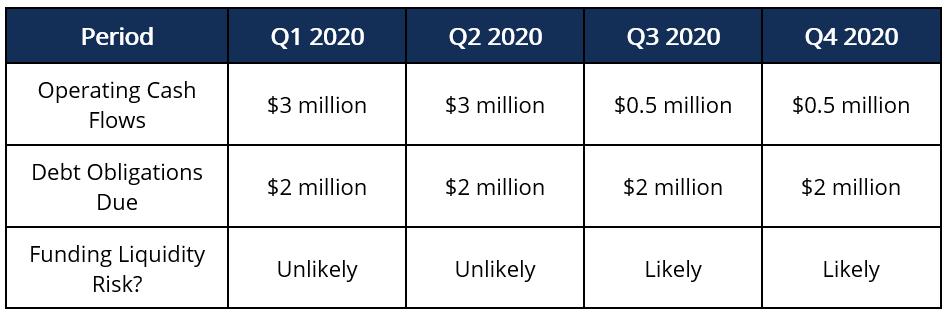
In Q3 2020 and Q4 2020, the company may not be able to generate enough cash flows (assuming that they do not keep a cash reserve) to satisfy its debt obligations.
When a company incurs a funding liquidity risk, they face the potential of having to liquidate capital assets (or other operating assets) at a price lower than the market price to satisfy their debt obligations. Selling operating assets could result in severe repercussions on the future revenue generation capabilities of the company.
Factors that Increase Risk
Funding liquidity risk can be heightened through the following factors:
- Seasonal fluctuations in revenue generation
- Business disruptions
- Unplanned capital expendituresCapital ExpendituresCapital expenditures refer to funds that are used by a company for the purchase, improvement, or maintenance of long-term assets to improve
- Increased operational costs
- Poor working capital management
- Poor matching of asset duration to debt duration
- Limited financing facilities
- Poor cash flow management
Measuring Liquidity Risk
Liquidity ratios, such as the current ratioCurrent Ratio FormulaThe Current Ratio formula is = Current Assets / Current Liabilities. The current ratio, also known as the working capital ratio, measures the capability of a business to meet its short-term obligations that are due within a year. The ratio considers the weight of total current assets versus total current liabilities. It indicates the financial health of a company and quick ratioQuick RatioThe Quick Ratio, also known as the Acid-test, measures the ability of a business to pay its short-term liabilities with assets readily convertible into cash, can be used as an indicator of a company’s funding liquidity risk. The current ratio, the most common ratio used to measure such a risk, is shown below:

Where:
- Current Assets are assets that are expected to be converted into cash within a year.
- Current Liabilities are liabilities that are expected to be due within a year.
Additional ratios such as the interest coverage ratioInterest Coverage RatioInterest Coverage Ratio (ICR) is a financial ratio that is used to determine the ability of a company to pay the interest on its outstanding debt., debt to gross cash flows, quick ratio, etc. should be used to provide a better picture of a company’s funding liquidity risk.
Mitigants to Risk
To mitigate funding liquidity risk, a company should assess its liquidity position. For example, a company could assess the:
1. Extent of dependence on financing
Companies that rely heavily on financing are subject to higher funding liquidity risk. Therefore, it would be important to assess financing facilities and try to minimize unnecessary financing.
2. Seasonality of sales
Companies that are cyclical may face poor cash flows in certain periods. Therefore, it would be important to assess cyclical periods of poor cash flows and identify ways to decrease operational costs during those periods.
3. Availability of funds
A line of credit is a classic mitigant to funding liquidity risk. A line of credit is a predetermined amount of credit that is extended to a borrower. The borrower is only charged interest on the amount taken from the line of credit. High availability of funds would help the company to meet debt obligations.
Example
A company’s balance sheet is as follows:
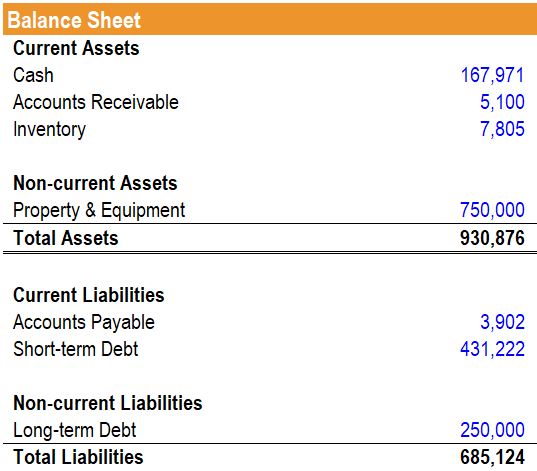
From looking only at the balance sheet, what can an investor infer about the company’s funding liquidity risk?
The company shows a current ratio of 0.42x and a quick ratio of 0.40x. Therefore, it would imply that the company faces significant risk.
Related Readings
CFI offers the Financial Modeling & Valuation Analyst (FMVA)™Become a Certified Financial Modeling & Valuation Analyst (FMVA)®CFI's Financial Modeling and Valuation Analyst (FMVA)® certification will help you gain the confidence you need in your finance career. Enroll today! certification program for those looking to take their careers to the next level. To keep learning and developing your knowledge base, please explore the additional relevant CFI resources below:
- Business RiskBusiness RiskBusiness risk refers to a threat to the company’s ability to achieve its financial goals. In business, risk means that a company's or an organization's plans may not turn out as originally planned or that it may not meet its target or achieve its goals.
- Liquidity EventLiquidity EventA liquidity event is a process by which an investor liquidates their investment position in a private company and exchanges it for cash. The main purpose of a liquidity event is the transfer of an illiquid asset (an investment in a private company) into the most liquid asset – cash.
- OverheadsOverheadsOverheads are business costs that are related to the day-to-day running of the business. Unlike operating expenses, overheads cannot be
- Statement of Cash FlowsStatement of Cash FlowsThe Statement of Cash Flows (also referred to as the cash flow statement) is one of the three key financial statements that report the cash
-

Understanding Risk Acceptance: A Comprehensive Guide
Accepting risk is a concept where an individual or business identifies risk and renders it acceptable, thereby making no effort to reduce or mitigate it. The potential loss from the identified and acc
-

Understanding Business Risk: Threats & Mitigation
Business risk refers to a threat to the company’s ability to achieve its financial goalsEarnings GuidanceAn earnings guidance is the information provided by the management of a publicly traded c
finance
- Understanding Risk Grades: An Investor's Guide
- Understanding Risk Preference: A Comprehensive Guide
- Understanding Liquidity in Financial Markets: A Comprehensive Guide
- Liquidity Premium: Definition, Calculation & Investment Implications
- Understanding Operating Risk: A Key Component of Business Risk
- Understanding Financial Risk: A Comprehensive Guide
- Risk Shifting: Definition, Examples & Implications
- Understanding Currency Risk: A Comprehensive Guide
- Understanding Liquidity Risk: Definition, Causes & Impact
-
 Understanding Risk Aversion in Investing: A Beginner's Guide
The term risk aversion is often applied to certain types of investors. Here are the basics of risk aversion and what it means to investors. Risk Aversion The term risk aversion basically means t...
-
Liquidity Mining Explained: Earn Passive Income with DeFi
The DeFi craze of 2020 brought an entirely new way of earning passive income, completely redefining the traditional concept of mining. Liquidity mining, otherwise known as yield farming, represents a ...