
Understanding LTM: Last Twelve Months Explained
LTM (Last Twelve Months), also sometimes known as the trailing or rolling twelve months, is a time frame frequently used in connection with financial ratios, such as revenuesSales RevenueSales revenue is the income received by a company from its sales of goods or the provision of services. In accounting, the terms "sales" and or return on equityReturn on Equity (ROE)Return on Equity (ROE) is a measure of a company’s profitability that takes a company’s annual return (net income) divided by the value of its total shareholders' equity (i.e. 12%). ROE combines the income statement and the balance sheet as the net income or profit is compared to the shareholders’ equity. (ROE), to evaluate a company’s performance during the immediately preceding 12-month time period. This is not necessarily related to a fiscal yearFiscal Year (FY)A fiscal year (FY) is a 12-month or 52-week period of time used by governments and businesses for accounting purposes to formulate annual period, as the LTM references any 12-month period.
Here is an example of how to calculate the last 12 months Earnings per ShareEarnings Per Share (EPS)Earnings per share (EPS) is a key metric used to determine the common shareholder's portion of the company’s profit. EPS measures each common share's profit (EPS) halfway through a company’s fiscal year.
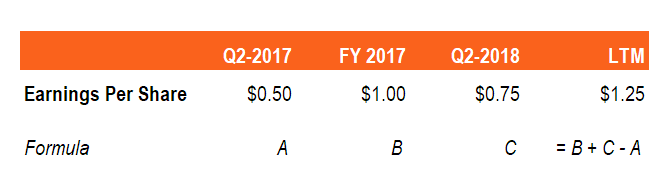
How to Generate the Last Twelve Month Figures from Financial Reports
In order to determine LTM figures, one uses the annual and last quarterly reports of a company. Items on the income statement for those reporting periods can be added together.
LTM figures for US-based companies can be easily calculated by using a company’s 10-K10-KForm 10-K is a detailed annual report that is required to be submitted to the U.S. Securities and Exchange Commission (SEC). The filing provides a comprehensive summary of a company’s performance for the year. It is more detailed than the annual report that is sent to shareholders and 10-Q SEC filingsPublic FilingsFind public company filings. CFI has organized all the main sources of public company filings such as 10-K, 10-Q, S-1,13D, EDGAR, SEDAR, and other databases. These sources are vital for financial analysts performing financial modeling and valuation work..
LTM revenue = most recent quarter figures + most recent annual figures – figures in the corresponding quarter 12 months before the most recent quarter
Alternatively, if one has access to full monthly data, then one can simply utilize the collection of the last twelve months of data.
To illustrate:
A company reported quarterly revenue of $5M on 3/31/2015, $15M yearly revenue on 12/31/2015, and $8M quarterly revenue on 3/31/2016. To generate the last twelve months’ revenue figure ending 3/31/2016, the amount of revenue generated is $18M ($8M+$15M-$5M).
Why do Analysts and Investors use LTM figures?
- LTM is considered useful in assessing the most recent business performance, which is indicative of the company’s current trend;
- Its figures are more current than the fiscal or annual financial statementsThree Financial StatementsThe three financial statements are the income statement, the balance sheet, and the statement of cash flows. These three core statements are, which helps to avoid potentially misleading short-term measurements;
- It is useful for comparing the relative performance of similar companies within an industry or sector;
- LTM figures provide a more accurate value of a business in the event of an acquisitionMergers Acquisitions M&A ProcessThis guide takes you through all the steps in the M&A process. Learn how mergers and acquisitions and deals are completed. In this guide, we'll outline the acquisition process from start to finish, the various types of acquirers (strategic vs. financial buys), the importance of synergies, and transaction costs; and
- It gives a relevant measurement of the price-to-earnings ratio.
The LTM time frame is sufficient to provide analysts and investors with financial metrics that are not inappropriately influenced or distorted by factors such as seasonality or brief market or economic turndowns. Some of the financial ratios that are most frequently calculated on an LTM basis are earnings per share (EPS) and dividend yieldDividend Yield FormulaThe Dividend Yield is a financial ratio that measures the annual value of dividends received relative to the market value per share of a security. It calculates the percentage of a company’s market price of a share that is paid to shareholders in the form of dividends.. See examples, how to calculate.
Additional Resources
CFI is the global provider of the Financial Modeling & Valuation Analyst (FMVA)®Become a Certified Financial Modeling & Valuation Analyst (FMVA)®CFI's Financial Modeling and Valuation Analyst (FMVA)® certification will help you gain the confidence you need in your finance career. Enroll today! program for finance professionals. Our mission is to help you advance your career, and with that goal in mind, the below resources will be useful.
Learn more about the use of the rolling twelve-month time period and financial analysis by reading the following resources from CFI:
- Financial Planning and AnalysisFP&A AnalystBecome an FP&A Analyst at a corporation. We outline the salary, skills, personality, and training you need for FP&A jobs and a successful finance career. FP&A analysts, managers, and directors are responsible for providing executives with the analysis and information they need
- Financial modeling guideFree Financial Modeling GuideThis financial modeling guide covers Excel tips and best practices on assumptions, drivers, forecasting, linking the three statements, DCF analysis, more
- Fiscal Year (FY)Fiscal Year (FY)A fiscal year (FY) is a 12-month or 52-week period of time used by governments and businesses for accounting purposes to formulate annual
- Last 12 Months RevenueLTM RevenueLTM Revenue is used in finance to measure a company’s financial health. It reports or calculates the revenue figures for the past 12 months.
-

Understanding Financial Crises: Causes, Impacts, and Examples
A financial crisis is defined as any situation where one or more significant financial assets – such as stocks, real estateReal EstateReal estate is real property that consists of land and impro
-

Financial Engineering: Principles, Applications & Career Paths
Financial engineering encompasses a broad, multidisciplinary field of study and practice that, essentially, applies an engineering approach and methodology to the world of finance. It integrates and u
finance
- Amalgamation Explained: Mergers & Corporate Combinations
- Financial Leverage: Definition, Calculation & Impact on Profitability
- Understanding Financial Distress: Causes, Consequences & Bankruptcy
- Financial Guarantee: Definition, Types & How They Work
- Financial Leverage Explained: Using Debt for Growth
- Understanding Financial Ratios: A Comprehensive Guide
- Understanding Financial Statement Normalization: A Comprehensive Guide
- Understanding the Role of an Accountant: Key Responsibilities & Importance
- Financial Reinsurance: A Comprehensive Guide for Businesses
-
 Factset: Financial Data & Analytics Solutions for Investment Professionals
Factset Research Systems is a company that provides software and financial data solutions for investment professionals. The company offers a number of financial services, such as business advisory, da...
-
 Understanding Finance: A Comprehensive Overview of Key Concepts
Finance is defined as the management of money and includes activities such as investing, borrowing, lending, budgeting, saving, and forecasting. There are three main types of finance: (1) personalPers...