
Understanding Look-Ahead Bias: Causes, Effects & Examples
Look-ahead bias is a type of bias that occurs when a study or simulation relies on data or information that was not yet available or known during the time period being studied. It generally leads to inaccurate results from a study or simulation. The incorporation of fundamental data that wasn’t available at the time of the study delivers biased results that are often close to the desired outcome but not to the real outcome.
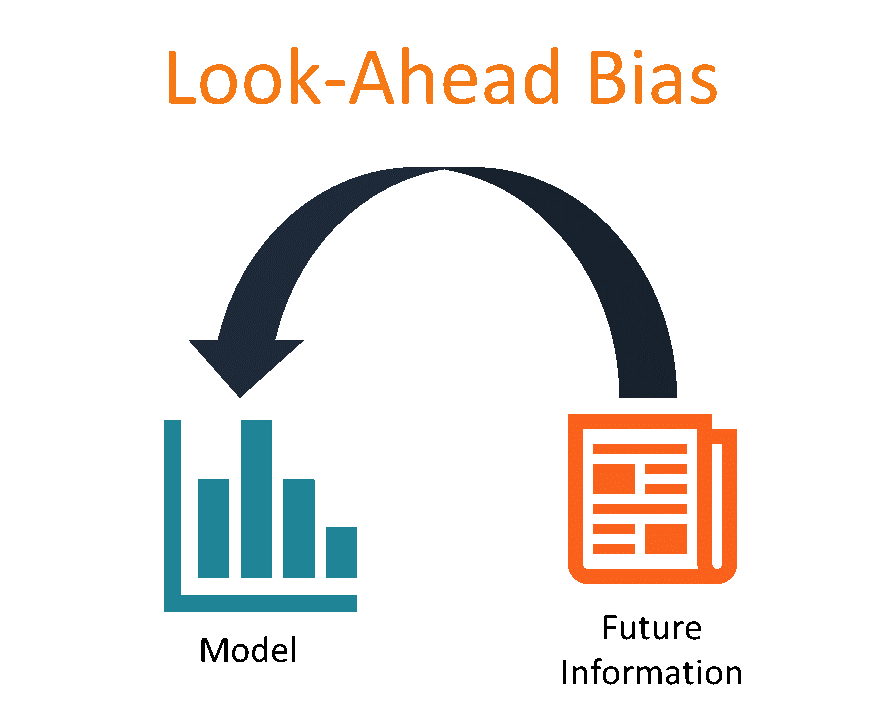
In finance, look-ahead bias is commonly encountered in trading strategies and various financial modelsTypes of Financial ModelsThe most common types of financial models include: 3 statement model, DCF model, M&A model, LBO model, budget model. Discover the top 10 types. If an analyst commits a look-ahead bias in a trading strategy, testing the strategy will likely return unreasonably positive results. However, the real application of the strategy is likely to deliver dramatically different results from those obtained during the testing process.
One of the issues with look-ahead bias is that it is reasonably difficult to detect during backtesting. Backtesting is a process of applying a model or a simulation to historical data to assess the accuracy of a model or a simulation.
In some cases, backtesting cannot signal that the model is biased. However, if during backtesting the model returns an exceptional result, then that can be a red flag that there is something wrong with the model. Many finance professionalsFinance Salary GuideIn this finance salary guide, we cover several finance jobs and their corresponding midpoint salaries for 2018. Regardless of the industry, a good finance professional is difficult to find. Competition to hire and retain top talent in the fields of finance and accounting remains tough. involved in the development of trading strategies carefully review strategies that indicate returns above a certain level – for example, 20%.
The best solution to avoid the look-ahead bias is a thorough assessment of the validity of developed models and strategies.
Example of Look-ahead Bias
Let’s consider that you work as a quantitative analystQuantsQuantitative analysts (also called “quants”) are professionals specializing in the design, development, and implementation of algorithms and mathematical or statistical models intended to solve complex financial problems. In their work, quantitative analysts apply a blend of techniques and knowledge at a hedge fund. You’re working on the development of a new trading strategy for equities. Your model assesses the relationship between the release of quarterly earnings reports and the stock price.
The main assumption behind your model is that the stock price reacts to earnings reportsThree Financial StatementsThe three financial statements are the income statement, the balance sheet, and the statement of cash flows. These three core statements are. However, during the backtesting of the model, you assume that the company’s earnings reports are released on the same date as when the fiscal quarter closes.
This situation is a classic example of look-ahead bias, given that the quarterly earnings reports become available only one month after the end of the quarter. Therefore, your backtesting incorporates information that was not available during the time being tested. Thus, the results of the backtesting are likely to be inaccurate.
Additional Resources
Thank you for reading CFI’s explanation of look-ahead bias. CFI offers the Financial Modeling & Valuation Analyst (FMVA)™Become a Certified Financial Modeling & Valuation Analyst (FMVA)®CFI's Financial Modeling and Valuation Analyst (FMVA)® certification will help you gain the confidence you need in your finance career. Enroll today! certification program for those looking to take their careers to the next level. To keep learning and advancing your career, the following CFI resources will be helpful:
- Anchoring BiasAnchoring BiasAnchoring bias occurs when people rely too much on pre-existing information or the first information they find when making decisions. Anchors are an important concept in behavioral finance.
- Belief PerseveranceBelief PerseveranceBelief perseverance, also known as belief persistence, is the inability of people to change their own belief, even upon receiving new information or facts
- Confirmation BiasConfirmation BiasConfirmation bias is the tendency of people to pay close attention to information that confirms their belief and ignore information that contradicts it. This is a type of bias in behavioral finance that limits our ability to make objective decisions.
- Hypothesis TestingHypothesis TestingHypothesis Testing is a method of statistical inference. It is used to test if a statement regarding a population parameter is correct. Hypothesis testing
-
Black-Scholes Model: Understanding Stock Option Pricing
The Black-Scholes-Merton (BSM) model is a pricing model for financial instruments. It is used for the valuation of stock options. The BSM model is used to determine the fair prices of stock options ba
-
Understanding the Heath-Jarrow-Morton (HJM) Interest Rate Model
The Heath-Jarrow-Morton Model – also known as the HJM Model – is a framework to represent forward interest rates using an existing term structure of interest rates. The model was created b
finance
- Media for Equity: An Alternative Startup Funding Model
- Model Audit: Ensuring Accuracy and Reliability in Financial Models
- Anchoring Bias: Understanding How First Impressions Influence Decisions
- Backtesting: A Comprehensive Guide to Strategy Validation
- Understanding Cognitive Bias: How It Impacts Decisions
- Confirmation Bias: Understanding How It Affects Financial Decisions
- Understanding Durability Bias: Why Past Performance Doesn't Guarantee Future Results
- Framing Bias: Understanding How Presentation Influences Decisions
- Understanding Home Bias in Investing: A Comprehensive Guide
-
 The Financial Modeler's Manifesto: Principles for Robust Financial Modeling
The Financial Modelers’ Manifesto is a proposal calling for greater fiscal and risk-managementRisk ManagementRisk management encompasses the identification, analysis, and response to risk factor...
-
 PRAT Model: Understanding Sustainable Growth & Financial Health
The PRAT model, also known as the sustainable growth rate (SGR) model, is used to describe the optimal rate of growth a company can achieve without borrowing more debt or using equity. The PRAT model ...