
Net Interest Margin (NIM): Definition & Importance
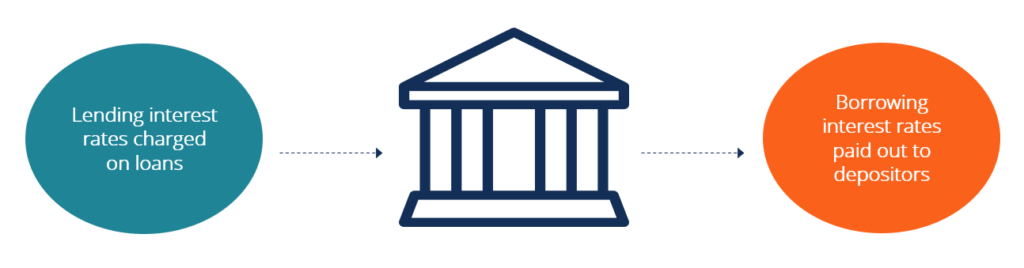
Net interest rate spread refers to the difference between the interest rate a financial institution pays to depositors and the interest rate it receives from loans. In other words, it is the difference between the borrowing and lending interest rates of the bank. The interest rate spread is a key determinant of the financial institution’s profitability and is similar to a profit marginProfit MarginIn accounting and finance, profit margin is a measure of a company's earnings relative to its revenue. The three main profit margin metrics.

Summary
- The net interest rate spread refers to the difference in the borrowing and lending interest rates for banks and other financial institutions. It can be described as a determinant of profitability for the institution.
- Typically, the interest paid out on deposits is at a lower rate than the interest the bank charges on loans, meaning that the bank generates income. Banks keep a close eye on the spread, because the greater the spread, the larger the income.
- The net interest rate spread is reported by banks in their financial statements and is examined closely by investors and other interested parties.
A Detailed Explanation – How Do Banks Operate?
To better understand the net interest rate spread, we first must understand how financial institutions operate. The financial institutions referred to here are mostly banks. Banks issue a variety of loans to customers, which includes mortgagesMortgageA mortgage is a loan – provided by a mortgage lender or a bank – that enables an individual to purchase a home. While it’s possible to take out loans to cover the entire cost of a home, it’s more common to secure a loan for about 80% of the home’s value. on a property, student loans, and auto loans. They charge interest on the loans.
Banks generate income through deposits in the form of savings and checking accounts, shareholder equity, or debt issuance and payout interest. Typically, the interest paid out on deposits is at a lower rate than the interest the bank charges on loans, meaning that the bank generates income. As such, the larger the interest rate spread, the higher the income the bank earns.
For commercial banks, the income gained through interest rate spreads is their primary source of income. The calculation for interest rate spread is quite simple – it is the difference between the two interest rates mentioned above.
Practical Example
For example, Bank ABC charges customers 4% interest for car loans and pays out interest to depositors for holding their money at a rate of 1.75%. It means that the interest rate spread will be 4% – 1.75% = 2.25%.
Importance of the Net Interest Rate Spread
The net interest rate spread is especially important because it is essentially a measure of the profit margin for the institution. It is because the larger the spread, the more money the bank earns. Both rates can fluctuate over time, which means that the bank needs to keep a close eye on them to prevent a substantial decrease in income.
The net interest rate spread is reported by banks – and other publicly-traded corporations that are responsible to shareholders – as disclosure in their financial statements for quarterly and year-end fiscal reports. The spreads of different banks are closely examined by international organizations, such as the World Bank, which releases data from different countries around the world to provide users with information on the average lending and deposit rates worldwide.
For investments, the interest rate spread is used to evaluate the rates of investments versus the benchmark rates in a particular industry. It commonly occurs for securities and bonds. The spread rates are compared according to the credit ratingCredit RatingA credit rating is an opinion of a particular credit agency regarding the ability and willingness an entity (government, business, or individual) to fulfill its financial obligations in completeness and within the established due dates. A credit rating also signifies the likelihood a debtor will default. and enable bonds of the same rating (such as AA or BB) to be compared against each other for more accurate results.
How Are Interest Rates Determined?
The interest rates themselves are a key determinant of the interest rate spread and are affected by several factors. Government policy plays a key role in determining the interest rates, as do market transactions in the open market.
In the United States, the policy set by the Federal Reserve Bank leads to a federal funds rateFederal Funds RateIn the United States, the federal funds rate is the interest rate that depository institutions (such as banks and credit unions) charge other depository institutions., which helps determine the rate at which institutions lend funds. It is done to maintain the mandatory amount of reserve required, meaning that the federal funds rate acts as a base interest rate. The other interest rates build upon the base rate according to each institution.
Net Interest Rate Spread Software
Banks typically use special software to help them calculate the net interest rate spread and manage the spread strategically. Examples of such software include the following:
- Margin Maximizer Suite: Originally developed by the US Banking Alliance, the software is installed onsite and uses a Microsoft Net-based application that must be installed on each user’s computer beforehand. It is also used in conjunction with an onsite consulting service.
- PrecisionLender: The web-based program is delivered to users as a service (SaaS) program.
- Austin Associates LLC: The program is catered more towards commercial loan pricing but is more traditional, as it uses HTML web forms.
Additional Resources
CFI offers the Commercial Banking & Credit Analyst (CBCA)™Program Page - CBCAGet CFI's CBCA™ certification and become a Commercial Banking & Credit Analyst. Enroll and advance your career with our certification programs and courses. certification program for those looking to take their careers to the next level. To keep learning and advancing your career, the following resources will be helpful:
- Annual Percentage Rate (APR)Annual Percentage Rate (APR)The Annual Percentage Rate (APR) is the yearly rate of interest that an individual must pay on a loan, or that they receive on a deposit account. Ultimately, APR is a simple percentage term used to express the numerical amount paid by an individual or entity yearly for the privilege of borrowing money.
- Credit SpreadCredit SpreadCredit spread is the difference between the yield (return) of two different debt instruments with the same maturity but different credit ratings.
- Spread TradingSpread TradingSpread trading – also known as relative value trading – is a method of trading that involves an investor simultaneously buying one security and selling a
- Net Interest Rate Differential (NIRD)Net Interest Rate Differential (NIRD)Net interest rate differential (NIRD) occurs when there is a difference in interest rates between two countries or regions. It normally takes place in the
-

Understanding Good Loan Interest Rates: What to Expect
What Is a Good Loan Interest Rate? What makes an interest rate "good" varies with the type of loan, and it changes over time. At different points in the 21st century, for instance,
-

Basis Point (bp): Understanding Interest Rate Fluctuations
A Basis Point, often referred to as a Beep (using the notation bp), is a measurement of one-hundredth of a percent or one ten-thousandth and is a term commonly used in financeFinance OverviewFinance i
finance
- Relative Interest Rates: Understanding Their Impact on the Economy
- Debentures Explained: A Comprehensive Guide to Unsecured Corporate & Government Debt
- Understanding Floating Interest Rates: Definition & How They Work
- Understanding Interest Rates: A Comprehensive Guide
- Understanding Interest Rate Risk: Definition & Impact
- Interest Rate Swaps: A Comprehensive Guide
- Net Interest Margin (NIM): Definition & Importance
- Simple Interest Explained: Calculation, Benefits & Examples
- Swap Spreads: Understanding the Difference and its Significance
-
 Swap Rate Explained: Understanding Fixed Exchange Rates in Derivatives
The swap rate is the fixed rate of a swapSwapA swap is a derivative contract between two parties that involves the exchange of pre-agreed cash flows of two financial instruments. The cash flows a...
-
 Understanding the Policy Interest Rate: Its Impact on the Economy
Three more sleep inducing words have perhaps never been strung together, but the policy interest rate is actually pretty exciting insofar as it's a little number that has a profound effect on a c...