
Stock Dividends: Definition, Types & How They Work
A stock dividend, a method used by companies to distribute wealth to shareholders, is a dividend payment made in the form of shares rather than cash. Stock dividends are primarily issued in lieu of cash dividends when the company is low on liquid cash on hand. The board of directorsBoard of DirectorsA board of directors is a panel of people elected to represent shareholders. Every public company is required to install a board of directors. decides on when to declare a (stock) dividend and in what form the dividend will be paid.

Impact of a Stock Dividend on Market Capitalization
Similar to a cash dividend, a stock dividend does not increase shareholder wealth or market capitalizationMarket CapitalizationMarket Capitalization (Market Cap) is the most recent market value of a company’s outstanding shares. Market Cap is equal to the current share price multiplied by the number of shares outstanding. The investing community often uses the market capitalization value to rank companies. Although it increases the number of shares outstanding for a company, the price per share must decrease accordingly. An understanding that the market capitalization of a company remains the same explains why share price must decrease if more shares are issued. The following diagram illustrates the concept:
Example of a Stock Dividend
Colin is a shareholder of ABC Company and owns 1,000 shares. The board of directors of ABC Company recently announced a 10% stock dividend. Assuming that the current stock price is $10 and there are 100,000 total shares outstanding, what is the effect of a 10% stock dividend on Colin’s 1,000 shares?
1. Determine the market capitalization of ABC Company:
$10 x 100,000 shares = $1,000,000 (market capitalization)
2. Determine the increase in shares outstanding due to a 10% stock dividend:
100,000 shares x 10% = 10,000 increase in shares outstanding
3. Determine the new total shares outstanding:
10,000 + 100,000 = 110,000 shares
4. Determine the number of shares Colin now owns:
Before the stock dividend, Colin owned 1% (1,000 / 100,000) of the total outstanding shares. Since a stock dividend is given to all shareholders, Colin’s ownership percentage in ABC Company remains the same.
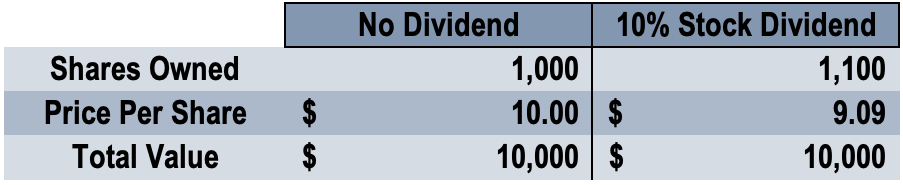
Therefore, Colin would own 1% of the new total shares outstanding or 1% x 110,000 = 1,100. The number is identical to increasing Colin’s 1,000 shares by the 10% stock dividend.
5. Determine the price per share of ABC Company:
A stock dividend does not increase the market capitalization of a company. The market capitalization of ABC Company remains $1,000,000. With 110,000 total shares outstanding, the stock price of ABC Company would be $1,000,000 / 110,000 = $9.09.
The following diagram illustrates the impact of a stock dividend on Colin:
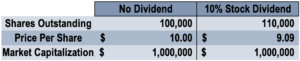
The following diagram illustrates the impact of a stock dividend on ABC Company:
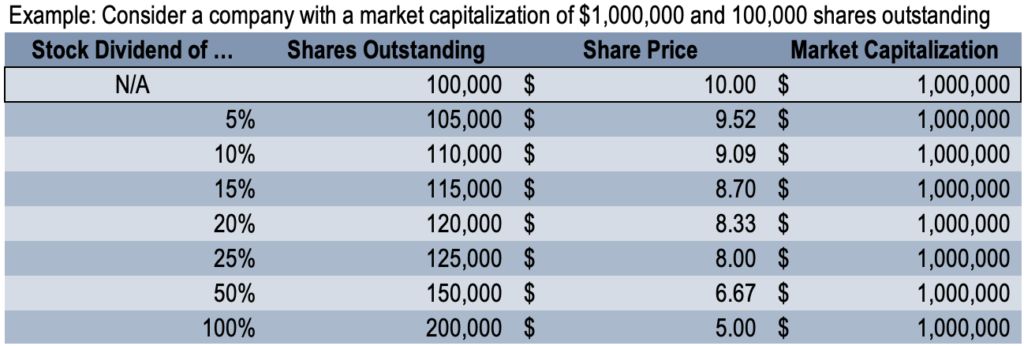
The key takeaway from our example is that a stock dividend does not affect the total value of the shares that each shareholder holds in the company. As the number of shares increases, the price per share decreases accordingly because the market capitalization must remain the same.
Advantages of a Stock Dividend
1. Maintaining cash position
A company that does not have enough cash may choose to pay a stock dividend in lieu of a cash dividend. In other words, a cash dividend allows a company to maintain its current cash position.
2. Tax considerations for a stock dividend
No tax considerations exist for issuing a stock dividend. For this reason, shareholders typically believe that a stock dividend is superior to a cash dividend – a cash dividend is treated as income in the year received and is, therefore, taxed.
3. Maintaining an “investable” price range
As noted above, a stock dividend increases the number of shares while also decreasing the share price. By lowering the share price through a stock dividend, a company’s stock may be more “affordable” to the public.
For example, consider an investor with $1,000 looking to invest in Stock A or Stock B. Stock A is priced at $2,000 while Stock B is priced at $500. Stock A would be deemed “unaffordable” for the investor since he only has $1,000 to invest.
Disadvantages of a Stock Dividend
1. Market signaling and asymmetric informationAsymmetric InformationAsymmetric information is, just as the term suggests, unequal, disproportionate, or lopsided information. It is typically used in reference to some type of business deal or financial arrangement where one party possesses more, or more detailed, information than the other.
The market may perceive a stock dividend as a shortage of cash, signaling financial problems. Market participants may believe the company is financially distressed, as they do not know the actual reason for management issuing a stock dividend. This can put selling pressure on the stock and depress its price.
2. Risky projects
Issuing a stock dividend instead of a cash dividend may signal that the company is using its cash to invest in risky projects. The practice can cast doubt on the company’s management and subsequently depress its stock price.
Journal Entries for a Stock Dividend
The journal entries for a stock dividend depends on whether the company is involved in a small stock dividend or a large stock dividend. The journal entries for both sizes are illustrated below:
1. Small dividend
A stock dividend is considered a small stock dividend if the number of shares being issued is less than 25%. For example, assume a company holds 5,000 common shares outstanding and declares a 5% common stock dividend. In addition, the par value per stock is $1, and the market value is $10 on the declaration date. In this scenario, 5,000 x 5% = 250 new common shares will be issued. The following entries are made:


2. Large dividend
A stock dividend is considered a large stock dividend if the number of shares being issued is greater than 25%. For example, assume a company owns 5,000 common shares outstanding and declares a 50% common stock dividend. In addition, the par value per stock is $1, and the market value is $10 on the declaration date. In such a scenario, 5,000 x 50% = 2,500 new common shares will be issued. The following entries are made:


More Resources
CFI is the official provider of the global Financial Modeling & Valuation Analyst (FMVA)™Become a Certified Financial Modeling & Valuation Analyst (FMVA)®CFI's Financial Modeling and Valuation Analyst (FMVA)® certification will help you gain the confidence you need in your finance career. Enroll today! certification program, designed to help anyone become a world-class financial analyst. To keep advancing your career, the additional CFI resources below will be useful:
- Capital GainCapital GainA capital gain is an increase in the value of an asset or investment resulting from the price appreciation of the asset or investment. In other words, the gain occurs when the current or sale price of an asset or investment exceeds its purchase price.
- Free FloatFree FloatFree float, also known as public float, refers to the shares of a company that can be publicly traded and are not restricted (i.e., held by insiders). In other words, the term is used to describe the number of shares that is available to the public for trading in the secondary market.
- Special DividendSpecial DividendA special dividend, also referred to as an extra dividend, is a non-recurring, "one-time" dividend distributed by a company to its shareholders. It is separate from the regular cycle of dividends and is usually abnormally larger than a company’s typical dividend payment.
- Weighted Average Shares OutstandingWeighted Average Shares OutstandingWeighted average shares outstanding refers to the number of shares of a company calculated after adjusting for changes in the share capital over a reporting period. The number of weighted average shares outstanding is used in calculating metrics such as Earnings per Share (EPS) on a company's financial statements
-

Phantom Stock: Definition, Benefits & How It Works
Many companies today are looking for creative ways to reward their senior managers and key executives for outstanding performance. One strategy is to provide these employees with what’s commonly refer
-
Stock Replenishment: A Comprehensive Guide for Inventory Management
Stock replenishment is one of the most important considerations when it comes to inventory management, as it helps ensure the right stock is on the shelves at the right time, while keeping inventory h
finance
- Understanding Stock Performance: A Guide for Investors
- Understanding Dividends: A Comprehensive Guide
- Founders Stock: Definition, Vesting, and Key Differences
- Restricted Stock: Definition, Types & How It Works
- Understanding Stocks: A Beginner's Guide to Share Ownership
- What is a Stock Option?
- Understanding Dividend Yield: A Comprehensive Guide
- Understanding Downtrends: Definition, Identification & Reversal
- Dividend Reinvestment Plans (DRIPs): A Beginner's Guide
-
Qualified Dividends: Tax Benefits & Requirements Explained
A qualified dividend is a type of payment that is made by a corporation to its shareholders. When this payment is received, the investor will have to pay capital gains tax, instead of regular in...
-
Special Dividends: Understanding One-Time Payments to Shareholders
A special dividend is a type of payment that is made by a company to its shareholders. This type of dividend is different from a traditional dividend that is received by stockholders in the comp...