
Understanding Dividend Yield: A Comprehensive Guide
The dividend rate is the amount of cash returned by a company to its stockholders on an annual basis as a percentage of the market valueMarket ValueMarket value is usually used to describe how much an asset or company is worth in a financial market. Itis mutually determined by market participants and of the company. The cash returned to investors is called a dividend, hence the term dividend rate.

Summary
- The dividend rate is the annual dividend on a single stock divided by the current market price of that stock.
- Dividends can vary greatly across companies and industries. Mature companies pay higher dividends than growing companies.
- An increase in a company’s dividend rate sends a positive signal to the market about the company’s stock.
Dividend Rate Formula
The dividend rate can be described as the amount of cash received by a shareholder, divided by the market value of the stock held by that shareholder. On a per-share basis, the dividend rate is the amount of annual dividend per stock, divided by the current price of the stock.
Dividend Rate = Dividend Per Share / Current Share Price
Dividend Rate Example
As of July 1, 2020, Boeing Co. distributes dividends of $2.055 per share every quarter. It adds up to an annual dividend of $8.22. The current price of Boeing’s stock is $180.32. Based on the formula above, if you divide the annual dividend per share of $8.22 by the current market price per share of $180.32, you get a dividend rate of 4.56%.
A dividend rate of 4.56% implies that every investor would receive annual dividends equal to 4.56% of the market value of Boeing’s stock held by them. So, if an investor holds 100 stocks of Boeing, the market value of stock held by that investor is $18,032, and the investor would receive 4.56% of that value annually in the form of dividends from the company. It amounts to an annual dividend amount of $822.
Companies With the Highest Dividend Rates
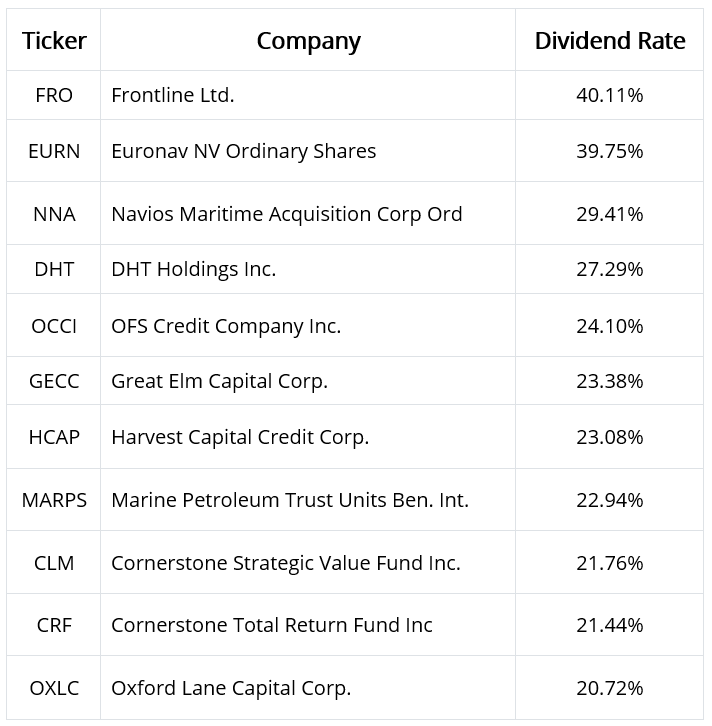
Variance in Dividend Rates
Dividend rates can vary greatly across companies and industries. For example, mature companies in an industry, such as basic materialsBasic Materials SectorThe basic materials sector is comprised of companies involved in the discovery, extraction, and processing of raw materials. It includes mining, forestry, would most likely provide investors with higher dividend rates as opposed to fast-growing technology companies.
It is the case because of limited options for mature companies to invest cash into further expansion or capital projects; hence, they choose to give back some of the cash to its shareholders. However, a high-growth company would want to use all available cash to fuel its strong growth and would likely not provide its shareholders with a dividend.
Signaling Effect of Dividend Rates
A high dividend rate provides two clear and distinct signals to the market. First, it indicates that the management believes in the company’s ability to generate steady cash flow from its operations for the foreseeable future. Second, it indicates that management faces limited options in terms of expansion and growth.
A declaration of a dividend or an increase in a dividend is generally seen as positive signals by the market because even if there’s not much room for the company to grow, a high dividend reduces the agency problem.
Tax Implications of Dividends
Most countries tax dividends. It is sometimes viewed as double taxation since the corporation is taxed based on the net income generated, and then the individual shareholders receiving the dividends are taxed as well.
The tax on capital gainsCapital Gains TaxCapital gains tax is a tax imposed on capital gains or the profits that an individual makes from selling assets. The tax is only imposed once the asset has been converted into cash, and not when it’s still in the hands of an investor. and the tax on dividends are generally not the same. Except for a few countries – such as Spain, Finland, and Estonia, among others – the capital gains tax is usually lower than the tax on dividends.
More Resources
CFI is the official provider of the Commercial Banking & Credit Analyst (CBCA)™Program Page - CBCAGet CFI's CBCA™ certification and become a Commercial Banking & Credit Analyst. Enroll and advance your career with our certification programs and courses. certification program, designed to transform anyone into a world-class financial analyst.
In order to help you become a world-class financial analyst and advance your career to your fullest potential, these additional resources will be very helpful:
- Dividend Payout RatioDividend Payout RatioDividend Payout Ratio is the amount of dividends paid to shareholders in relation to the total amount of net income generated by a company. Formula, example
- Earnings Per Share (EPS)Earnings Per Share (EPS)Earnings per share (EPS) is a key metric used to determine the common shareholder's portion of the company’s profit. EPS measures each common share's profit
- Important Dividend DatesImportant Dividend DatesIn order to understand dividend-paying stocks, knowledge of important dividend dates is crucial. A dividend typically comes in the form of a cash distribution that is paid from the company's earnings to investors.
- Net Investment Income (NII)Net Investment Income (NII)Net investment income (NII) is the total income before taxes that an investor receives on their portfolio of investment assets. Net investment income is
-

Floating Rate Funds: Understanding & Investing in Variable Interest Rates
A floating rate fund is a type of mutual fund that invests in securities paying fluctuating interest rates. Floating rate funds primarily invest in debt instrumentsDebt InstrumentA debt instrument is
-

Forward Premium Explained: Understanding Currency Expectations
Forward premium occurs when the forward exchange rate is quoted higher than the spot exchange rate. The expectation of the market is that the domestic currency will be worth less in the future or will
invest
- Understanding Dividends: A Comprehensive Guide
- Dividend Growth Rate (DGR): Definition & Calculation
- Hurdle Rate: Definition, Calculation & Importance for Investors
- Understanding Interest Rates: A Comprehensive Guide
- Ex-Ante: Understanding Predictions in Finance
- Understanding LIBOR: What It Is and How It Works
- Qualified Dividends: Tax Benefits & Requirements Explained
- Understanding Burn Rate: A Key Metric for Startup Success
- Special Dividends: Understanding One-Time Payments to Shareholders
-
 Understanding Dividend Policy: A Comprehensive Guide
A company’s dividend policy dictates the amount of dividends paid out by the company to its shareholders and the frequency with which the dividends are paid out. When a company makes a profit, t...
-
 Understanding Exempt-Interest Dividends: A Tax-Efficient Investment
Exempt-interest dividend refers to any dividend or part of it that a regulated investment company pays that is not subject to tax. It is designated as such in a written notice that is mailed to the co...