
Understanding Dividends: A Comprehensive Guide
A dividend is a share of profits and retained earningsRetained EarningsThe Retained Earnings formula represents all accumulated net income netted by all dividends paid to shareholders. Retained Earnings are part that a company pays out to its shareholders. When a company generates a profit and accumulates retained earnings, those earnings can be either reinvested in the business or paid out to shareholders as a dividend. The annual dividend per share divided by the share price is the dividend yieldDividend Yield FormulaThe Dividend Yield is a financial ratio that measures the annual value of dividends received relative to the market value per share of a security. It calculates the percentage of a company’s market price of a share that is paid to shareholders in the form of dividends.. See examples, how to calculate.

How a dividend works
A dividend’s value is determined on a per-share basis and is to be paid equally to all shareholders of the same class (common, preferred, etc.). The payment must be approved by the Board of Directors.
When a dividend is declared, it will then be paid on a certain date, known as the payable date.
Steps of how it works:
- The company generates profitsNet IncomeNet Income is a key line item, not only in the income statement, but in all three core financial statements. While it is arrived at through and retained earnings
- The management team decides some excess profits should be paid out to shareholders (instead of being reinvested)
- The board approves the planned dividend
- The company announces the dividend (the value per share, the date when it will be paid, the record date, etc.)
- The dividend is paid to shareholders
Dividend example
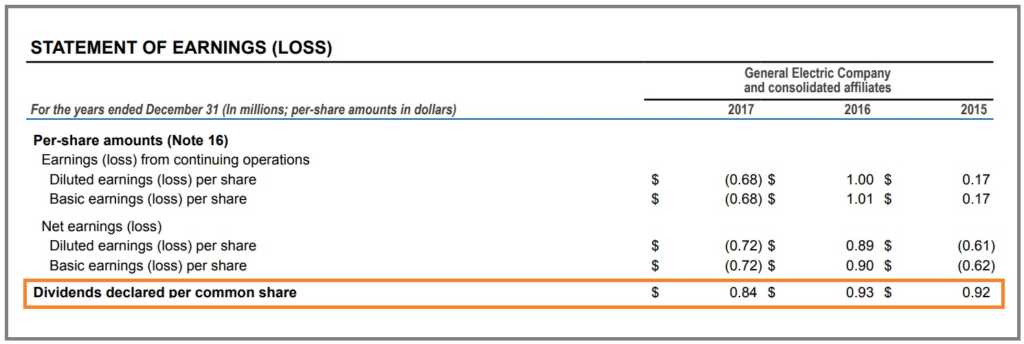
Below is an example from General Electric’s (GE)’s 2017 financial statementsThree Financial StatementsThe three financial statements are the income statement, the balance sheet, and the statement of cash flows. These three core statements are. As you can see in the screenshot, GE declared a dividend per common share of $0.84 in 2017, $0.93 in 2016, and $0.92 in 2015.
This figure can be compared to Earnings per ShareEarnings Per Share (EPS)Earnings per share (EPS) is a key metric used to determine the common shareholder's portion of the company’s profit. EPS measures each common share's profit (EPS) from continuing operations and Net Earnings for the same time periods.
Types of dividends
There are various types of dividends a company can pay to its shareholders. Below is a list and a brief description of the most common types that shareholders receive.
Types include:
- Cash – this is the payment of actual cash from the company directly to the shareholders and is the most common type of payment. The payment is usually made electronically (wire transfer), but may also be paid by check or cash.
- Stock – stock dividends are paid out to shareholders by issuing new shares in the company. These are paid out pro-rata,ProratedIn accounting and finance, prorated means adjusted for a specific time period. For example, if an employee is due a salary of $80,000 per year based on the number of shares the investor already owns.
- Assets – a company is not limited to paying distributions to its shareholders in the form of cash or shares. A company may also pay out other assets such as investment securities, physical assets, and real estate, although this is not a common practice.
- Special – a special dividend is one that’s paid outside of a company’s regular policy (i.e., quarterly, annual, etc.). It is usually the result of having excess cash on hand for one reason or another.
- Common – this refers to the class of shareholders (i.e., common shareholders), not what’s actually being received as payment.
- Preferred – this also refers to the class of shareholders receiving the payment.
- Other – other, less common, types of financial assets can be paid out as dividends, such as options, warrants, shares in a new spin-out company, etc.
Dividend vs buyback
Managers of corporations have several types of distributions they can make to the shareholders. The two most common types are dividends and share buybacks. A share buyback is when a company uses cash on the balance sheetBalance SheetThe balance sheet is one of the three fundamental financial statements. The financial statements are key to both financial modeling and accounting. to repurchase shares in the open market. This has two effects.
(1) it returns cash to shareholders
(2) it reduces the number of shares outstanding.
The reason to perform share buybacks as an alternative means of returning capital to shareholders is that it can help boost a company’s EPS. By reducing the number of shares outstanding, the denominator in EPS (net earnings/shares outstanding) is reduced and, thus, EPS increases. Managers of corporations are frequently evaluated on their ability to grow earnings per share, so they may be incentivized to use this strategy.
Impact of a dividend on valuation
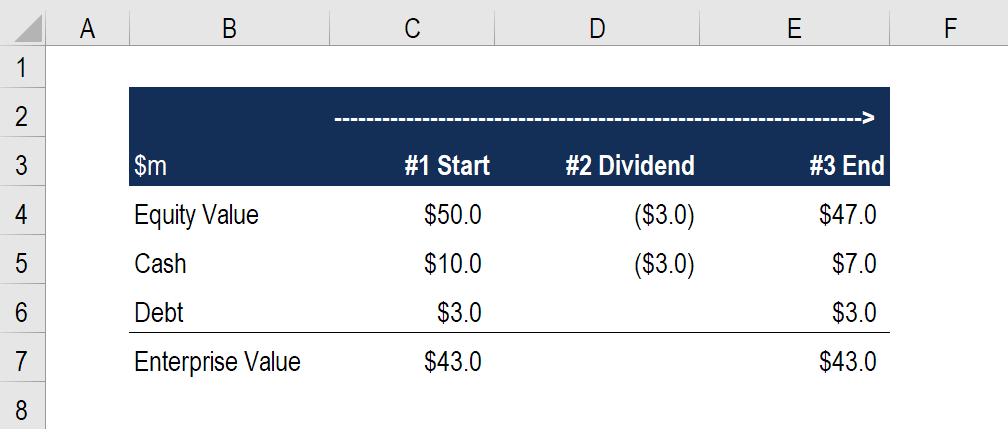
When a company pays a dividend, it has no impact on the Enterprise ValueEnterprise Value (EV)Enterprise Value, or Firm Value, is the entire value of a firm equal to its equity value, plus net debt, plus any minority interest of the business. However, it does lower the Equity Value of the business by the value of the dividend that’s paid out.
Dividends in financial modeling
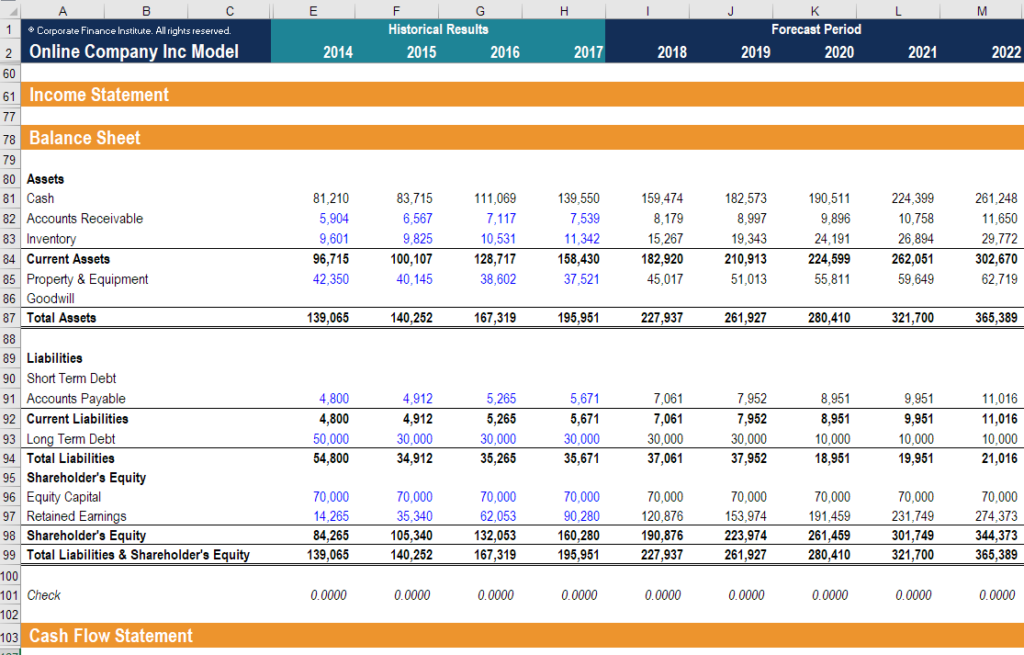
In financial modelingWhat is Financial ModelingFinancial modeling is performed in Excel to forecast a company's financial performance. Overview of what is financial modeling, how & why to build a model., it’s important to have a solid understanding of how a dividend payment impacts a company’s balance sheet, income statement, and cash flow statement. In CFI’s financial modeling course, you’ll learn how to link the statements together so that any dividends paid flow through all the appropriate accounts.
A well laid out financial model will typically have an assumptions section where any return of capital decisions are contained. For example, if a company is going to pay a cash dividend in 2021, then there will be an assumption about what the dollar value will be, which will flow out of retained earnings and through the cash flow statement (investing activities), which will also reduce the company’s cash balance.
Additional resources
CFI is the official provider of the global Financial Modeling & Valuation Analyst (FMVA)™Become a Certified Financial Modeling & Valuation Analyst (FMVA)®CFI's Financial Modeling and Valuation Analyst (FMVA)® certification will help you gain the confidence you need in your finance career. Enroll today! certification program, designed to help anyone become a world-class financial analyst. To keep advancing your career, these additional CFI resources will be useful:
- Valuation MethodsValuation MethodsWhen valuing a company as a going concern there are three main valuation methods used: DCF analysis, comparable companies, and precedent transactions
- Analysis of Financial StatementsAnalysis of Financial StatementsHow to perform Analysis of Financial Statements. This guide will teach you to perform financial statement analysis of the income statement,
- EBITDA MarginEBITDA MarginEBITDA margin = EBITDA / Revenue. It is a profitability ratio that measures earnings a company is generating before taxes, interest, depreciation, and amortization. This guide has examples and a downloadable template
- Projecting Balance Sheet Line ItemsProjecting Balance Sheet Line ItemsProjecting balance sheet line items involves analyzing working capital, PP&E, debt share capital and net income. This guide breaks down how to calculate
-

Deemed Dividends: Understanding Tax Implications for Investors
What Is a Deemed Dividend? A deemed dividend is a tax instrument used by publicly traded corporations as a means of shifting tax liability from shareholders during the sale of company stock.
-

Understanding Dividend Policy: A Comprehensive Guide
A company’s dividend policy dictates the amount of dividends paid out by the company to its shareholders and the frequency with which the dividends are paid out. When a company makes a profit, t
finance
- Accelerated Dividends: Understanding Early Dividend Payments
- Understanding Corporations: Definition, Formation & Key Features
- Cost of Equity: Definition, Calculation & Importance
- Dividend Coverage Ratio (DCR): Understanding Financial Health
- Shareholders' Agreement: Definition, Purpose & Key Provisions
- Stock Dividends: Definition, Types & How They Work
- Understanding Dividend Yield: A Comprehensive Guide
- Qualified Dividends: Tax Benefits & Requirements Explained
- Special Dividends: Understanding One-Time Payments to Shareholders
-
![Shareholder Agreement: Definition, Purpose & Key Provisions | [Your Company Name]](https://www.etffin.com/article/uploadfiles/202110/2021100815175931_S.jpeg) Shareholder Agreement: Definition, Purpose & Key Provisions | [Your Company Name]
Shareholder Agreement: Definition, Purpose & Key Provisions | [Your Company Name]A shareholder agreement outlines how a company is to be operated, the rights and obligations afforded to the shareholders, and the relationship between the company and the shareholders. It is similar ...
-
 Special Dividends: Understanding One-Time Distributions
A special dividend, also referred to as an extra dividend, is a non-recurring, “one-time” dividend distributed by a company to its shareholders. It is separate from the regular cycle of di...